What to expect from the accounting exam format in South Africa

An accounting exam in South Africa follows a predictable shape: objective questions worth a light weight of marks, structured written tasks that dominate the paper, and at least one full financial statement or reconciliation question that tests whether you can pull everything together. Grade 12 papers typically run 2 hours with a total mark allocation that mirrors the time you should spend per question.
Success in this exam format comes down to three things:
- Knowing the paper structure well enough that nothing on exam day surprises you
- Matching your time per mark, not per question
- Practising against real past papers and memos from PapersZA, the DBE, or the IEB, so your first encounter with the format isn’t in the exam hall
Key Takeaways
Mastering the accounting exam format in South Africa means matching your time to the mark allocation, knowing your board’s specific paper structure, and practising against real memos until marking criteria feel automatic.
| Point | Details |
|---|---|
| Time-per-mark discipline | Budget roughly 0.8 minutes per mark on a 150-mark, two-hour paper and write target times in the margin. |
| Board format differences matter | DBE, IEB, and Cambridge (30%/70% split across two papers) structure exams differently, so match your practice papers to your own board. |
| Command words drive marks | “Calculate” needs a method and figure; “interpret” needs a specific number plus commentary on what it means. |
| Memos reveal the real mark scheme | Mark your own timed past papers against official memos to catch formatting and labelling errors, not just wrong totals. |
| No formula sheet is provided | Memorise ratio formulas and the accounting equation, since DBE and IEB papers don’t issue one. |
Table of Contents
- Understanding the overall accounting exam structure
- How DBE, IEB and Cambridge papers compare
- The question types that actually decide your mark
- What examiner marking actually rewards, and how to practise it
- Managing your time inside the exam and across your revision plan
- Command words that tell you exactly what the examiner wants
- Grading criteria and what counts as a pass
- High school format versus what changes at university and professional level
- Calculator and formula sheet rules you need to know
- The format problems that trip up most students, and fixes that work
- Where to find official papers, syllabi and memos
- Why the format matters more than the content review
- Sources
- FAQ
Understanding the overall accounting exam structure
Every accounting paper, regardless of board, mixes a handful of recurring question types. Objective items (multiple choice, matching, true/false) usually open the paper and carry the lightest weight of marks. Structured questions follow, asking you to complete ledgers, journals, or partial financial statements in stages. Then comes the heavyweight section: full financial statement preparation, often paired with notes, adjustments, and sometimes an interpretation or analysis component using ratios.
One mark, one minute is the rule of thumb most South African accounting teachers use to teach pacing — a 150-mark, two-hour paper gives you about 0.8 minutes per mark, so a 20-mark question should take roughly 16 minutes, not 30.
The three components map neatly onto what examiners are actually testing:
- Objective questions test recall and basic understanding of concepts and terminology
- Structured tasks test application: can you process a transaction correctly through the accounting cycle
- Financial statements and interpretation questions test whether you can synthesise everything into a coherent, balanced report and then explain what it means
That last skill, interpretation, is where most marks get lost. Knowing that a business’s current ratio dropped isn’t enough; you need to say why it matters.
How DBE, IEB and Cambridge papers compare
South African students sit one of three main exam formats, and the differences matter more than most learners realise when they grab a random past paper to practise with.
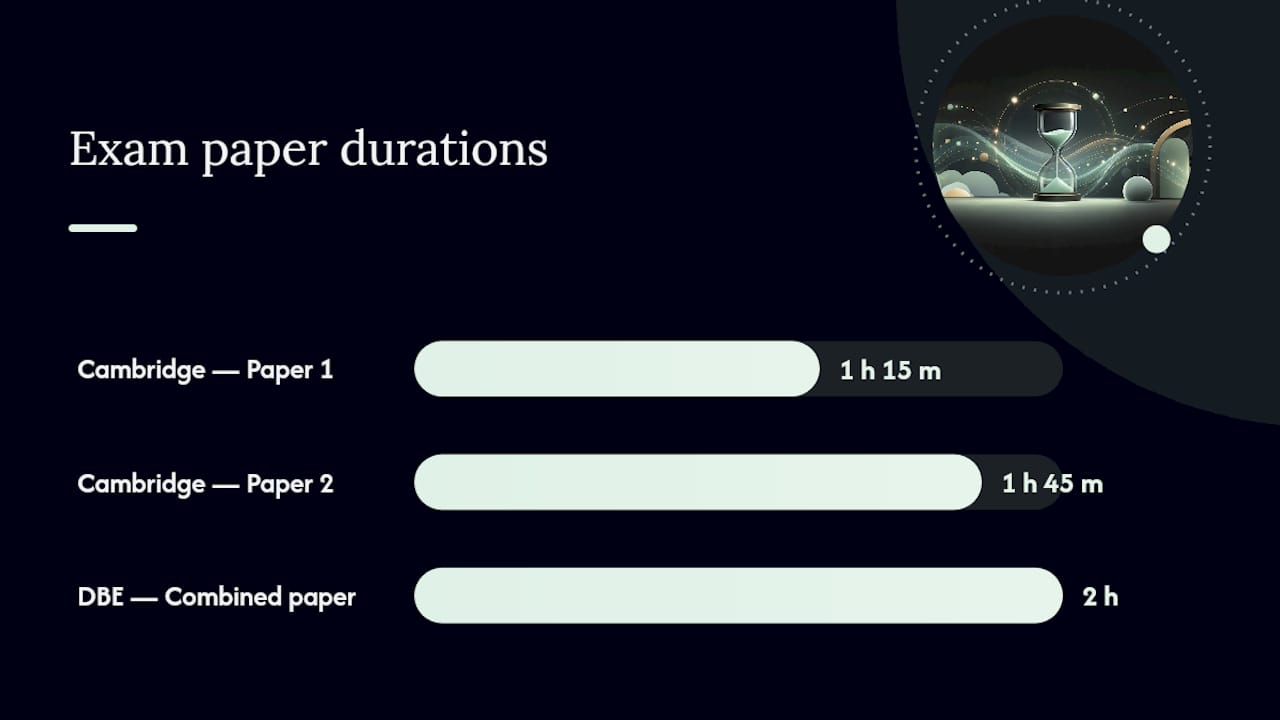
DBE (Department of Basic Education) structures Grade 12 Accounting around two papers per exam sitting in most years, combined into a single comprehensive paper in others depending on the year’s format, typically totalling 150 marks over 2 hours. The emphasis sits heavily on financial statements, cash flow statements, and cost accounting, with a strong bookkeeping foundation carried over from Grade 11.
IEB papers cover similar content but often weight interpretation and analysis questions more heavily, expecting written commentary rather than just numbers. IEB tends to ask more “explain the effect on…” questions that reward reasoning over recall.
Cambridge International, used in a number of South African private and international schools, structures its IGCSE Accounting (0985) exam very differently. It splits into Paper 1, a 1 hour 15 minute, 35-mark multiple-choice component, and Paper 2, a 1 hour 45 minute, 100-mark structured paper, weighted 30% and 70% respectively. That two-paper split, with the objective section sat and marked separately, is a genuinely different exam experience from the single combined DBE paper.
- DBE and IEB past papers transfer well between each other for practising bookkeeping and financial statement mechanics
- Cambridge’s Paper 1 style multiple choice doesn’t fully prepare you for DBE’s structured mark allocation, and vice versa
- Always check the mark allocation printed next to each question. Cambridge papers explicitly print sub-question marks to guide pacing, and that habit is worth copying even when practising DBE papers.
Pro Tip: If your school follows DBE or IEB but you find a Cambridge past paper online, use it only for content revision, not timing practice. The paper structures are different enough that timing yourself against the wrong format builds bad habits.
The question types that actually decide your mark
Recognising a question type before you start answering saves time and prevents you from misreading what’s being asked. Accounting exams generally test six recurring formats:
- Journal entries — test whether you understand the double-entry principle and correct account names. Marks are usually awarded per correct debit/credit pair, not per line.
- Ledger accounts (T-accounts) — test posting accuracy and balancing. Marking memos often award marks for correctly bringing down the balance, not just for entries.
- Trial balance and adjustments — test whether you can apply year-end adjustments (accruals, prepayments, depreciation) before figures move into financial statements.
- Financial statements (Income Statement, Balance Sheet, Cash Flow Statement) — test whether you can assemble a complete, correctly formatted report. Formatting and labelling often carry their own marks separate from the figures.
- Reconciliations (bank, debtors, creditors) — test attention to detail and your ability to explain differences between two records.
- Interpretation and analysis — test your ability to calculate and comment on ratios, ask you to compare years, and reward specific commentary over vague statements.
Marking memos consistently reward small habits: labelling totals clearly, showing the working for a calculation rather than just the final figure, and carrying balances forward accurately between linked questions. Miss the label on a total and you can lose a mark even when the number itself is correct.
What examiner marking actually rewards, and how to practise it
Marking memos are the single most underused resource in accounting revision. They don’t just give you the correct answer, they show you exactly how marks are split within a question, which lines carry independent marks, and which small errors get penalised only once rather than repeatedly (a principle often called “own figure” marking).
A practice routine that consistently works looks like this:
- Attempt a full past paper under timed conditions — no notes, no pausing, phone away.
- Mark it yourself against the official memo, line by line, not just the final total.
- Log every error in a simple table: what you got wrong, why, and which question type it was.
- Target your next practice session on that specific weakness rather than doing another random full paper.
PapersZA hosts over 8,315 past papers spanning grades 3 to 12, including DBE, IEB and provincial Accounting papers with their memos, all free and without needing an account. That scale matters for this routine specifically, because logging weaknesses only works if you have enough different papers to target them without repeating the same questions.
Pro Tip: Don’t mark yourself immediately after finishing a paper. Wait an hour, then mark with fresh eyes. You’ll catch more of your own formatting and labelling errors that you’d otherwise overlook because you remember what you meant to write.
Managing your time inside the exam and across your revision plan
The single biggest format mistake students make isn’t a content gap, it’s spending 40 minutes on a 15-mark question because it “felt important.” Time management in accounting exams is arithmetic, not instinct.
- Calculate your time-per-mark before you start. For a 150-mark, two-hour paper, that’s roughly 0.8 minutes per mark. A 30-mark financial statement question gets about 24 minutes, no more.
- Read the whole paper first, marking questions by confidence level, and answer your strongest section first to bank marks early.
- Leave the interpretation or analysis question for last if it’s optional in placement, since it needs calm, unhurried thinking rather than exam-adrenaline speed.
For revision, a six to eight week plan built around past papers works better than reading textbooks cover to cover. Certification-level exam guidance consistently recommends timed mock exams as the most effective single preparation method, and the same logic scales down to Grade 12 revision. A practical structure:
- Weeks 1 to 2: Work through older past papers by topic, untimed, to rebuild content confidence
- Weeks 3 to 5: Full past papers, strictly timed, alternating DBE and IEB papers if you’re DBE-based, marking against memos each time
- Weeks 6 to 8: Focus practice sessions on your logged weak areas, then finish with two full timed papers in exam-day conditions
The Mathvault covers general techniques for simulating real exam pressure that apply just as well to accounting as to any other subject.
Command words that tell you exactly what the examiner wants
Every accounting question uses specific instruction words, and misreading them costs marks even when your accounting knowledge is fine. Command words map to a required depth of answer, and treating “explain” like “state” is one of the most common ways students underperform.
- Calculate — show the method and the final figure; a bare number without workings often forfeits method marks
- Prepare — produce a fully formatted document (statement, account, schedule) with correct headings and structure
- Explain — give a cause and effect statement, not just a fact
- Interpret — comment on what a figure or trend means for the business, using specific numbers
- Compare — explicitly reference both items or years, not just describe one
- Identify — name the item or concept precisely, using correct terminology
- Justify — give a reasoned argument, usually referencing figures from earlier in the question
Certification and exam guidance consistently frames command words this way: calculate demands a procedure plus an answer, while interpret demands commentary on implications, and that distinction alone explains a lot of lost marks on otherwise correct arithmetic.
Pro Tip: Underline the command word in every question before you start writing. It takes two seconds and stops you from answering “explain” questions with a one-word “state” answer.
Common mistakes that quietly cost marks: skipping the adjustment line in a trial balance question, forgetting to reconcile a bank statement balance to the cash book, and leaving a financial statement unbalanced because a total wasn’t carried forward correctly.
Grading criteria and what counts as a pass
South African accounting exams award marks cumulatively across sections, not through a single pass/fail threshold on any one question.
Marks within each question are broken into method marks, figure marks, and format or presentation marks. A financial statement question, for instance, typically allocates separate marks for correct headings, correct classification of items, and the arithmetic itself. That means a student who gets the final total wrong can still bank most of the marks in a question if the structure and method are correct, and conversely a student who gets the right number through an incorrect method can lose marks even with a “correct” answer.
Interpretation and analysis questions are marked differently again: examiners look for a specific figure referenced in your answer, plus a valid comment tied to that figure. A vague statement like “the business is doing well” without a number attached typically earns zero, even if the sentiment is accurate.
Understanding this structure changes how you should check your own answers. Before moving to the next question, check that you’ve labelled totals, shown your method, and referenced actual figures in any written commentary, not just whether the final number matches what you expect.
High school format versus what changes at university and professional level
The accounting exam format you meet in Grade 12 is deliberately more structured than what follows in university or professional study, and knowing that gap helps you prepare for what’s next rather than assuming the format stays fixed.
High school papers (DBE, IEB, Cambridge IGCSE) are heavily scaffolded: questions are broken into clearly labelled parts, formats for financial statements are usually provided or expected in a standard layout, and mark allocations are printed alongside each sub-question. The goal is testing whether you can apply a known process correctly.
University-level accounting exams shift toward less scaffolding and more case-based or integrated questions, where you’re expected to decide which method or statement format applies rather than being told. Professional-body exams go further still. ACCA’s Financial Accounting exam, for example, runs as a two-hour computer-based test split into an objective Section A and a multi-task Section B, testing recording, processing, and reporting skills across a mix of formats rather than one long structured paper.
The practical implication for a Grade 12 student: the discipline you build now around timing, labelling, and following mark allocations transfers directly upward. The scaffolding disappears later, but the underlying skills examiners test, recording accurately and reporting clearly, don’t change.
Calculator and formula sheet rules you need to know
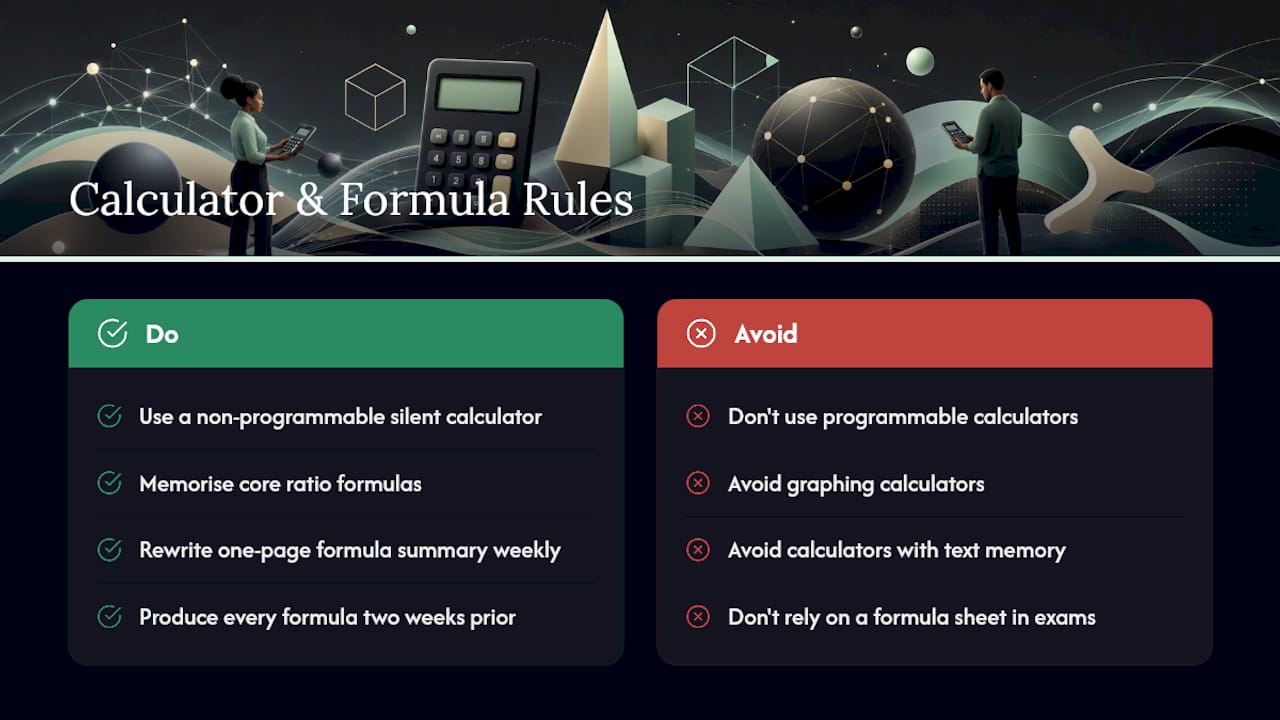
Calculators are permitted in South African Accounting exams at DBE and IEB level, but the rules around which type are stricter than most students realise. Non-programmable, silent calculators are the standard requirement; calculators with stored formulas, text memory, or graphing capability are typically not allowed in the exam room, and invigilators do check.
No formula sheet is issued for DBE or IEB Accounting papers the way there might be for Mathematics. This is a deliberate design choice: the exam is testing whether you know the accounting equation, ratio formulas, and depreciation calculations from memory, not whether you can look them up. That makes memorising the core ratio formulas (gross profit margin, current ratio, acid test ratio, return on equity) a non-negotiable part of revision, not an afterthought.
Cambridge International papers follow a similar principle: candidates are expected to know standard formats and formulas, with any specific instructions on calculation printed directly in the question rather than provided separately.
Practically, this means your revision should include a one-page formula summary you rewrite from memory weekly, not one you keep referring back to. By the final two weeks before the exam, you should be able to produce every ratio formula and the accounting equation without hesitation, because there’s no sheet to fall back on in the exam room.
The format problems that trip up most students, and fixes that work
Certain format mistakes show up year after year across DBE, IEB, and Cambridge markers’ reports, and they’re avoidable once you know to watch for them.
Running out of time on the last question. This happens when students don’t calculate time-per-mark at the start. The fix is mechanical: write your target finish time for each question in the margin before you begin writing.
Treating accounting as pure arithmetic. Educators consistently flag this as the reason capable students underperform: they get the numbers right but lose marks on terminology, labelling, and interpretation because they never learned to think of accounting as a reporting language with its own vocabulary, not just a maths exercise.
Losing marks on presentation, not content. Financial statements have expected formats. Missing a heading, misclassifying an item under the wrong section, or failing to show a subtotal costs marks separately from the arithmetic, and it’s one of the easiest categories of marks to secure with practice.
Panicking on interpretation questions. These questions feel open-ended, but they’re actually formulaic: state the figure, state the trend, state the likely cause or implication. Practising the same three-step structure across multiple past papers removes the guesswork.
Under-practising with real past papers. Textbook exercises rarely match the exact phrasing and structure examiners use. Working through actual Grade 12 Accounting past papers and memos exposes you to real question phrasing far earlier than doing generic textbook drills, and that familiarity alone reduces the anxiety that causes rushed, careless answers on exam day.
Where to find official papers, syllabi and memos
Start with the source documents rather than summaries:
- DBE and IEB publish official syllabi and examination guidelines directly
- Cambridge International’s IGCSE Accounting 0985 syllabus covers component structure and assessment objectives in detail
- PapersZA’s Accounting Grade 12 page and Grade 11 page hold the actual past papers and memos for practice
Always confirm you’re downloading papers matched to your own board and grade before you start a timed session; mixing formats undermines the pacing habits you’re trying to build.
Why the format matters more than the content review
Most accounting revision advice focuses on content: know your journals, know your ratios, know your adjustments. That’s necessary but incomplete. The students who consistently outperform their content knowledge on exam day are the ones who treated the exam format itself as something to study, not just the subject matter inside it.
The conventional advice to “just do more past papers” undersells what actually needs to happen. Doing ten past papers without marking each one against the memo teaches you almost nothing about where your marks are actually being lost. Doing three past papers, marked properly line by line against the memo, with errors logged and specifically re-practised, teaches you far more about your actual weaknesses than volume alone ever will.
If there’s one place to start, it’s command words. Students lose marks not because they don’t know accounting, but because they answer “explain” like “state” and “interpret” like “calculate.” That single fix, reading the instruction word before writing a single figure, probably recovers more marks per hour of effort than any other revision habit. Everything else, timing, formula memorisation, format practice, builds on that foundation once it’s solid.
FAQ
How many papers make up the accounting exam in South Africa?
DBE Grade 12 Accounting is typically written as a single comprehensive paper worth 150 marks over 2 hours, while Cambridge IGCSE splits into two separate papers, a multiple-choice component and a structured paper.
Can I use a calculator in an accounting exam?
Yes, but only a non-programmable, silent calculator is generally permitted; devices with stored formulas or graphing functions are typically not allowed.
Is a formula sheet provided in the exam?
No. DBE and IEB Accounting exams don’t issue a formula sheet, so ratio formulas and the accounting equation need to be memorised.
Where can I find official past papers and memos?
PapersZA hosts thousands of free South African past papers and memos across grades 3 to 12, including DBE, IEB, and provincial Accounting papers, with no account required.
What’s the minimum mark to pass Accounting?
How should I split my study time before the exam?
A six to eight week plan works well: content review first, then strictly timed full past papers marked against memos, finishing with targeted practice on your logged weak areas.