Active recall method for students: how to study smarter

The active recall method is the deliberate practice of pulling information out of your memory rather than reading it again. That single shift, from passive review to active retrieval, is what separates students who retain material for weeks from those who forget it overnight. Close your notes, try to write down everything you know, then check what you missed. That is the whole idea.
Three things you can do in the next five minutes:
- Blank-page recall: Close your notes, set a timer for five minutes, and write down everything you remember about the topic. Do not peek until the timer ends.
- Ten flashcards: Write a question on one side, the answer on the other. Quiz yourself before you open a single textbook.
- One past-paper question: Pull up a past exam question and answer it from memory before reviewing the marking memo.
Table of Contents
- How does the active recall method actually work?
- What does the research say about retrieval practice?
- Why passive study habits keep letting students down
- What are the best active recall techniques to use?
- A simple 3-step routine for every study session
- How to combine active recall with spaced repetition
- Which tools should you use: Anki, Quizlet, or paper?
- Sample study sessions you can use right now
- Common problems with active recall and how to fix them
- How to know if active recall is working for you
- Key takeaways
- Why every student should drop rereading and start retrieving
- Useful sources
- FAQ
How does the active recall method actually work?
The mechanism is called the testing effect, and it is more interesting than it sounds. When you try to retrieve something, your brain does not simply play back a recording. It reconstructs the memory, building new associative pathways in the process. Each reconstruction makes the next retrieval faster and more reliable. Rereading, by contrast, gives you familiarity without that reconstruction work, which is why a chapter can feel understood on Monday and completely blank on Friday.
There is a useful distinction here between recognition and recall. Recognition is what happens when you see a highlighted sentence and think “yes, I know that.” Recall is what happens when you close the book and have to produce the answer yourself. Exams test recall. Rereading trains recognition. The mismatch is why so many students feel prepared and then underperform.
One more thing worth knowing: the struggle itself is the mechanism. Feeling stuck during retrieval is not a sign that the method is failing. Research on unsuccessful retrieval attempts shows that even a failed attempt to recall something produces better long-term retention than passive review. The effort is the point.
What does the research say about retrieval practice?
The foundational work comes from Henry Roediger and Jeffrey Karpicke, whose 2006 experiments showed that students who were tested on material remembered it substantially better after a delay than students who spent the same time restudying. The gap was not small. Students in the restudy group felt more confident immediately after studying, but performed worse when tested a week later.
“Retrieval practice produces a powerful memory enhancement effect — often larger than additional study — and this benefit holds across a wide range of materials and populations.” Roediger & Karpicke, 2006, summarised in What Works, What Doesn’t
A systematic review published in PubMed confirmed that active recall strategies, including flashcards, retrieval practice, and concept mapping, are associated with higher academic achievement in young adults across multiple subject areas. This is not a niche finding for one type of learner. It holds broadly.
The practical implication is straightforward. If you have 60 minutes to study, spending 45 minutes retrieving and 15 minutes reviewing gaps will outperform 60 minutes of rereading. The discomfort of not knowing the answer is exactly where the learning happens.
Why passive study habits keep letting students down
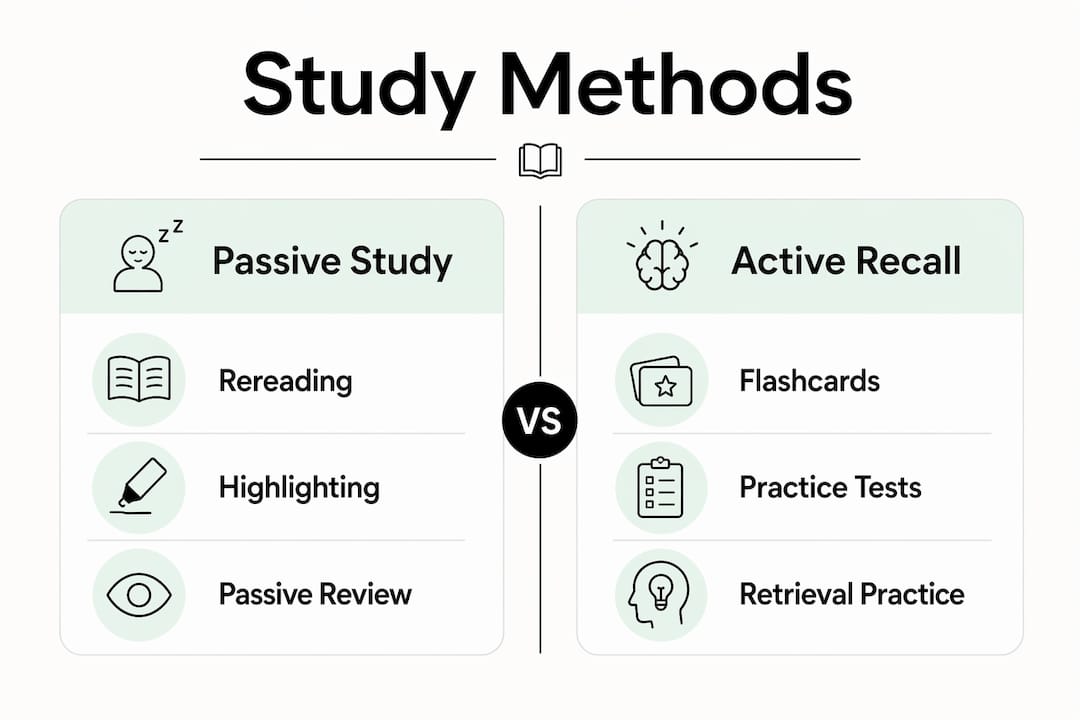
Most students default to rereading and highlighting because both feel productive. They are not. Learning scientists, including John Dunlosky, have pointed out that rereading and highlighting create a sense of familiarity that students mistake for mastery. The material looks familiar, so it feels learned. It is not.
Key differences between passive and active study:
- Effort: Rereading is low-effort; retrieval is cognitively demanding.
- Feedback: Passive review gives no signal about what you actually know. Retrieval does.
- Gap visibility: You cannot see what you do not know until you try to produce it.
- Retention: Retrieval practice produces durable memory; rereading produces temporary familiarity.
| What students usually do | What to do instead |
|---|---|
| Reread notes or textbook chapters | Close notes and write from memory |
| Highlight key sentences | Turn highlights into questions and answer them |
| Copy out definitions | Cover the definition and explain it in your own words |
| Review a worked example | Attempt the problem first, then check the solution |
| Watch a lecture recording passively | Pause every few minutes and recall the main point |
The swap matters for exam performance because exams are retrieval events. Every minute you spend in recognition mode is a minute not spent training the skill the exam actually tests.
What are the best active recall techniques to use?
Active recall is a category of techniques, not a single trick. The core rule across all of them is the same: retrieve first, check second.

Flashcards
Write one question on the front, one answer on the back. The quality of the card matters more than the quantity. A card that asks “What is osmosis?” is weaker than one that asks “Why does water move across a semi-permeable membrane from low to high solute concentration?” When you review, say the answer aloud before flipping. Mark cards you got wrong and keep them in rotation until you get them right consistently.
Pro Tip: Never retire a card just because you got it right once. Long-term retention depends on keeping difficult and marginal items in rotation until they are consistently mastered.
Blank-page recall (blurting)
Take a blank sheet of paper and write down everything you know about a topic without looking at anything. It is messy and uncomfortable, which is exactly why it works. Use it at the start of a study session to surface gaps before you open your notes. Anything missing from your page is your study priority.
Practice tests and past papers
Practice testing with past papers is the gold standard for exam preparation because it trains both content retrieval and the production skills the exam format demands. Papersza hosts a free library of South African past exam papers and memos organised by subject, grade, year, and session. No account needed. For Grade 10 English, for example, you can pull past papers and memos and work through questions under timed conditions, then mark your own answers against the memo.
The Feynman technique
Choose a concept and explain it out loud as if you are teaching it to someone who has never heard of it. Where your explanation gets vague or you reach for the textbook, that is a knowledge gap. The Feynman technique tests understanding rather than surface recall, which makes it especially useful for conceptual subjects like economics, biology, or history.
Question generation
After reading a section, close it and write five questions the material could answer. Then answer them. This works well with Cornell-style notes: write questions in the left margin and answers in the right, then cover the right side and test yourself. Avoid questions that only ask “what is X.” Push for “why,” “how,” and “compare X and Y” prompts, which build deeper, transferable memory traces.
A simple 3-step routine for every study session
You do not need a complicated system. This three-step routine works for any subject.
- Define your scope. Before you open anything, write down the specific topic or question set you are covering. A session with no defined scope drifts into passive review.
- Retrieve without notes. Spend the first 60–70% of your session attempting to recall everything relevant: blank page, flashcards, or past-paper questions. No peeking.
- Check and correct. Open your notes or the marking memo. Identify what you missed or got wrong. Study only those gaps, not the whole topic again.
Session checklist before you start:
- Write your topic scope on paper.
- Set a timer (25–45 minutes works well for most students).
- Put your phone face-down or in another room.
- Have your blank page, flashcard deck, or past-paper question ready.
End each session by tagging the items you got wrong. Those become the first questions in your next session. Do not wait until the next day to review them; a quick five-minute pass before bed consolidates the correction.
How to combine active recall with spaced repetition
Retrieval practice and spaced repetition work together. Retrieval strengthens a memory; spacing times the retrieval so it happens just before you would naturally forget the material. Together, the effect is multiplicative.
A simple spacing schedule for new material:
- Day 1: Learn the material and do a retrieval session the same day.
- Day 2: Retrieve again.
- Day 4: Retrieve again.
- Day 8 (one week later): Retrieve again.
- Day 15 (two weeks later): Final review before the material is considered consolidated.
If you get an item right every time, you can extend the interval. If you keep getting it wrong, shorten the gap and review it more frequently. The UNC Learning Center recommends treating study like athletic training: short, frequent, high-effort sessions rather than long passive marathons.
For automation, Anki handles this scheduling for you. It uses a spaced repetition algorithm to decide when each card comes up, based on how you rated your recall. Flashcards reviewed with Anki produce strong long-term retention because the system schedules retrieval at near-optimal intervals. Quizlet offers manual scheduling and is faster to set up for shared card sets. If you prefer paper, a simple five-box index-card system (move a card forward a box when you get it right, back a box when you get it wrong) replicates the core logic without any app.

Massed practice (cramming) has one legitimate use: the 24 hours before an exam, when you need to refresh material already consolidated. For anything beyond that window, spaced retrieval beats cramming every time.
Which tools should you use: Anki, Quizlet, or paper?
The best tool is the one you will actually use consistently. Here is how to choose.
Anki suits students who want full spaced-repetition automation and are willing to spend time building good decks. The card editor supports images, audio, and cloze deletions (fill-in-the-blank format), which makes it powerful for medical, science, and language study. The setup investment is real, but the scheduling payoff over a semester is significant.
Quizlet is faster to start. You can create a set in minutes, and there are millions of shared sets for common subjects. The Learn mode adapts to your performance, though its spaced-repetition logic is less rigorous than Anki’s. Good for quick topic reviews and collaborative study.
Paper flashcards have one underrated advantage: writing the card by hand is itself a retrieval and encoding exercise. They are also exam-realistic, since you are not staring at a screen.
| Feature | Digital flashcards (Anki/Quizlet) | Paper flashcards |
|---|---|---|
| Cost | Free (basic tiers) | Low (index cards) |
| Spaced-repetition automation | Yes (Anki: full; Quizlet: partial) | Manual only |
| Review reminders | Yes | No |
| Exam realism | Moderate | High |
| Portability | High (phone/tablet) | Moderate |
Setup tips for Anki:
- Create one deck per subject, with sub-decks per topic.
- Write cards in your own words, not copied from notes.
- Use cloze deletions for definitions and formulas.
- Review daily, even if only for 10 minutes.
For Quizlet, keep sets to 20–30 cards maximum. Larger sets dilute focus and make sessions feel endless.
Papersza fits into any tooling workflow as the source of exam-realistic retrieval material. Once you have built your flashcard knowledge base, past papers from Papersza give you the hardest test: producing answers under real exam conditions, without any prompts.
Sample study sessions you can use right now
15-minute daily maintenance session
- Open your Anki or Quizlet deck (or your paper cards). (3 min)
- Work through due cards, answering before flipping. (9 min)
- Note any cards you got wrong. Tag them for tomorrow. (3 min)
45-minute topic mastery session
- Blank-page recall: write everything you know about the topic. (8 min)
- Check your notes. Identify gaps. (5 min)
- Create 5–10 new flashcards for the gaps. (7 min)
- Retrieve from the new cards immediately. (10 min)
- Attempt one past-paper question on the topic. (10 min)
- Mark against the memo. Record what you missed. (5 min)
90-minute pre-exam intensive session
- Blank-page recall of the full topic area. (15 min)
- Review gaps only. (10 min)
- Work through a full past-paper section under timed conditions. (40 min)
- Self-mark with the memo. Categorise errors: knowledge gap vs. careless mistake. (15 min)
- Do a final rapid-fire flashcard pass on the knowledge gaps. (10 min)
Short sessions beat long ones for daily maintenance. Save the 90-minute block for the week before an exam, not as your default mode.
Common problems with active recall and how to fix them
“I feel too stuck to start.” Switch to a single flashcard or a one-sentence blurt. The barrier is almost always the blank page, not the method. Start with one question, not a full session.
“My questions are too easy and I’m not learning anything.” You are writing recognition questions (“What is X?”) instead of recall questions (“Explain why X happens” or “Compare X and Y”). Rewrite your prompts to demand explanation, not just identification.
“I keep discarding cards I got right once.” Keep them in rotation. One correct answer does not mean the memory is consolidated. Remove a card only after you have retrieved it correctly across multiple spaced sessions.
“I lose focus after ten minutes.” This is common, and especially pronounced for students with ADHD. Active recall works particularly well for attention difficulties because it converts study into short, task-driven units with immediate feedback. Use a 10-minute timer, do one retrieval task, take a two-minute break, repeat. Environmental cues help too: same desk, same time, phone out of reach.
“I’m not sure if I’m making progress.” Track your flashcard accuracy over time. If you are getting 60% right in week one and 85% right in week three, the method is working. Past-paper scores are the most honest signal: if your marks on timed questions are improving, your retrieval is improving.
When to escalate: If you are consistently scoring below 50% on past-paper questions after three weeks of retrieval practice, consider forming a study group, working through questions with a tutor, or using the marking memos on Papersza to understand exactly where your answers diverge from the expected response.
How to know if active recall is working for you
Three metrics worth tracking:
- Past-paper accuracy: Score your answers against the memo each session. Track the percentage correct per topic over time.
- Time to recall: Note how long it takes to retrieve an answer. Faster retrieval on the same card over successive sessions is a direct measure of memory consolidation.
- Spaced-repetition ease score: In Anki, the ease score on each card reflects how reliably you retrieve it. A rising average ease score across your deck means the material is consolidating.
A simple self-test: spend one week doing retrieval practice on a topic, then spend one equivalent week rereading notes on a different topic of similar difficulty. Test yourself on both at the end of the two weeks. The retrieval-practice topic will almost certainly score higher. That comparison is the clearest evidence most students need to commit to the method.
Two tips to make it stick: keep sessions short enough that you do not dread them, and scope each session to one specific topic rather than “studying.” Vague scope is the fastest way to drift back into passive review.
Key takeaways
Active recall, the practice of retrieving information from memory rather than rereading it, consistently outperforms passive study for long-term retention and exam performance.
| Point | Details |
|---|---|
| Retrieve first, check second | Always attempt recall before opening notes; the struggle is where the learning happens. |
| Use varied techniques | Flashcards, blank-page recall, past papers, and the Feynman technique each target different types of knowledge. |
| Pair with spaced repetition | Review material at increasing intervals (day 1, 2, 4, 8, 15) to consolidate memories before they fade. |
| Track progress honestly | Past-paper accuracy and time-to-recall are the most reliable signals that retrieval practice is working. |
| Start in the next 24 hours | Do one blank-page recall session on today’s topic before you go to sleep tonight. |
Why every student should drop rereading and start retrieving
The evidence for retrieval practice has been accumulating for over a century, and yet rereading remains the default study habit for most students. That gap between what the research shows and what students actually do is not a knowledge problem. It is a comfort problem. Rereading feels safe. You are always making progress, always moving through the page. Retrieval feels like failure half the time, which is precisely why it works.
What I find most compelling about the research is not the retention numbers but the mechanism: the brain strengthens a memory by reconstructing it, not by re-exposing itself to it. That means every moment of struggle during a retrieval session is doing something. The blank page is not an obstacle. It is the training.
For students preparing for South African exams, Papersza makes the hardest part of retrieval practice easy to access. The past papers and memos are organised by subject, grade, and year, and every document is free to download without registration. Use them as the final test in every study session. Build your knowledge with flashcards and blurting, then prove it with a past paper. That combination, retrieval practice plus exam-realistic testing, is the most effective study system most students will ever use.
Try it for one week. Track your past-paper scores before and after. The results will make the argument better than any article can.
Useful sources
Further reading and resources for students who want to go deeper on the research and tools:
- Roediger & Karpicke, 2006 (Scientific American summary): The foundational study showing that retrieval practice produces substantially higher retention than restudying. Start here if you want to understand why the method works.
- Active recall strategies and academic achievement: PubMed systematic review: A systematic review confirming that flashcards, retrieval practice, and concept mapping are associated with higher GPA and test scores in young adults. Useful for students who want peer-reviewed evidence across multiple subjects.
- Studying 101: UNC Learning Center: Practical guidance on distributed practice, session length, and active engagement. Recommended for students building a weekly study schedule.
- Active recall study technique: The Focused Student: A practitioner-focused explanation of how active recall works, with specific adaptations for students with ADHD and attention difficulties.
- Most effective study methods: The Focused Student: Covers why rereading and highlighting underperform and what to replace them with. Good companion reading to the active-vs-passive section above.
- Active recall explained: 10000Hours blog: A thorough practitioner guide covering the testing effect, failed retrieval, and why past papers are the gold standard for exam prep.
- Birmingham City University: Active recall guide: A university-level overview of active recall techniques including blurting, flashcards, and spaced repetition, with references to Rawson & Dunlosky and Roediger & Butler.
- Papersza: South Africa’s largest past-paper library: Free access to over 8,315 past exam papers and memos for grades 3–12, organised by subject, grade, year, and session. No account required. Use for exam-realistic retrieval practice.
- Papersza: English Grade 10 past papers and memos: Subject-grade-specific resource for Grade 10 English practice testing.
- Papersza: How it works: Explains how papers and memos are sourced and organised, and how to use the memo for self-marking after retrieval practice.
FAQ
What is the 3-step active recall method?
Define your scope, retrieve everything you know without looking at notes, then check your sources and study only the gaps. Repeat the retrieval step in the next session before reviewing anything new.
How do you do active recall correctly?
Always attempt to produce the answer before checking. Close your notes, write or say what you remember, then open the source to identify what you missed. Never review first and retrieve second.
What is an example of active recall?
Writing down everything you remember about the water cycle on a blank page, then checking your textbook to see what you left out, is a classic example. Answering a past-paper question from memory before reading the marking memo is another.
Is active recall good for ADHD?
Yes. Active recall converts study into short, task-driven retrieval units with immediate feedback, which helps sustain focus. Using a 10-minute timer per retrieval task and taking brief breaks between units works well for students with attention difficulties.