Afrikaans Paper 3 format: the complete exam guide

Afrikaans Paper 3 is a three-section writing exam worth 100 marks total, and the DBE’s official format document is clear about what you must submit: Section A (Essay) for 50 marks, Section B (Longer transactional text) for 30 marks, and Section C (Shorter transactional text) for 20 marks. You answer ONE question from each section. Before you write a single word, the DBE requires you to:
- Write a cover page showing subject, level, paper, year, marks, time allocation, and total pages
- Start every section on a new page
- Write all answers in the language of assessment (Afrikaans Eerste Addisionele Taal or the relevant level)
- Include your planning (mind map, diagram, flowchart, or keywords) visibly in your script and hand it in
For immediate practice, the Afrikaans FAL Grade 12 archive on Papersza gives you official DBE papers and memos sorted by year and session, free to download without an account.
Key takeaways
Afrikaans Paper 3 rewards preparation: students who submit visible planning, use correct formats for each section, and practise with real DBE memos consistently score in the higher mark bands.
| Point | Details |
|---|---|
| Three sections, 100 marks | Section A (50), Section B (30), Section C (20); answer one question per section. |
| Planning is compulsory | Submit a labelled mind map or bullet plan for every section or lose marks. |
| Section C word count | Keep shorter transactional texts within 80–100 words; going outside this range costs marks. |
| Tone and register matter | Match your language register to the task: formal for letters and reports, informal for WhatsApp messages. |
| Practise with Papersza | Download free Afrikaans FAL Grade 12 past papers and memos at papersza.co.za to practise under timed conditions. |
Table of Contents
- Afrikaans Paper 3 format: what each section actually asks for
- Planning templates and time management that actually work
- What markers actually see in the first 30 seconds
- Past Afrikaans Paper 3s and memos: where to find them
- Sources
- FAQ
Afrikaans Paper 3 format: what each section actually asks for
Each section tests a different kind of writing. Knowing the differences before the exam is what separates a prepared student from one who loses easy marks on format alone.
Section A: Essay (50 marks)
You choose one essay topic from several options. Examiners expect a well-planned, structured piece with a clear introduction, developed body paragraphs, and a conclusion. The DBE marking guidelines use detailed level descriptors that weight content and planning most heavily, followed by language and style, then structure. A generic essay with no clear argument scores in the lower bands regardless of grammar.
Section B: Longer transactional text (30 marks)
Common formats include a formal letter, a report, a newspaper article, or a speech. Each has its own layout conventions — a formal letter needs a sender’s address, date, salutation, and sign-off; a report needs headings and numbered points. Examiners check whether you have used the correct format for the task, not just whether your Afrikaans is accurate.
Section C: Shorter transactional text (20 marks)
This is the 80–100-word section. The November 2023 Afrikaans FAL Paper 3 featured an advert, a WhatsApp message, and directions as typical tasks. The May–June 2022 paper included an invitation card, a diary entry, and instructions. Word count matters here: going under 80 or over 100 words signals poor control.
Planning templates and time management that actually work
The DBE requires clearly labelled planning handed in with your script for every section. This is not optional. A blank planning page costs you marks even if your essay is good.
Here is a workflow you can replicate under exam pressure:
- Section A (Essay) — 3–5 minutes: Draw a quick mind map. Put your topic in the centre, branch out three to four main ideas, and note one example per branch. Then write a five-line paragraph plan: intro (your stance), body paragraph 1, body paragraph 2, body paragraph 3, conclusion.
- Section B (Longer transactional) — 2–3 minutes: Bullet-point the required format elements (heading, address, date, body, sign-off) before writing. This doubles as your planning and your format checklist.
- Section C (Shorter transactional) — 1–2 minutes: Note the audience, purpose, and tone in three words. For a WhatsApp message: informal, brief, emoji optional. For a formal invitation: full names, date, venue, RSVP.
- Write, then edit: Leave five minutes at the end to re-read for language errors and confirm word counts.
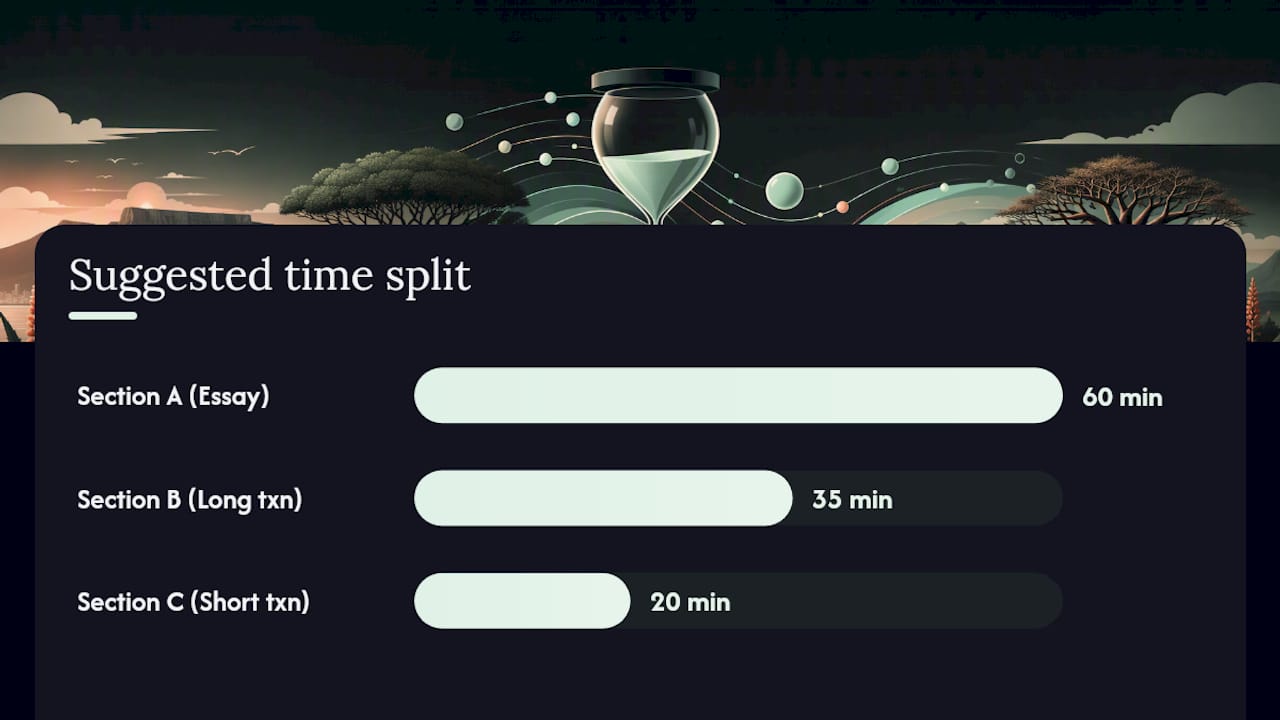
A suggested time split for a two-hour paper: Section A 60 minutes (planning 5 + writing 50 + edit 5), Section B 35 minutes (planning 3 + writing 27 + edit 5), Section C 20 minutes (planning 2 + writing 15 + check 3). Adjust to your school’s guidance, but practise to this rhythm during revision.
Before you hand in, run this checklist:
- Cover page completed with all required fields
- Each section starts on a new page
- Planning is visible, labelled, and attached
- Every answer has a title or heading
- Word count for Section C is within 80–100 words
- Quick language scan done
Pro Tip: Draw a single neat line through your planning before submitting — this signals to the marker that it is planning, not part of your final answer, and keeps your script tidy.
What markers actually see in the first 30 seconds
The single most common examiner complaint is not poor grammar. It is poor planning or a generic tone that ignores the task’s audience. A formal letter written in the same casual register as a WhatsApp message loses marks in both content and language bands, even if every sentence is grammatically correct.

What a marker notices immediately: a neat cover page, clear section breaks, labelled planning, and a visible heading on each answer. These take less than two minutes to get right and signal to the examiner that you know the format.
Tone shifts are where many students drop marks in Section B and C. A formal letter to a principal uses “Geagte Mnr./Mev.” and a professional sign-off. A WhatsApp message to a friend uses short sentences and a conversational register. Practise writing the same information in two different registers and compare them side by side.
Use the DBE marking rubrics when you mark your own practice answers. Match your response to the level descriptors, not just the total mark.
Past Afrikaans Paper 3s and memos: where to find them
Papersza hosts South Africa’s largest independent archive of past exam papers and memos, free to access with no account required. For Afrikaans Paper 3 practice, go directly to the Afrikaans FAL Grade 12 page, filter by year and session, and download both the question paper and the memo.
A practice routine that works: pick a past Paper 3, set a two-hour timer, write all three sections under exam conditions, then mark your answers against the memo using the DBE rubric level descriptors. Identify which section lost the most marks and repeat that task type the following day. The memo shows you exactly what the examiner expected, including format elements you may have missed.
Sources
- FORMAT, STRUCTURE AND MARK ALLOCATION OF QUESTION PAPER
FAQ
How many sections does Afrikaans Paper 3 have?
Three sections: Section A (Essay, 50 marks), Section B (Longer transactional text, 30 marks), and Section C (Shorter transactional text, 20 marks). You answer one question from each.
How long should Section C answers be?
Section C shorter transactional texts should be 80–100 words. The November 2023 DBE paper specifies this range for tasks like adverts, WhatsApp messages, and directions.
Do I have to hand in my planning?
Yes. The DBE requires that all planning be clearly labelled and submitted with your answer script. Leaving it out can cost you marks even if your final answer is strong.
What types of texts appear in Section B?
Common Section B formats include formal letters, reports, newspaper articles, and speeches. Each has specific layout requirements that examiners check alongside content and language.
Where can I find free Afrikaans Paper 3 past papers and memos?
Papersza offers a free, searchable archive of official DBE Afrikaans FAL past papers and memos for Grade 12, available at Papersza with no registration required.