Business studies essays: Grade 12 NSC exam guide

The NSC Business Studies essay is worth 40 marks: 32 for factual content and 8 for Insight (LASO). That split matters more than most students realise. You can know every fact in the textbook and still walk out with 28/40 if your layout is wrong, your analysis is absent, and you never signal LASO to the marker. Here is the exam checklist you need before you write a single sentence:
- Write INTRODUCTION and CONCLUSION as headings. Never write the heading BODY.
- Use each bulleted sub-question from the exam paper as a subheading in your body.
- Answer every sub-question in full sentences, not bullet points.
- Plan for 5–8 minutes before writing. Budget roughly 40–45 minutes total for the essay.
- Annotate LASO in the left-hand margin as you write: mark L, A, S, O next to the relevant sentences.
- At the end of the essay, write the mark allocation: e.g. Facts: 28 / Insight: 7 / Total: 35.
- Stop writing facts once you reach the sub-maximum for each subsection. Repetition earns zero.
Table of Contents
- What does the required Business Studies essay structure look like?
- How do the 8 insight marks (LASO) actually work?
- How to plan and write your essay to score high
- Common mistakes that cost marks in Business Studies essays
- Annotated sample excerpt and where to find official past papers
- A focused 4-week practice plan using past papers
- Key takeaways
- Why memo-based practice changes how students write
- PapersZA gives you every Business Studies memo in one place
- Useful sources and where to download official memoranda
- FAQ
What does the required Business Studies essay structure look like?
The DBE prescribes a specific structure, and markers check for it before they read a single fact. Get the structure wrong and you lose Layout marks before the content is even assessed.
INTRODUCTION is your first heading. Under it, write two to four sentences: state your direct answer to the question, define the key concept(s) the question asks about, and link the definition to the question’s context. Do not pad it. A clean, direct introduction signals to the marker that you understand the question.
The body follows immediately, but you never write the heading “BODY.” Instead, copy each bulleted sub-question from the exam paper and use it as a subheading. Write a focused paragraph under each one. When you have reached the sub-maximum marks for that subsection, stop. Every additional sentence is wasted time.
CONCLUSION is your final heading. Write one or two sentences that tie your answer back to your opening thesis. Do not introduce new facts here, and do not copy sentences from earlier in the essay verbatim. A conclusion that simply restates the introduction word-for-word earns no marks.
Formatting details the DBE expects:
- Headings written in capitals: INTRODUCTION, CONCLUSION
- Sub-question headings taken directly from the paper (not invented)
- LASO symbols in the left-hand margin next to the relevant sentence
- Mark allocation written at the end: Facts / Insight / Total
Pro Tip: Write your INTRODUCTION and CONCLUSION headings in capitals and underline them. It takes two seconds and immediately signals correct layout to the marker.
How do the 8 insight marks (LASO) actually work?
The 8 insight marks assess four things: Layout, Analysis, Synthesis, and Originality. They are awarded separately from the 32 factual marks, and they require deliberate effort. You cannot earn them by accident.
Layout (L) is the easiest mark to secure. Use the correct headings, write in clear paragraphs, and annotate LASO symbols in the left margin. Markers are instructed to look for these signals, so make them visible.
Analysis (A) means showing cause-and-effect or explaining implications, not just stating facts. Compare these two sentences:
- Weak: “Load shedding affects businesses.”
- Strong: “Load shedding increases operating costs because businesses must run generators, which reduces profit margins and may force retrenchments.”
The second sentence earns an A mark. Use sentence stems like “This will likely cause… because…” or “The implication of this is…” to push a fact into analysis.
Synthesis (S) means connecting two or more concepts or syllabus points to reach a broader conclusion. For example, linking the impact of the Consumer Protection Act on business ethics, or connecting entrepreneurship theory to a specific market failure. One sentence that bridges two dot points is enough.
Originality (O) is where many students leave marks on the table. Markers reward a specific, dated South African example over a generic textbook reference. Mentioning load shedding’s effect on SMEs in 2023, or referencing the National Minimum Wage adjustment, is more valuable than writing “for example, a business in South Africa.” Keep a short list of recent SA business events in your revision notes.
Practical micro-strategy:
- As you write each sentence, ask: “Is this just a fact, or does it analyse, connect, or give a real example?”
- Mark L, A, S, or O in the left margin next to the sentence that earns it.
- Aim for at least one A, one S, and one O per essay.
Pro Tip: You do not need a separate paragraph for LASO. Weave analysis and synthesis into your factual paragraphs and mark them in the margin. One strong analytic sentence per subsection is enough to earn the mark.
How to plan and write your essay to score high
The fastest path to clear marks is planning before writing. Students who spend 5–8 minutes on a plan consistently produce better-structured answers than those who write immediately.
- Read the question twice. Underline the key concept and each bulleted sub-question.
- Brain-dump for 3 minutes. Write every relevant fact, term, and example you can recall next to each sub-question. Do not write in sentences yet.
- Identify your LASO opportunities. Mark which facts you can push into analysis, which two points you can synthesise, and which SA example you will use for originality.
- Write your INTRODUCTION. One thesis sentence, one definition, one link to the question. Three sentences maximum.
- Write each body subsection. Use the sub-question as the heading. Write full sentences. Stop at the sub-maximum. Mark LASO in the margin as you go.
- Write your CONCLUSION. One or two sentences. Tie back to the thesis. No new facts.
- Check LASO and mark allocation. Spend the last 2–3 minutes confirming you have marked L, A, S, O in the margin and writing the allocation at the essay end.
Suggested timing for a 40–45 minute essay:
| Phase | Time |
|---|---|
| Reading and planning | 5–8 minutes |
| INTRODUCTION | 3–4 minutes |
| Body (all subsections) | 28 minutes |
| CONCLUSION | 3 minutes |
| LASO check and allocation | 2–3 minutes |
For paragraph structure, use a compact version of the DPEEL framework: Define the concept, state your Point, Explain it, give Evidence (a real SA example for O), and Link back to the question. Insert your LASO margin marker at the sentence where the insight occurs.

Professional business writing is direct and concise. Markers prefer one precise sentence over three vague ones. Write in the active voice, use correct business terminology, and avoid repeating the same fact in different words.
Pro Tip: If you run out of time, write your CONCLUSION heading and one sentence rather than leaving it blank. An incomplete conclusion still earns the Layout mark for the heading.
Common mistakes that cost marks in Business Studies essays
Most mark losses come from a short list of avoidable errors. Here is what DBE memoranda flag repeatedly:
- Writing “BODY” as a heading. This is a layout error. Use the paper’s sub-questions as headings instead.
- Repeating the same fact. Markers stop awarding facts once the sub-maximum is reached. Repetition adds nothing.
- Failing to indicate LASO. If you do not mark L, A, S, O in the margin, the marker may not award insight marks even if the content qualifies.
- Weak introductions. An introduction that only restates the question earns minimal marks. Define the concept and link it to the question directly.
- Introducing new facts in the conclusion. The conclusion must close the argument, not extend it.
- Over-writing one subsection. Students sometimes write three paragraphs on the first sub-question and run out of time for the rest. Each subsection has a sub-maximum; once you hit it, move on.
- Failing to write the mark allocation at the end. Memos require candidates to indicate facts vs insight at the essay end. Missing this costs you a Layout mark.
Quick do-not-do checklist:
- Do not use “BODY” as a heading
- Do not repeat facts in different words
- Do not skip the margin LASO markers
- Do not introduce new content in the CONCLUSION
- Do not write past the sub-maximum for any subsection
Annotated sample excerpt and where to find official past papers
The best way to understand what earns marks is to see it. Below is a short annotated paragraph showing how facts and LASO work together in a single body subsection.
Sub-question heading: Discuss the impact of the Consumer Protection Act on business operations.
[L] Businesses must display prices clearly and provide accurate product information to consumers. [A] This increases compliance costs because companies must invest in staff training and updated labelling systems, which reduces short-term profit margins. [S] Combined with the Companies Act’s corporate governance requirements, this creates a regulatory environment that rewards ethical business conduct and penalises non-compliance. [O] In 2023, several South African retailers faced penalties for misleading pricing during Black Friday promotions, illustrating the Act’s enforcement reach.
Annotation key:
- [L] — correct heading used, clear paragraph structure
- [A] — cause-and-effect explanation of compliance costs
- [S] — two Acts linked to reach a broader governance point
- [O] — specific, dated South African example
How to read a DBE marking memorandum:
- Look for the sub-maximum listed per sub-question (e.g. “max 8 marks per subsection”).
- Note the marking notes: these tell you which facts earn marks and which are considered repetition.
- The memo’s allocation statement shows how markers split facts vs insight at the essay end.
Where to practise:
| Resource | What it offers | How to access |
|---|---|---|
| DBE official memos | Essay mark breakdowns, exemplar answers, marking rules | DBE exemplar guidelines |
| PapersZA | Grade 12 Business Studies past papers and memos, free, no registration | Grade 12 Business Studies papers |
| Provincial memos | Western Cape, Gauteng, KZN memos with local marking variations | Via PapersZA subject pages |
| StudyClix | SA exam-style practice and guidance aligned to DBE expectations | StudyClix website |
Practice instructions:
- Download a past paper and memo from PapersZA or the DBE site.
- Write the essay under timed conditions (40–45 minutes).
- Mark your own work against the memo: stop at the sub-maximum, assign facts and insight separately.
- Annotate your own answer with LASO markers and compare to the memo’s expected insight signals.
- Practising with memos teaches you the specific language markers expect, which reduces layout and answering errors over time.
A focused 4-week practice plan using past papers
A structured 4-week routine that combines timed essays, memo-based marking, and targeted LASO practice will raise your insight score faster than re-reading notes.
-
Week 1 — Diagnostic. Write one full timed essay (40–45 minutes) without preparation. Mark it against the memo. Record your facts score and your LASO score separately. Identify which LASO component you missed most (usually A or O). Review the DBE structure rules and rewrite your introduction and conclusion.
-
Week 2 — Targeted LASO practice. Write two timed essays. For each one, focus specifically on the LASO component you missed in Week 1. After each essay, mark it against the memo and annotate every sentence with its LASO category. Use Grade 11 Business Studies papers from PapersZA for additional sub-question drills if you need more practice on a specific topic.
-
Week 3 — Full exam simulation. Write two essays under strict exam conditions: no notes, timed, answer booklet format. Mark both against the memo using DBE marking behaviour (stop at sub-maximum, split facts and insight). Track your scores on a simple table: date, topic, facts/32, insight/8, total/40.
-
Week 4 — Refinement and rapid drills. Write one full essay and three rapid subsection drills (15 minutes each, one sub-question only). Focus on speed and LASO density. Review your weakest subsection topic using PapersZA to source a past question on that exact topic.
How to grade yourself with memos:
- Apply the sub-maximum strictly. If the memo says max 8 for a subsection, stop counting at 8 even if you wrote more.
- Assign each marked sentence as either a fact or an insight mark.
- Record your LASO evidence: which sentences earned A, S, or O, and why.
For exam-writing technique ideas beyond the DBE, structured essay coaching approaches used in international test prep reinforce the same core habit: plan before you write, and practise under timed conditions.
Key takeaways
A Business Studies NSC essay earns full marks when you combine 32 well-structured factual sentences with 8 deliberately signalled LASO insights, using the exact headings the DBE requires.
| Point | Details |
|---|---|
| Mark split | The essay is worth 40 marks: 32 for facts and 8 for Insight (LASO). |
| Required headings | Use INTRODUCTION and CONCLUSION; never write BODY as a heading. |
| LASO in the margin | Mark L, A, S, O next to the relevant sentence so markers can award insight. |
| Stop at sub-maximum | Repetition earns zero; move to the next subsection once the sub-max is reached. |
| Practise with PapersZA | Download Grade 12 Business Studies past papers and memos free at PapersZA to self-mark under timed conditions. |
Why memo-based practice changes how students write
Most students treat past papers as a test of what they know. The smarter use is treating them as a map of how the examiner thinks. When you read a DBE marking memo carefully, you start to notice patterns: the exact phrasing that earns a fact mark, the type of sentence that gets flagged as analysis, the difference between a synthesis point and a repetition. That shift in perspective is what separates a student who scores 28 from one who scores 36.
The students who improve most quickly are not the ones who study the most content. They are the ones who learn to write the way the memo expects. That means using the sub-question as a heading without being told twice, marking LASO in the margin as a habit rather than an afterthought, and writing the allocation at the end of every practice essay until it is automatic.
Teachers who give feedback by pointing directly to memo language, rather than general comments like “add more analysis,” see faster improvement. “Your sentence on page 2 states the fact but does not explain why it happens. The memo awards an A mark for cause-and-effect. Rewrite it with ‘because’” is a correction a student can act on immediately.
PapersZA gives you every Business Studies memo in one place
Finding the right past paper and memo should take seconds, not a full afternoon of searching. Papersza hosts Grade 12 Business Studies past papers and their official marking memoranda, sourced from the DBE, IEB, and provincial authorities. No account, no registration, no cost.
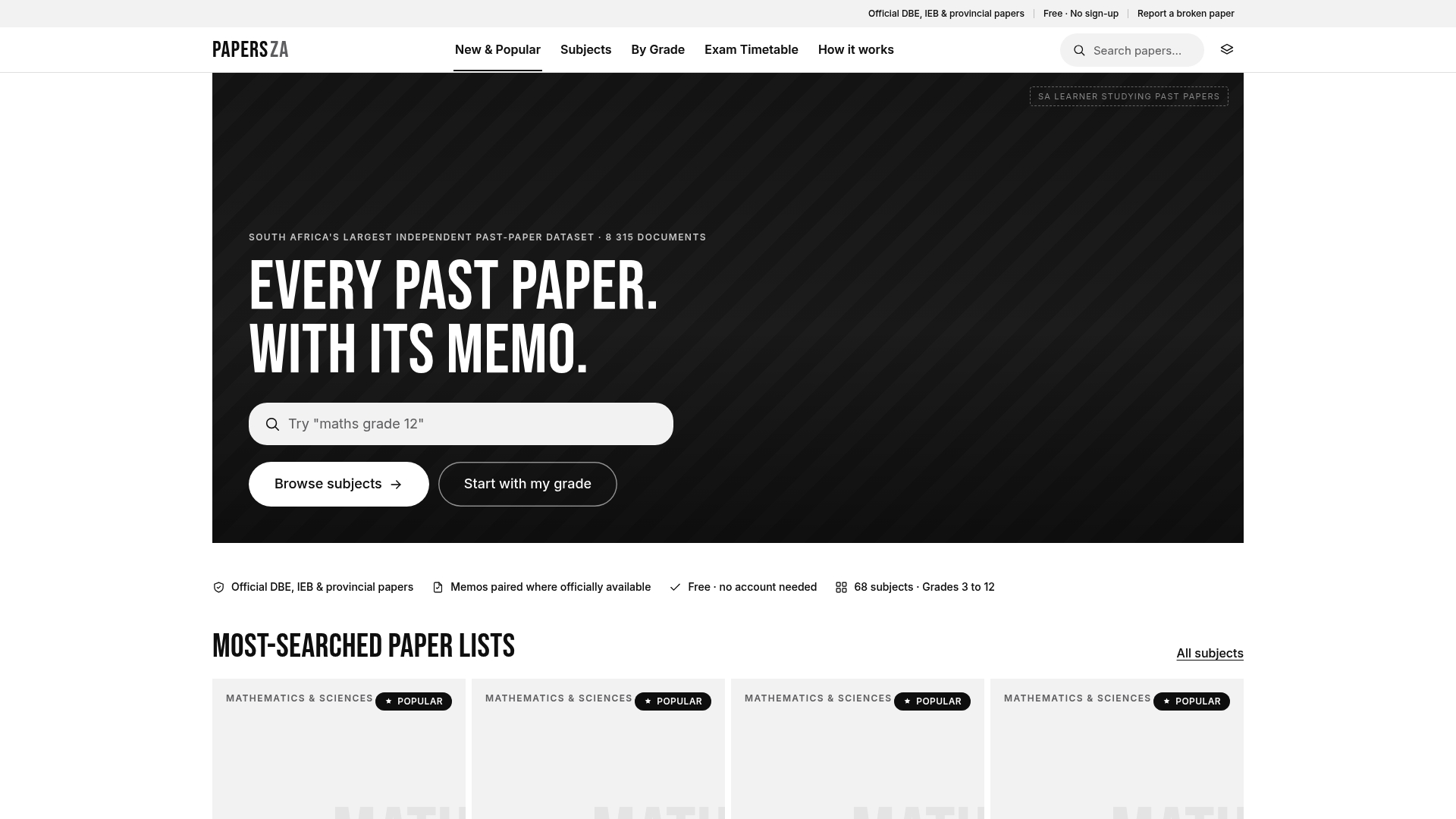
The workflow is straightforward: search for Business Studies Grade 12, select the year and session, download the paper and the memo, and practise under timed conditions. Mark your own essay against the memo using the DBE sub-maximum rules. Repeat weekly. Papersza’s library covers multiple years and sessions, so you will never run out of fresh questions to practise on. See how PapersZA works to get started in under a minute.
Useful sources and where to download official memoranda
- DBE NSC Business Studies exemplar and marking guidelines — the primary source for essay structure rules, LASO definitions, mark allocation protocols, and exemplar answers. Download directly from the DBE exemplar page.
- PapersZA — Grade 12 Business Studies — fast access to official past papers and memos for self-marking practice. Visit papersza.co.za/past-papers/business-studies/grade-12. No registration required.
- StudyClix — supplementary SA exam-style practice and guidance aligned to DBE expectations; useful for additional topic drills and worked examples.
- Provincial memos — Western Cape, Gauteng, and KwaZulu-Natal memos are available through PapersZA’s subject pages and often include useful marking variations and additional exemplar answers.
This article provides general exam guidance for educational purposes. Always confirm current DBE requirements and mark allocations with your teacher or the official DBE website for your specific examination session.
FAQ
How many marks is the Business Studies essay worth?
The NSC Grade 12 Business Studies essay is worth 40 marks: 32 for factual content and 8 for Insight (LASO).
What headings must I use in a Business Studies essay?
The DBE requires the headings INTRODUCTION and CONCLUSION. Never write BODY as a heading; use the paper’s bulleted sub-questions as your body subheadings instead.
What does LASO stand for in Business Studies?
LASO stands for Layout, Analysis, Synthesis, and Originality. These four components make up the 8 insight marks awarded separately from factual content.
How do I earn Originality marks in the essay?
Reference a specific, dated South African business example rather than a generic textbook statement. A named event or trend with a year attached counts more than a vague “for example, a business in South Africa.”
Where can I find Business Studies past papers and memos to practise?
Papersza provides free access to official DBE, IEB, and provincial Business Studies Grade 12 papers and memos with no registration required.