Getting exam-ready for the CAT practical exam in South Africa

Download two recent South African CAT Paper 1 practicals and their memos, then attempt one under a strict 3-hour timed session before you do anything else. That single action tells you more about your readiness than a week of reading notes.
Here’s where to start:
- PapersZA for free Paper 1 practicals and memos with no account needed, organised by grade and year
- DBE past papers and memos, the official national exam papers with the exact instruction wording you’ll see in the real exam
- WCED CAT guidance documents, which explain PAT phases and what examiners expect in each task
Once you’ve pulled two papers, mark your first attempt against the memo before you touch a second one. That’s where the real learning happens.
Key Takeaways
Consistent timed practice with official memos, not passive reading, is what actually improves CAT practical exam results.
| Point | Details |
|---|---|
| Start with two past papers | Download two recent Paper 1 practicals and memos from PapersZA or DBE and attempt one under timed conditions immediately. |
| Know the mark structure | Paper 1 runs several hours for a set number of marks; the PAT contributes a quarter of your final mark. |
| Drill weak sections weekly | Rotate spreadsheet, word-processing, and database drills, then mark against memos to build a weak-area list. |
| Fix technical settings first | Set regional settings to South Africa and confirm decimal and list separators before you start any task. |
| Use PapersZA for free practice | PapersZA’s Grade 11 and 12 CAT pages give free, no-account access to past papers and memos for regular mock practice. |
Table of Contents
- What does the CAT practical exam actually test?
- How should you structure your study time?
- What should you do (and avoid) in the exam room?
- Which technical settings protect your marks?
- Where can you find the best practice materials?
- Why past papers with memos beat any study guide
- How PapersZA gets you exam-ready faster
- Sources
- FAQ
What does the CAT practical exam actually test?
Paper 1 is a practical exam that lasts several hours and covers word-processing, spreadsheets, databases, and HTML, usually stitched into one or two integrated scenarios rather than four separate tasks. That structure is confirmed in the Computer Applications Technology learner guidance from WCED, and it’s worth internalising early because it changes how you should practise.
150 marks, 3 hours, four application areas. That works out to roughly one mark every 72 seconds if you spread evenly, though in practice spreadsheet and database sections eat more time than word-processing.
The remaining assessment comes from school-based tasks and Paper 2 theory, but Paper 1 and the PAT are where most students either gain or lose the marks that decide their final grade.
Typical Paper 1 questions include:
- Short word-processing edits: headers, styles, mail merge fields
- Spreadsheet tasks demanding formulae and functions, not typed-in values
- Database queries, sorts, and reports pulled from a given table
- An integrated scenario where you move data between a spreadsheet and a document
Memos matter here because they show exactly where marks live, often in a specific cell or a named field, not just in a correct-looking answer.
How should you structure your study time?
A CAT practical isn’t a subject you cram. It’s a set of physical habits, like touch-typing, that you build through repetition. A weekly rhythm works better than scattered late-night sessions.
Try this structure for the weeks leading up to your exam:
- One full timed practical per week (3 hours). Simulate exam day exactly, same duration, no pausing, no looking up formulae mid-task.
- Three shorter drills spread through the week, rotating between spreadsheets, word-processing, and database or HTML tasks.
- Mark every attempt against the official memo, and keep a running list of “penalty points”: answers placed in the wrong cell, a formula typed but not applied to the full range, missing absolute references.
- Progress from untimed to section-timed to fully timed as your comfort grows, then increase mock frequency to two full practicals a week in the final fortnight.
Spreadsheet drills deserve extra attention. Grade 12 practical tasks consistently instruct candidates to use formulae or functions for every calculation and to apply absolute references only where the question requires them, and that single instruction trips up more students than any content gap. Set up a worksheet, copy a formula down a column, and check whether your relative and absolute references behaved the way you expected. Do the same with a small database query task and a word-processing exercise that asks you to insert and format an object to an exact specification.
Pro Tip: Keep a running “mistakes log” after each mock, three columns: what you got wrong, why, and the fix. After four or five mocks, that log becomes your personal syllabus for the final week.
What should you do (and avoid) in the exam room?
A few habits separate a smooth practical from a stressful one, and none of them require extra knowledge, just discipline.
Do this:
- Set your regional settings and language to South Africa before typing a single answer. Wrong decimal or date formats silently break formulas.
- Save every file frequently, using the exact filename given in the question paper, and never delete or rename the master file.
- Run a final check that every file opens correctly and that answers sit in the exact cell or location the memo expects.
Don’t do this:
- Don’t add extra content beyond what’s asked. Examiners mark only the requested cells or fields, and an extra formula in the wrong place can actually cost you time without earning anything.
- Don’t assume a task is complete just because it “looks right” on screen. Open the file again and compare it to the instruction wording.
Pro Tip: Read the last line of every question twice. Most lost marks come from students answering the question they expected, not the one actually printed on the paper.
Which technical settings protect your marks?
Technical setup issues cost marks that have nothing to do with subject knowledge, and they’re entirely preventable.
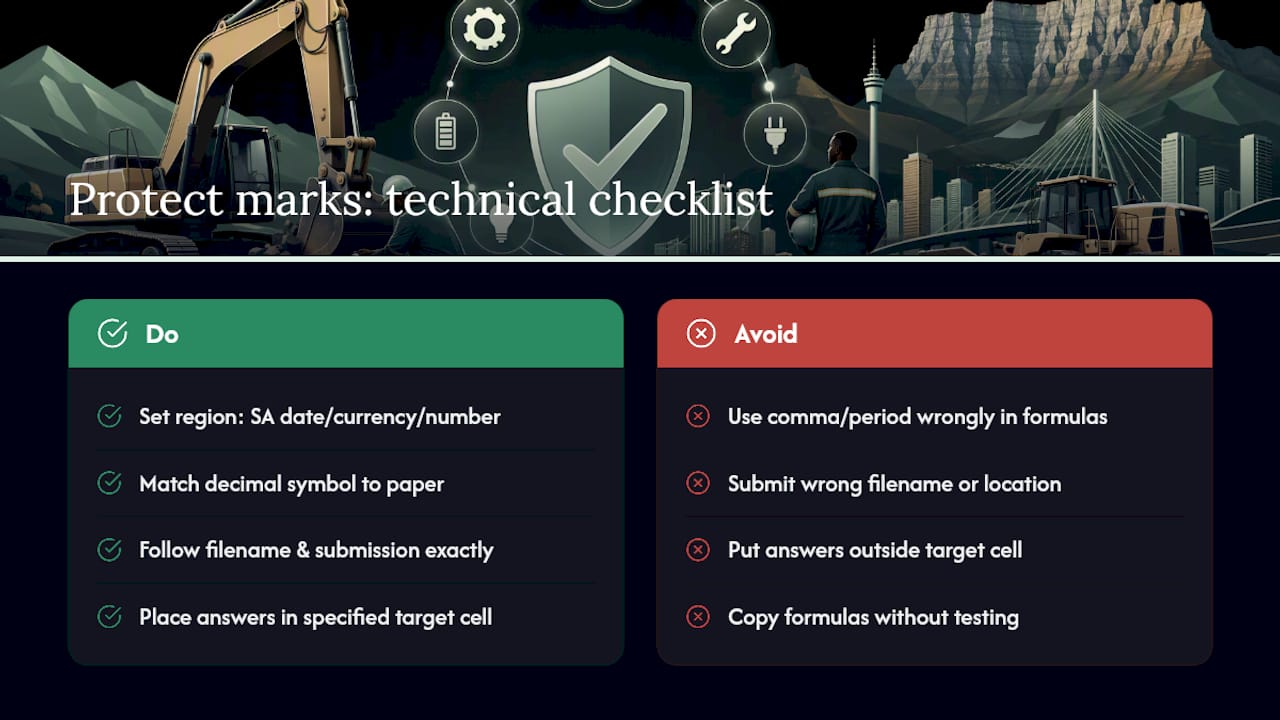
Check your regional settings first: date format, currency, and number formatting should all match South Africa, and your decimal symbol and list separator need to match whatever the question paper specifies, a point SACAI’s exam guidance flags directly. A comma where the system expects a period will break a formula that looks otherwise correct.
Follow file-naming and submission instructions exactly. Exam instruction sheets are explicit that answers outside the specified target cell are not marked, even when the logic behind them is sound, so filename and cell placement aren’t formalities.
Test your formulas against sample data before relying on them, especially where you’ve copied a formula across a range with mixed absolute and relative references. And save constantly. SACAI’s guidance around file backups exists because work is regularly lost to corrupted files or power interruptions, and knowing how to request a master file replacement from your invigilator beats losing an hour of work in silence.
Where can you find the best practice materials?
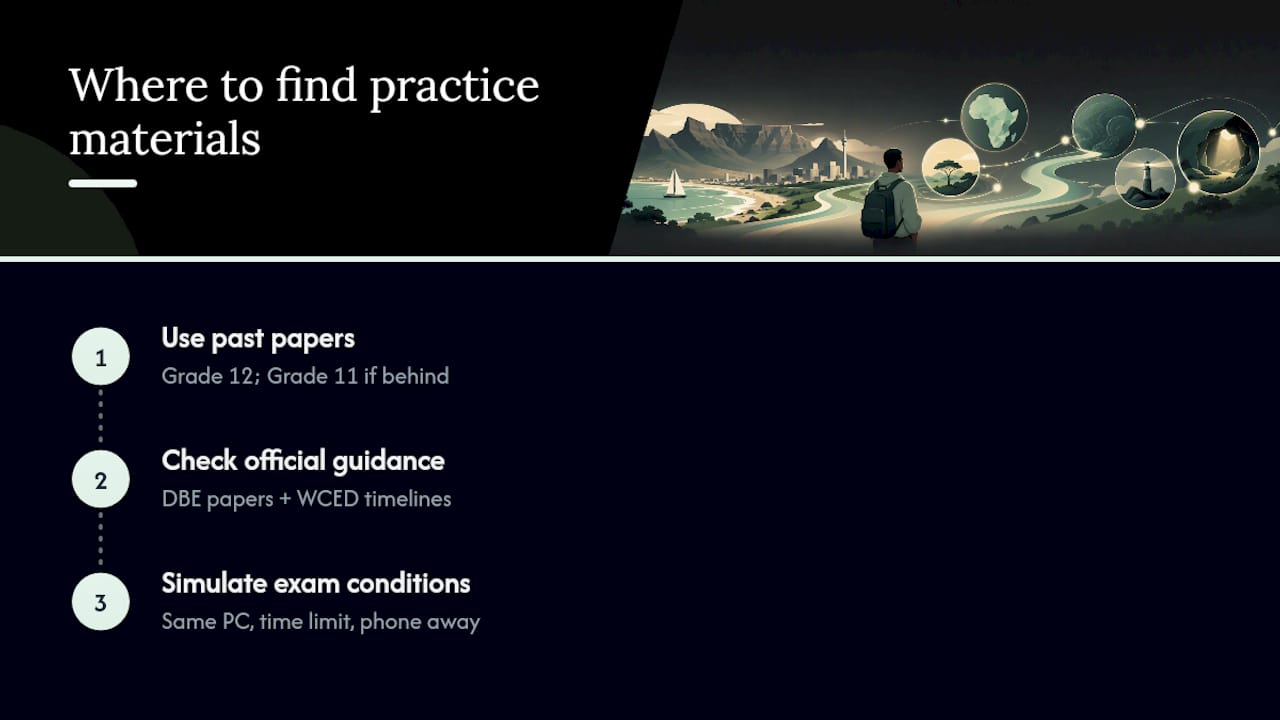
Start with PapersZA’s Grade 12 CAT past papers and memos, which give you the exact Paper 1 format you’ll face, paired with memos for honest self-marking. If you’re a grade behind, the Grade 11 CAT collection builds the same skills at a slightly gentler difficulty curve before you step up.
For official instruction wording and PAT timelines, go straight to DBE past papers and WCED’s guidance documents. Neither replaces practice, but both tell you exactly how examiners phrase instructions and what phase your PAT should be in by a given term.
Once you’ve got papers in hand, simulate real conditions: same computer, same time limit, phone away, memo closed until you’re done.
Why past papers with memos beat any study guide
Practising with real memos teaches you something no textbook can: examiners mark specific cells, specific filenames, specific formatting, not general understanding. I’ve seen students who clearly understood spreadsheets lose marks because their answer sat one row off from where the memo expected it. That’s not a knowledge gap. It’s a habit gap, and only memo-based practice fixes it.
What makes this sustainable is access. PapersZA’s papers and memos are free and require no account, so there’s no friction between deciding to practise and actually doing it. That matters more than it sounds, because consistency beats intensity when you’re building exam-room habits.
How PapersZA gets you exam-ready faster
PapersZA hosts thousands of South African past papers and memos across grades 3 to 12, including a dedicated CAT collection for Grade 11 and 12 learners, all free and accessible without creating an account. That matters when you’re trying to fit in one more mock practical between homework and everything else on a school night.
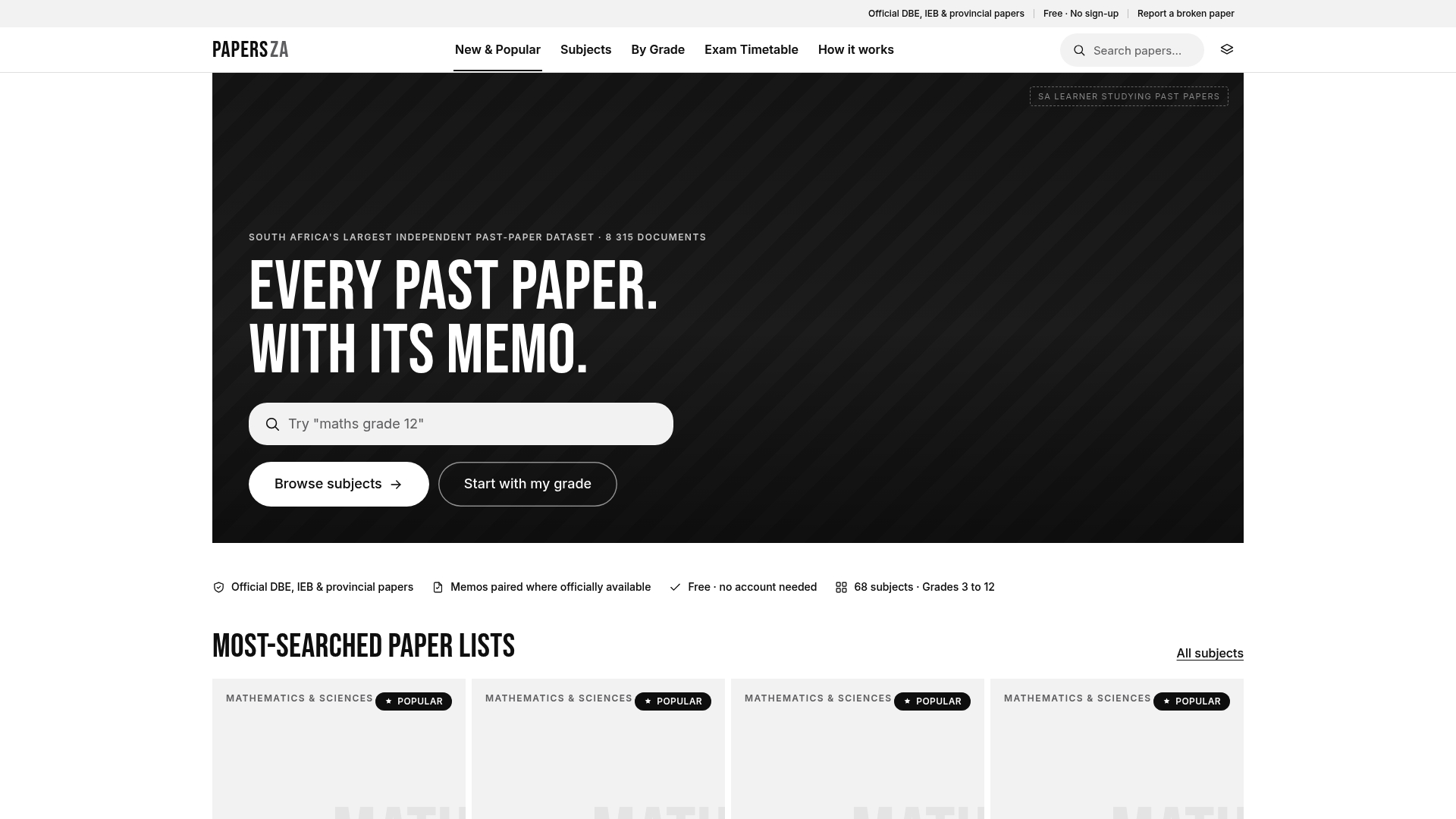
Start simple: open the Grade 12 CAT past papers and memos page, pull down a recent Paper 1 practical and its memo, and run a timed mock this week. If you’re also revising other subjects, the same no-account system works across the full PapersZA dataset, so one bookmark covers your entire exam season, not just CAT. Bookmark the CAT grade page now, before revision season gets busy, so it’s one click away every time you need a fresh paper.
Sources
FAQ
How long is the CAT practical exam?
Paper 1 runs for 3 hours and carries 150 marks, covering word-processing, spreadsheets, databases, and HTML.
What percentage of my final CAT mark is the PAT?
The Practical Assessment Task contributes 25% of your final mark, built up across phases through the school year.
Where can I get CAT past papers for free in South Africa?
PapersZA offers free Grade 11 and 12 CAT past papers and memos with no account required, alongside official DBE and WCED documents.
Why did I lose marks even though my formula was correct?
Answers placed outside the specified target cell aren’t marked, so cell placement and exact file naming matter as much as formula logic.
How many timed mock practicals should I do before the exam?
Aim for at least one full 3-hour timed practical per week during peak preparation, increasing to two in the final fortnight before the exam.