Consumer studies exam topics for Grade 12: the full breakdown

The Grade 12 Consumer Studies exam tests five topics: The Consumer, Food and Nutrition, Clothing, Housing and Interior, and Entrepreneurship. The paper runs for three hours with a total of 200 marks, split into six compulsory questions. Section A covers short questions from all five topics, while Section B focuses on longer, topic-specific answers. Every question draws on a case study, extract, graph, label, or menu, because the DBE examination guideline tests whether you can apply knowledge to a scenario, not just recite a definition.
Two resources matter more than any study summary you’ll find online. The official CAPS-aligned examination guideline from the Department of Basic Education tells you exactly what’s examinable and how marks are weighted. The Grade 12 Consumer Studies past papers and memos on PapersZA let you practise under real exam conditions and mark your own work against the memo.
Here’s what you need to know before you open a single revision book:
- The five topics: The Consumer, Food and Nutrition, Clothing, Housing and Interior, Entrepreneurship
- Paper format: 3 hours, 200 marks, six compulsory questions
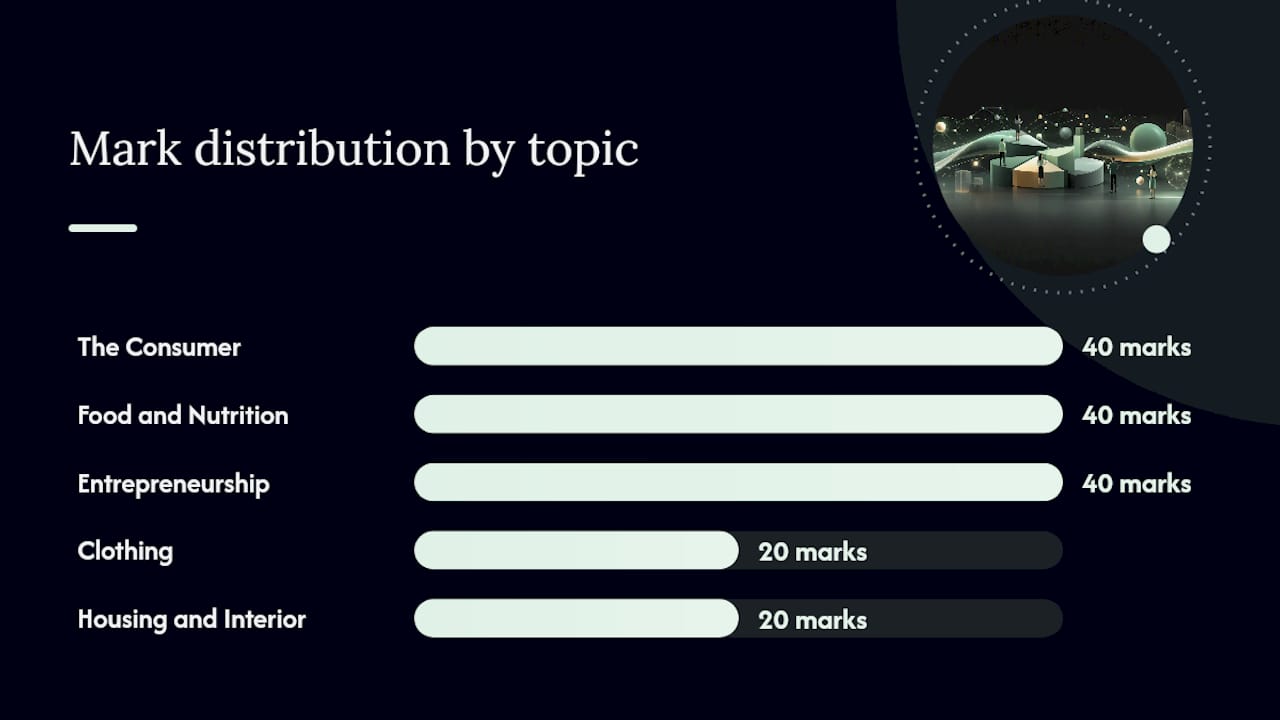
- Marks weighting: The Consumer (40), Food and Nutrition (40), Clothing (20), Housing and Interior (20), Entrepreneurship (40)
- Where to start: the DBE guideline for what’s examinable, PapersZA for timed practice with memos
Key Takeaways
Success in Grade 12 Consumer Studies depends on matching study time to the 200-mark weighting and practising application through timed past papers rather than passive memorisation.
| Point | Details |
|---|---|
| Prioritise the 40-mark topics | The Consumer, Food and Nutrition, and Entrepreneurship together carry 120 of 200 marks. |
| Practise with official past papers | Use DBE papers and the PapersZA Grade 12 collection for timed, memo-marked practice. |
| Match answers to command words | “Discuss” and “evaluate” need weighed reasoning; “name” and “list” need short, direct answers. |
| Annotate every case study | Underline scenario-specific details before answering, since markers expect direct references. |
| Show your working in calculations | Entrepreneurship costing questions award partial marks for correct method, not just the final figure. |
Table of Contents
- Consumer studies exam topics: how the 200-mark paper is structured
- The Consumer: what to study and how to answer scenario questions
- Food and nutrition: examinable facts, case-study technique and revision checklist
- Clothing: key syllabus items and how exam questions test visual and practical knowledge
- Housing and interior: what learners must know and how to evaluate choices
- Entrepreneurship: exam focus, common tasks and scoring tips
- Where to find past papers and memos and how to use them
- Exam technique and a short revision plan learners can follow
- Why you can trust this guide: PapersZA credentials and source transparency
- Detailed explanation of mark distribution per topic to prioritize study time
- Updates or changes in the syllabus for the current exam year
- Sample answers or exemplars demonstrating high-scoring responses
- Effective study tips and revision strategies tailored for consumer studies exams
- What this exam actually rewards, and what learners get wrong
- Sources
- FAQ
Consumer studies exam topics: how the 200-mark paper is structured
Section A tests all five topics through short, sharp questions, which is why you can’t afford to skip any topic entirely, even ones you find boring. Section B gives you longer, scenario-based questions organised by topic, and this is where the real marks live because you have to build an argument, not just tick a box.
The mark distribution tells you exactly where to spend your revision hours. According to the DBE guideline, the weighting looks like this:
- The Consumer — 40 marks
- Food and Nutrition — 40 marks
- Clothing — 20 marks
- Housing and Interior — 20 marks
- Entrepreneurship — 40 marks
That’s 120 marks out of 200 sitting in just three topics: The Consumer, Food and Nutrition, and Entrepreneurship. Clothing and Housing carry half the weight of the others, which doesn’t mean you skip them, but it does mean you shouldn’t spend equal hours on all five.
Examiners lean heavily on realistic source material: a supermarket receipt, a food label, a municipal bill, a fabric care symbol, a business cash flow table. The official November 2023 question paper shows this pattern clearly, with almost every question anchored to a visual or a scenario rather than a bare recall prompt.
Pro Tip: Time yourself at roughly 0.9 minutes per mark. On a 40-mark topic like The Consumer, that’s about 36 minutes, including the time it takes to read and annotate the case study.
The Consumer: what to study and how to answer scenario questions
The Consumer topic is worth 40 marks, tied with Food and Nutrition and Entrepreneurship for the heaviest weighting on the paper. It covers financial literacy, contracts, credit, and resource use, all wrapped in scenarios about a fictional household or shopper.
Key subtopics you need locked down:
- Tax basics: how SARS collects income tax, what VAT is, and how it applies to everyday purchases
- Municipal charges: rates, water, electricity, and refuse removal as fixed household costs
- Simple versus compound interest, at a conceptual level rather than complex calculations
- Credit concepts under the National Credit Act, including reckless lending and a consumer’s right to information
- Energy and water sources, comparing renewable and non-renewable options and evaluating responsible use
The National Credit Act questions rarely ask for the act’s full text. Examiners want you to identify whether a scenario shows responsible or reckless credit behaviour, and to explain the consumer’s rights in that specific case. That’s an application skill, not a memory test.
Energy and water questions often show up as comparison tasks: solar versus coal, borehole versus municipal supply, with marks for weighing cost, reliability, and environmental impact against each other rather than just listing facts.
Scam and fraud scenario questions are common in this section too. You’ll usually be given a short story, maybe a phishing email or a door-to-door salesperson, and asked to identify the warning signs and advise the consumer. The trick is matching your answer to the command word. “Identify” wants a short, direct list. “Discuss” or “evaluate” wants you to weigh options and reach a conclusion, ideally in full sentences that show your reasoning.

The DBE guideline weights this topic at 40 out of 200 marks, tied with two other topics for the highest weighting on the entire paper, which confirms why financial literacy content deserves early and repeated revision rather than a last-minute skim.
Food and nutrition: examinable facts, case-study technique and revision checklist
Food and Nutrition carries 40 marks, the same weighting as The Consumer and Entrepreneurship, and it’s arguably the topic with the most factual content to memorise. The DBE guideline lists nutrition-related health conditions, food-borne disease, additives, labelling, and food security as the core content areas.
Health conditions and glycaemic index
Diabetes, hypoglycaemia, hyperglycaemia, and osteoporosis show up regularly, usually through a case study describing a patient’s symptoms or diet. You need to know the cause, the prevention strategy, and the dietary management approach for each condition, not just a textbook definition.
Glycaemic index (GI) questions test whether you understand that low-GI foods release glucose slowly, which matters for managing blood sugar spikes in diabetic patients. You’ll often be given a table of foods with their GI values and asked to build a meal plan or explain why one food is a better choice than another for a specific person’s condition.
Food-borne illness and labelling
Food-borne diseases test three things: how the pathogen spreads, the incubation period, and the prevention method, usually food handling or storage. Salmonella and E. coli are the most commonly referenced examples in past papers.

Food labelling questions increasingly ask you to spot misleading claims. A pack that says “no added sugar” can still be high in natural sugars, and a “low fat” claim doesn’t mean low calorie. Additives get tested on their function (preservative, colourant, emulsifier) rather than their chemical names, so don’t waste time memorising E-numbers you’ll never be asked to recall directly.
Food security in South Africa
This subtopic covers South Africa’s reliance on imports for certain staples, the impact of drought on local food production, and what household or national self-sufficiency actually looks like in practice. Expect a short paragraph-style answer here rather than a list.
Your revision checklist for this topic:
- Know the cause, prevention, and management for diabetes, hypoglycaemia, hyperglycaemia, and osteoporosis
- Practise reading a GI table and applying it to a specific dietary scenario
- Learn the transmission, incubation, and prevention pattern for at least two common food-borne diseases
- Be able to identify a misleading label claim and explain why it’s misleading
- Understand food security in the South African context: imports, drought, self-sufficiency
Pro Tip: Food and Nutrition rewards learners who practise reading labels and menus from real past papers rather than just memorising a textbook chapter. Pull two or three past papers and time yourself answering only the food-related questions.
Clothing: key syllabus items and how exam questions test visual and practical knowledge
Clothing is worth 20 marks, half the weight of The Consumer or Food and Nutrition, but the questions here are often quick wins if you’ve done the visual-analysis practice. This topic tends to reward learners who’ve actually looked at fabric samples and care labels rather than only reading about them.
Core content to know cold:
- Natural versus synthetic fibre types and how each affects comfort, durability, and cost
- Fabric properties relevant to specific clothing choices, like breathability for activewear or insulation for winter wear
- Care label symbols and what they mean for washing, drying, ironing, and dry cleaning
- Basic stain removal principles, matched to fabric type and stain source
- Fashion cycles and how to interpret a graph or illustration showing trend changes over time
Visual analysis questions are where Clothing separates confident learners from unprepared ones. You’ll be shown an image, sometimes a garment, sometimes a graph of fashion trend data, and asked to interpret it. The skill is describing what you actually see before you start explaining what it means; jumping straight to interpretation without grounding it in the image is a common way to lose easy marks.
Sustainability questions have become more frequent in recent papers, usually asking you to briefly discuss the environmental impact of fast fashion or the benefits of buying secondhand or recycled textiles. Keep this answer short and specific. A generic “fast fashion is bad for the environment” line earns little; naming the actual issue (water use in cotton production, textile waste in landfills) earns more.
Housing and interior: what learners must know and how to evaluate choices
Housing and Interior sits at 20 marks, matching Clothing as the lightest-weighted topic, but it consistently produces some of the most scenario-heavy questions on the paper. Expect a family or individual case study describing their housing needs, income, and lifestyle.
You need working knowledge of:
- Three common housing options (renting, buying, building) with the advantages, disadvantages, and financial responsibilities of each
- Contractual obligations tied to housing, including lease terms and bond agreements
- Municipal services and how access to water, electricity, and refuse removal shapes a household’s housing choice
- Appliance selection criteria, especially energy and water efficiency ratings, upfront cost versus long-term running cost, and environmental impact
Evaluation-style questions dominate this topic. You’re typically given a family’s circumstances and asked to recommend a housing option or an appliance, then justify it. The structure that scores well: state your recommendation clearly, give two or three supporting reasons tied directly to the scenario’s details, then briefly acknowledge a trade-off. Examiners reward learners who show they’ve weighed the options, not just picked one.
Appliance questions increasingly test energy efficiency labelling, since South African households face regular tariff increases and load shedding pressures. Knowing how to compare the long-term cost of an energy-efficient appliance against its higher purchase price is a skill worth practising with real numbers from past papers.
Entrepreneurship: exam focus, common tasks and scoring tips
Entrepreneurship carries 40 marks, tied for the heaviest weighting alongside The Consumer and Food and Nutrition, and it’s the topic most likely to include calculation-based questions. Most scenarios centre on a home-based or small-scale business, often food or craft production, and ask you to work through planning and costing decisions.
The tasks that come up most consistently:
- Drawing up or interpreting a simple work plan or production schedule for a small business
- Calculating startup costs, including raw materials, equipment, and initial marketing spend
- Choosing a distribution method appropriate to the product and target market
- Explaining how using local raw materials can reduce costs or support community suppliers
- Justifying a marketing approach based on the business’s budget and customer base
Calculation questions want your working shown, not just a final number. If you’re asked to calculate the cost per unit of a product, write out each cost component before landing on the total. Markers award method marks even when the final figure is slightly off, but only if they can see how you got there.
The examiners consistently link theory back to a supplied scenario rather than asking abstract “define entrepreneurship” questions. If a case study describes a woman starting a small catering business from her kitchen, expect questions about her startup costs, her pricing strategy, and the risks specific to food-based home businesses, not generic business theory. Learners who practise pulling detail directly from the case study, rather than writing a memorised paragraph about entrepreneurship in general, score noticeably higher on this section.
Where to find past papers and memos and how to use them
Official DBE papers matter because they’re the only source that shows you exactly how examiners phrase questions and weight marks in a real exam setting. The November 2023 Grade 12 Consumer Studies paper is a solid example of the six-question structure in action, and working through it gives you a feel for pacing that no summary can replace.
PapersZA’s Grade 12 Consumer Studies collection organises past papers and memos by year and session, so you can build a practice schedule without hunting across multiple government pages. Every document is free to download and there’s no account required, which matters when you’re trying to grab a paper the night before a test date.
Getting real value out of past papers comes down to how you use them, not how many you collect:
- Time yourself strictly. A 40-mark topic should take you around 36 minutes; if you’re taking an hour, your pacing needs work before your content does.
- Mark your own answers against the memo honestly, including partial marks for correct method even when your final answer is wrong.
- Keep a running list of question types that keep repeating (glycaemic index tables, appliance comparisons, credit scenarios) so you can spot the examiners’ favourite formats.
- Work through at least three different exam sessions, not just the most recent one, since question style shifts slightly year to year.
Pro Tip: Don’t just read the memo after marking yourself. Compare your wording against the memo’s expected phrasing, especially for evaluation answers, so you learn the sentence structures that earn full marks rather than partial ones.
Papers and memos are typically available as PDFs, and many DBE papers are published in both English and Afrikaans depending on the medium of instruction at your school. If you’re studying a related subject with similar case-study demands, the Business Studies Grade 12 collection is worth a look too, since both subjects test scenario interpretation in similar ways.
Exam technique and a short revision plan learners can follow
A structured plan beats last-minute cramming, and Consumer Studies rewards steady practice more than most subjects because the content is broad but the question style is predictable once you’ve seen enough papers.
Here’s a five-week plan mapped to the syllabus weighting:
- Week 1: The Consumer (financial literacy, credit, energy and water) plus one timed Section A practice
- Week 2: Food and Nutrition (health conditions, GI, labelling, food security) plus one past paper’s food questions
- Week 3: Entrepreneurship (costing, work plans, distribution) plus one full past-paper attempt
- Week 4: Clothing and Housing together, since their combined 40 marks match one heavyweight topic
- Week 5: Full timed past papers only, marked against memos, focusing on your weakest topic from weeks 1 to 4
For each case study question, follow a simple four-step approach: read the whole extract once without answering anything, annotate key details as you go, plan your answer structure for two minutes on longer questions, then write. Skipping the annotation step is the single biggest reason learners miss details that are sitting right there in the extract.
Command words matter more than most learners realise. “Name” or “list” wants short answers with no explanation. “Explain” wants a reason attached to a fact. “Discuss” or “evaluate” wants you to weigh at least two sides before reaching a conclusion. Mismatching your answer length to the command word is one of the fastest ways to lose marks on an otherwise correct answer.
The most common mistakes examiners flag are answers that ignore the specific scenario in favour of a generic, memorised paragraph, and answers with no clear structure, especially on evaluation questions that need a recommendation followed by reasons.
Why you can trust this guide: PapersZA credentials and source transparency
This guide draws directly on the DBE Consumer Studies examination guideline and the official November 2023 question paper, not secondhand summaries. Every mark allocation and structural detail here traces back to those two documents.
Papersza built its reputation on exactly this kind of source discipline. A few things worth knowing about where this material comes from:
- Papersza hosts one of South Africa’s largest independent collections of past exam papers, spanning grades 3 to 12 across multiple subjects
- The Consumer Studies Grade 12 collection specifically includes past papers paired with memos for self-assessment
- Every document on the platform is free to download, with no account or registration required
- You can verify any claim in this guide by cross-checking it against the DBE’s own published guideline, which is publicly available and linked throughout this article
If you want to check our numbers against the source yourself, the DBE guideline is the definitive reference, and it’s worth reading in full at least once before the exam.
Detailed explanation of mark distribution per topic to prioritize study time
The mark distribution isn’t just administrative detail. It’s the single most useful planning tool you have for deciding where your revision hours go.
Three topics, The Consumer, Food and Nutrition, and Entrepreneurship, each carry 40 marks, adding up to 120 of the paper’s 200 marks. Clothing and Housing and Interior each carry 20 marks.
This doesn’t mean ignoring Clothing or Housing. A learner who scores well across all five topics will outperform one who’s excellent at three and weak at two, since even a 20-mark topic can be the difference between a pass and a distinction. But if you’re triaging in the final two weeks before the exam and have to choose, spend that time on the 40-mark topics first, since the return on each study hour is proportionally higher there.
Use the mark weighting to sanity-check your revision notes too. If your Food and Nutrition notes are three pages long and your Housing notes are ten, your effort doesn’t match the exam’s actual demands, and it’s worth rebalancing before exam week arrives.
Updates or changes in the syllabus for the current exam year
The core CAPS structure for Grade 12 Consumer Studies, the five topics and the 200-mark, six-question paper format, has remained stable in recent examination cycles according to the DBE guideline. What tends to shift year to year is the specific scenario content examiners choose, not the underlying topic weighting or structure.
For the 2026 exam year, learners should check the DBE’s official website directly for any circular or annexure updates to the examination guideline before finalising a revision plan, since curriculum bodies occasionally issue minor content clarifications between publication cycles. Relying on the most recent official guideline document, rather than a summary from a previous year, is the safest way to confirm you’re studying the correct version of the syllabus.
Practically, this means the study approach in this guide holds regardless of small annual adjustments: master the five topics, understand the mark weighting, and practise applying theory to scenarios using recent past papers. The skills examiners test, financial literacy, nutrition science, textile knowledge, housing evaluation, and business planning, don’t change even when the specific case study content does.
Sample answers or exemplars demonstrating high-scoring responses
A high-scoring evaluation answer follows a recognisable pattern: state your position clearly in the first sentence, support it with two or three reasons drawn directly from the case study, then acknowledge a limitation or trade-off before closing. A weak answer skips straight to reasons without stating a clear position, leaving the marker to guess what you’re actually arguing.
Take a housing evaluation question asking whether a family should rent or buy. A strong response opens with “Renting is the more suitable option for this family because…” rather than launching straight into a list of renting’s general pros and cons. It then ties each reason to a specific detail from the scenario, such as the family’s irregular income or short-term work contract, rather than generic textbook advantages.
For calculation-based Entrepreneurship questions, high-scoring answers show every step: raw material costs, labour, overheads, and the final total, each on its own line rather than one lumped figure. Markers award partial credit for correct method, so an answer that shows its working, even with one arithmetic slip, usually scores higher than a correct final number with no working shown at all.
The common thread across every high-mark example is specificity. Answers that quote or reference exact details from the supplied case study consistently outscore answers built around generic, memorised content that could apply to any scenario.
Effective study tips and revision strategies tailored for consumer studies exams
Past-paper practice under timed conditions is the single most effective Consumer Studies revision strategy, more effective than re-reading notes or highlighting textbooks. The subject rewards application, and application is a skill you build through repetition against real exam questions, not passive review.
Group your revision by mark weighting rather than working through topics in textbook order. Spend proportionally more time on The Consumer, Food and Nutrition, and Entrepreneurship, since together they make up 120 of the paper’s 200 marks.
Practise annotating case studies before you attempt to answer them. Underline numbers, names, and specific circumstances in the scenario, since these details are almost always what the marker expects you to reference in your answer.
Build a short glossary of command words (name, explain, discuss, evaluate, justify) with a one-line reminder of what each expects, and keep it visible while you practise past papers until the distinctions become automatic. Finally, mark yourself honestly against memos rather than assuming you would have earned full marks, since spotting your own gaps now is far cheaper than discovering them in the exam hall.
What this exam actually rewards, and what learners get wrong
The conventional advice around Consumer Studies revision leans too hard on memorisation: learn the definitions, learn the lists, hope the exam asks what you expected. That approach caps out around a mid-range mark because the DBE guideline is explicit that questions test application to case studies, not recall.
What the mark weighting actually tells you is a prioritisation problem, not a content problem. Three topics carry 120 of 200 marks. Treating all five topics as equally important is the most common planning mistake I see reflected in how learners structure their revision time, and it’s an easy one to fix once you see the numbers laid out.
The learners who improve fastest aren’t the ones who read more notes. They’re the ones who run timed past papers early enough to still fix bad habits, mark themselves honestly against the memo, and treat command words as instructions rather than decoration. Start with a full past paper in week one, not week five. You’ll find your actual weak spots faster than any study guide will tell you.
— Nkosi
FAQ
What topics are covered in Consumer Studies?
Grade 12 Consumer Studies covers five topics: The Consumer, Food and Nutrition, Clothing, Housing and Interior, and Entrepreneurship, weighted at 40, 40, 20, 20, and 40 marks respectively.
What subjects overlap with Consumer Studies skills?
Business Studies shares case-study interpretation and costing skills with the Entrepreneurship section, making it a useful subject to cross-reference during revision.
What are some important topics for consumer awareness?
Key consumer awareness topics include understanding credit and the National Credit Act, recognising misleading food labels, comparing energy and water sources, and spotting scam or fraud scenarios in everyday transactions.
What topics does the Grade 10 Consumer Studies curriculum cover?
Earlier grades introduce the same five broad topic areas at a foundational level, building the base knowledge that Grade 12 later tests through more complex, scenario-based questions.
Where can I download official Grade 12 Consumer Studies past papers?
You can download official DBE papers directly from the Department of Basic Education, or use the PapersZA Grade 12 Consumer Studies collection for papers paired with memos in one place.