How to structure an economics essay for top marks

A high-scoring economics essay follows one clear pattern: a short, precise introduction that defines key terms and states your thesis, two or three fully developed analysis paragraphs that each apply theory and evaluate it, and a judgement-focused conclusion. That pattern holds whether you are writing a 10-mark class test or a 30-mark NSC paper.
Model opening line: “This essay argues that [your position], because [brief reason], though the extent depends on [key condition].”
Model closing line: “On balance, [your position] holds under [condition], but the effect is likely to be limited/significant because [one evaluative point].”
Exam time check for a 25–30 mark essay: 5–7 minutes planning, 35–40 minutes writing, 3–5 minutes reviewing.
Before you write a single sentence, spend those planning minutes on:
- Decoding the command word (discuss, evaluate, explain, assess)
- Identifying the two strongest points you can develop fully
- Deciding where a diagram fits and which paragraph it belongs in
- Sketching a one-line thesis you will carry through to the conclusion
Key takeaways
A high-scoring economics essay requires a clear thesis in the introduction, two or three fully developed paragraphs each containing a point, explanation, example, and evaluation, and a conditional judgement in the conclusion.
| Point | Details |
|---|---|
| Structure every essay in three parts | Introduction (define + thesis), body (2–3 paragraphs), conclusion (conditional judgement). |
| Use the DEEEL paragraph formula | Each paragraph: Point, Explain, Apply, Evaluate, Link. Never stop at description. |
| Evaluation is the mark-differentiator | Integrate evaluation into each paragraph; do not save it for the conclusion. |
| Two strong points beat five weak ones | Develop your best two arguments fully rather than listing many underdeveloped ideas. |
| Papersza for timed practice | Download free DBE and IEB past papers and memos at Papersza to rehearse structure under real exam conditions. |
Table of Contents
- What does a good economics essay structure look like?
- The paragraph formula you should use every time
- How to plan and write under exam conditions
- How to use examples, data, and diagrams effectively
- A sample question, 5-minute plan, and model paragraph
- What actually separates a good essay from a great one
- Practice the structure with real past papers on Papersza
- Sources
- FAQ
What does a good economics essay structure look like?
The DBE’s official curriculum materials align essay mark schemes with a three-part structure. Here is how each part earns marks, and roughly how long to spend on each.
| Essay part | Job it does | Suggested time (30-mark paper) | Marks typically available |
|---|---|---|---|
| Introduction | Define terms, state scope and thesis | 5 minutes | 2–4 marks |
| Body paragraph 1 | Point, explanation, example, evaluation | 12–15 minutes | 8–12 marks |
| Body paragraph 2 | Point, explanation, example, evaluation | 12–15 minutes | 8–12 marks |
| Body paragraph 3 (if needed) | Additional point or counter-argument | 8–10 minutes | 4–6 marks |
| Conclusion | Weigh evidence, conditional judgement | 5 minutes | 2–4 marks |
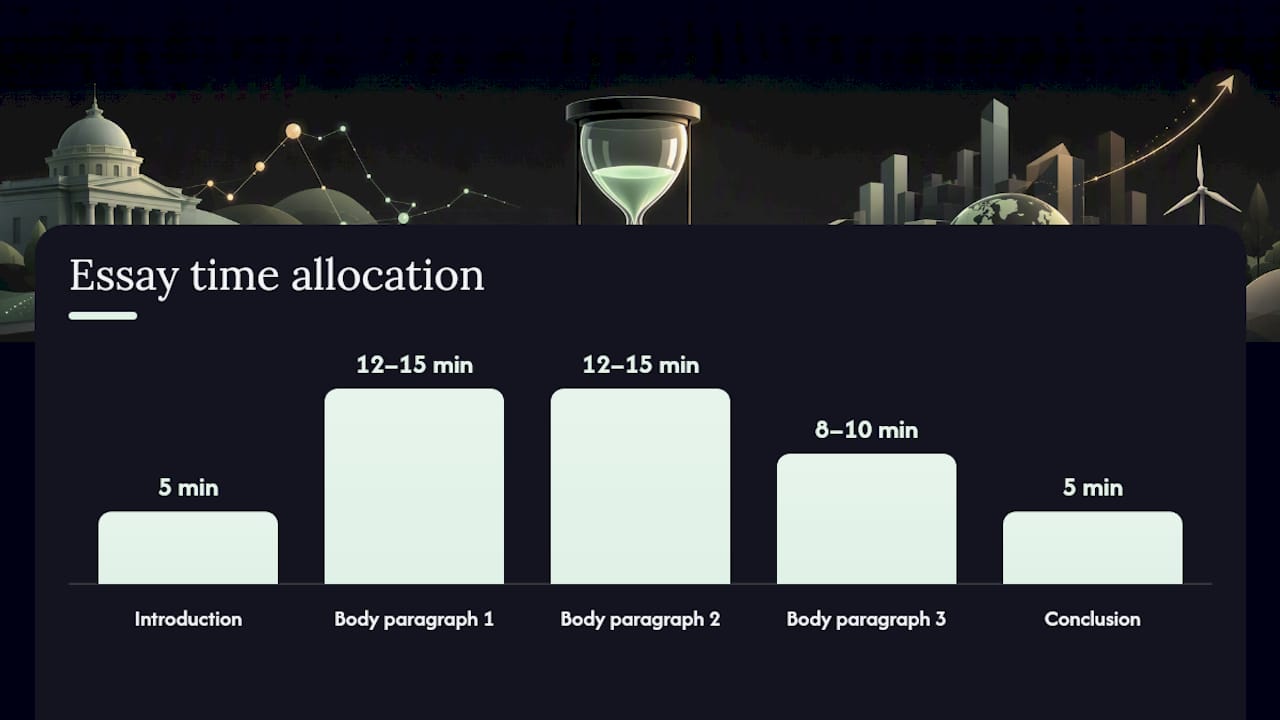
The Economics Network’s essay-writing guidance frames it neatly: say what you are going to say, say it, then say what you said. Each paragraph should open with a thesis sentence so a reader could follow your argument from the first line of each section alone.
Introduction checklist:
- Define every key term in the question (one sentence each)
- State the scope: what you will and will not cover
- Give a one-line thesis that directly answers the question
- Signpost the two or three points you will develop
Body paragraph checklist:
- Open with a clear point that answers the question
- Explain the mechanism (why does this happen?)
- Apply a real-world example or draw a diagram
- Evaluate: under what conditions does this hold? What are the limits?
- End with a mini-judgement linking back to the question
Conclusion checklist:
- Weigh the evidence from both sides
- State a conditional judgement (“on balance… provided that…”)
- Do not introduce new arguments
- Keep it to three or four sentences
For in-class essays and assignments, add a brief reference list at the end using APA or Harvard style.
The paragraph formula you should use every time
Every body paragraph in an economics essay should follow the same repeatable structure. The version that works best for NSC and IEB exams is a Point, Explanation, Application, Evaluation sequence, sometimes called DEEEL (Define, Explain, Evidence, Evaluate, Link). Distinction-level essays consistently use this chain-of-reason approach because it forces you to move beyond description into analysis.
Sentence-starters for each step:
- Point: “One key effect of [policy/concept] is…”
- Explain: “This occurs because… / The mechanism here is…”
- Apply: “For example, in South Africa… / As shown in a relevant economic model…”
- Evaluate: “However, this effect depends on… / The extent to which this holds is limited by…”
- Link: “Therefore, [policy/concept] is likely to [outcome], particularly when [condition].”
Here is a short annotated model paragraph on minimum wage policy:
[Point] A national minimum wage tends to reduce employment in labour-intensive sectors. [Explain] When the wage floor is set above the market equilibrium, the cost of labour rises, so firms substitute capital for labour or reduce output. [Apply] South Africa’s National Minimum Wage, adjusted annually, has been cited in debates about employment in the agricultural and retail sectors, where margins are thin. [Evaluate] The size of this effect depends on the elasticity of demand for labour: in sectors where workers are easily replaced by machinery, job losses are larger; in sectors requiring skilled labour, the impact is more muted. [Link] On balance, the employment effect is real but sector-specific, meaning a blanket judgement overstates the case.
Pro Tip: Pick your two strongest points and develop each one fully rather than listing four or five thin points. Examiners consistently reward depth over breadth, and a well-built paragraph with genuine evaluation outscores three paragraphs that stop at description.
How to plan and write under exam conditions
Five minutes of planning prevents forty minutes of drift. Here is a protocol that works under timed conditions.
- Read the question twice. Underline the command word and the key economic concept.
- Decode the command word. “Discuss” means argue both sides. “Evaluate” means weigh and judge. “Explain” means mechanism only.
- Write a one-line thesis. Commit to a position before you start writing.
- Choose two main points. Write them as single sentences. Decide which paragraph each belongs in.
- Mark where diagrams go. Write “D1 here” or “supply-demand diagram” next to the relevant point so you do not forget mid-essay.
- Assign minutes. Intro: 5 min. Para 1: 12 min. Para 2: 12 min. Conclusion: 5 min. Review: 3 min.
Common examiner red flags and quick fixes:
- Over-long introduction — if your intro runs more than a paragraph, cut it. Define, scope, thesis. Done.
- Missing evaluation — if every paragraph ends with a fact, add one sentence starting with “However…” or “The extent to which…”
- Unlabelled diagrams — a diagram with no axes, no labels, and no reference in the text scores nothing. Label everything or leave it out.
- Drifting off-question — after every paragraph, re-read the question. Does your paragraph answer it directly?
Pro Tip: Running out of time? Write two fully developed paragraphs and a one-line conclusion. Then add a note: “A third paragraph would have addressed [topic] by arguing [brief point].” Markers can see your reasoning even if you did not finish, and integrated evaluation in the paragraphs you did complete still earns marks.
Before you hand in, check:
- Does the introduction contain a clear thesis?
- Does each body paragraph open with a point that answers the question?
- Is every diagram fully labelled with axes, curves, and equilibrium points?
- Does each paragraph contain at least one evaluative sentence?
- Does the conclusion state a conditional judgement?
How to use examples, data, and diagrams effectively
Examiners reward evidence that is relevant, specific, and integrated into the argument. A statistic dropped in without explanation earns nothing. A statistic that supports a point, is explained, and is linked back to the question earns full marks for that criterion.
Integrating evidence: what works
- State the fact briefly: “South Africa has faced persistently high levels of unemployment in recent years.”
- Explain what it shows: “This suggests that structural factors, not just cyclical demand, are driving joblessness.”
- Link it to your argument: “A demand-side stimulus alone is therefore unlikely to resolve the problem.”
Practising with economics data response questions sharpens this skill quickly. Data-response tasks train you to read a table or extract, identify the relevant trend, and write a focused analytical sentence rather than a vague description.
Diagram labelling checklist:
- Both axes labelled (Price/Quantity, Wage/Employment, etc.)
- All curves labelled (AD, AS, S, D, MPC, etc.)
- Equilibrium point(s) marked with coordinates or letters (P1, Q1)
- Shifts shown with arrows and labelled (e.g., “AD shifts right”)
- A caption or in-text reference: “As shown in Figure 1…”
Do’s and don’ts:
- Do explain what the diagram shows in one sentence immediately after it appears.
- Do link the diagram explicitly to your argument (“This shift illustrates why output rises in the short run”).
- Do not draw a diagram and then ignore it.
- Do not include a diagram you cannot fully label and explain.
Ready-to-use South African example phrases:
- “South Africa’s progressive tax system, as outlined in the annual National Budget…”
- “The South African Reserve Bank’s repo rate decisions directly affect borrowing costs for households…”
- “Load-shedding has been identified as a supply-side constraint reducing potential GDP…”
- “The Gini coefficient in South Africa reflects one of the highest levels of income inequality globally…”
A sample question, 5-minute plan, and model paragraph
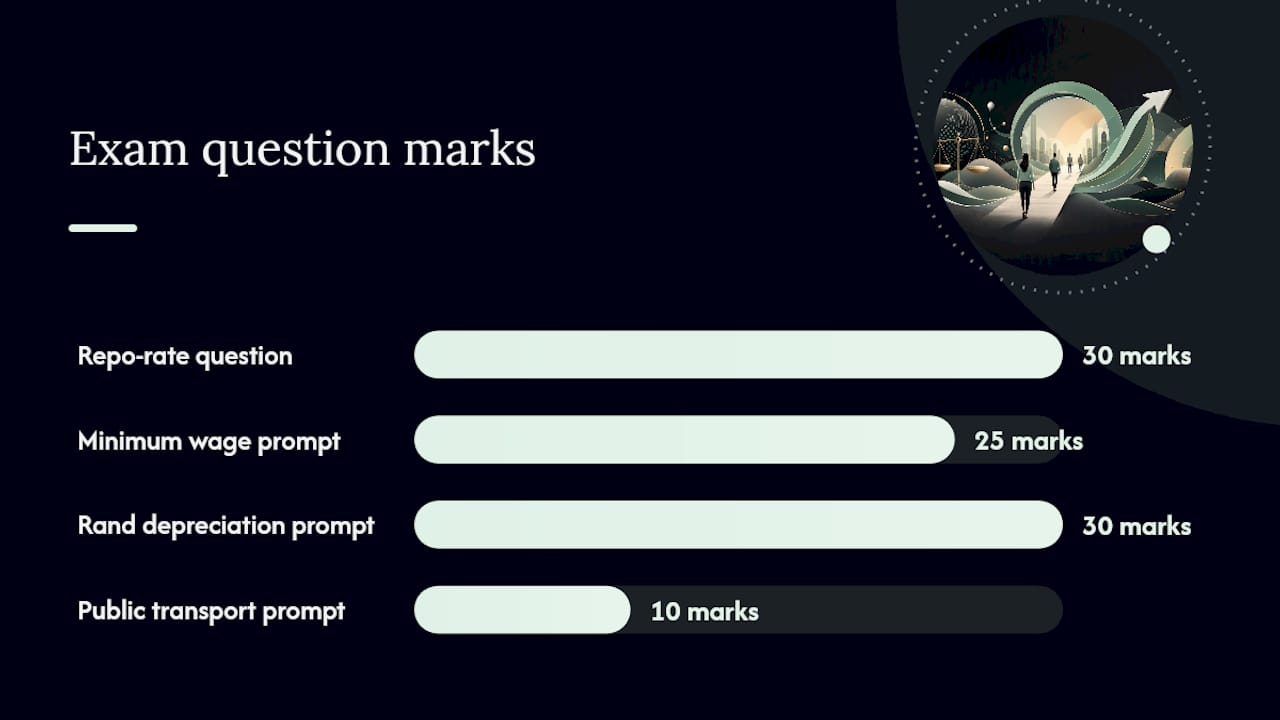
Sample question (30 marks): “Evaluate the likely effects of a decrease in the repo rate on the South African economy.”
5-minute plan:
- Define: repo rate, monetary policy, aggregate demand
- Thesis: A repo rate cut stimulates demand and investment, but the effect is constrained by structural factors such as high unemployment and load-shedding.
- Para 1: Lower borrowing costs → increased investment and consumer spending → AD shifts right → higher output and employment (draw AD/AS diagram here)
- Para 2: Evaluate limits — households with high debt may not borrow more; banks may not pass on the full cut; inflation risk if AD rises too fast
- Conclusion: On balance, a repo rate cut is likely to provide a modest stimulus, but structural constraints limit its effectiveness.
Examiner’s note: This plan earns marks because it commits to a thesis before writing, maps each paragraph to a distinct economic mechanism, and builds evaluation into the plan itself rather than leaving it for the conclusion. Markers look for structured reasoning from the first sentence, not a list of facts assembled at the end.
Model paragraph (Para 1):
[Point] A decrease in the repo rate reduces the cost of borrowing across the economy. [Explain] When the South African Reserve Bank lowers the repo rate, commercial banks typically reduce their prime lending rate, making loans cheaper for households and firms. [Apply] This encourages consumer spending on credit and business investment in capital, shifting the aggregate demand curve to the right, as shown in Figure 1. [Evaluate] The size of this effect depends on consumer confidence and the degree to which banks pass on the rate cut; if households are already over-indebted, lower rates may not translate into higher spending. [Link] The repo rate cut therefore stimulates demand in principle, but its real-world impact in South Africa is likely to be moderate rather than transformative.
Practice prompts to try under timed conditions:
- “Discuss the economic effects of a rise in the national minimum wage.” (25 marks, 40 minutes)
- “Evaluate the impact of a depreciation of the rand on South Africa’s current account.” (30 marks, 45 minutes)
- “Explain why a government may choose to subsidise public transport.” (10 marks, 15 minutes)
What actually separates a good essay from a great one
The essays that score in the top band share one quality that has nothing to do with knowing more content: they answer the question in every paragraph, not just in the introduction and conclusion. Most students write a strong opening, drift into description in the body, and then try to rescue the essay with a judgement at the end. Markers see this constantly, and it costs marks at precisely the level where the difference between a B and an A sits.
Evaluation is the lever. Not a sentence tacked onto the end of a paragraph, but a genuine engagement with conditions, magnitude, and time horizon. Ask yourself: does this effect hold in the short run or the long run? Is it large or small? Does it depend on an assumption that may not hold in South Africa’s context? A paragraph that asks and answers those questions, even briefly, reads like analysis. One that does not reads like a textbook summary.
Economy of points matters too. Two paragraphs that each build a complete chain of reasoning, with a real example and a genuine evaluative sentence, will outscore four paragraphs that each stop at explanation. The structure is not a cage; it is a scaffold. Use it to build something that stands on its own.
Practice the structure with real past papers on Papersza
Reading about essay structure is one thing. Writing a timed response and then checking it against an official memo is where the skill actually forms.

Papersza hosts South Africa’s largest free collection of past exam papers and memos, covering DBE, IEB, and provincial papers across grades 3 to 12, with no account required. For economics students, the most direct route is the Grade 12 economics past papers collection, where you can download a question paper, set a timer, write your essay, and then compare your response line by line against the official memo. That comparison is where you spot exactly which marks you are leaving on the table. Grade 11 students can build the same habit using the Grade 11 economics papers. If you are new to the platform, how Papersza works explains the download process in under a minute.
Sources
- How to Write Perfect Economic Essay - Economics Help
- Writing for Economics: Essay writing
- How to Write Distinction-Level Economics Essays - JC Economics
- A Level Economics Essay Structure: Key Techniques
- ECONOMICS
FAQ
How do I structure an economics essay?
Use a three-part structure: an introduction that defines key terms and states your thesis, two or three body paragraphs each following the Point, Explain, Apply, Evaluate, Link sequence, and a conclusion that delivers a conditional judgement. The Economics Network recommends opening each paragraph with a thesis sentence so the argument is clear from the first line.
How do you get an A in economics essays?
Evaluation is the differentiator. Examiners consistently reward essays that integrate evaluation into each paragraph rather than saving it for the conclusion. Two fully developed paragraphs with genuine evaluative reasoning outperform four descriptive ones.
What are good topics for an economics essay?
Commonly tested NSC topics include monetary policy (repo rate and inflation), fiscal policy (government spending and taxation), market failure (externalities, public goods), income inequality (Gini coefficient, redistribution), and international trade (exchange rates, current account). Choose a topic where you can apply at least one diagram and one South African real-world example.
What should an economics essay introduction include?
Define every key term in the question, state the scope of your argument, and give a one-line thesis that directly answers the question. Keep it to one short paragraph. The DBE’s mark-allocation guidance awards marks for a clear, focused introduction, not a lengthy preamble.
Where can I find past economics papers to practise with?
Papersza hosts free DBE, IEB, and provincial economics papers and memos across grades 11 and 12. Download a paper, write under timed conditions, and check your response against the official memo to identify exactly where marks are being lost.