English Paper 1 format: the complete NSC Grade 12 guide

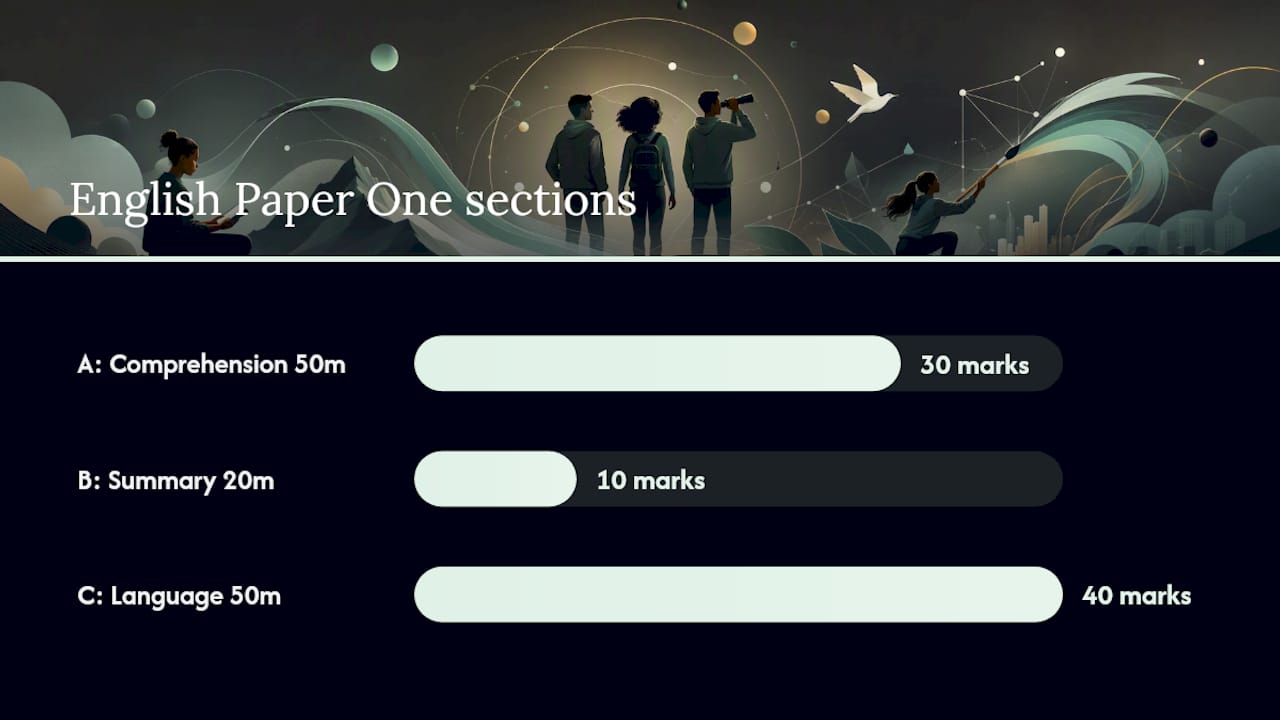
The NSC Grade 12 English Paper 1 is a 2-hour exam worth 80 marks (https://www.education.gov.za/LinkClick.aspx?fileticket=ZJZsyNpCu9Y%3D&mid=13691&portalid=0&tabid=5193), split across three sections: Section A (Comprehension, 30 marks), Section B (Summary, 10 marks), and Section C (Language Structures and Conventions, 40 marks). Know that structure cold before you sit down to write.
Here is how the time breaks down, based on the DBE sample paper:
- Section A — Comprehension: about fifty minutes
- Section B — Summary: about twenty minutes
- Section C — Language Structures and Conventions: about fifty minutes
Those allocations are not suggestions to ignore. Students who drift over time in Section A routinely run out of enough time for Section C, which carries the most marks. Practise to the clock from day one.
Key takeaways
The NSC Grade 12 English Paper 1 is marked out of 80 over a 2-hour period, with Section C carrying the most weight. Targeted timed practice with official memos produces faster improvement than unfocused revision.
| Point | Details |
|---|---|
| Paper structure | 80 marks, 2 hours: Section A (30), Section B (10), Section C (40). |
| Time allocation | DBE suggests 50 minutes for Section A, 20 for Section B, 50 for Section C. |
| Formatting rules | Start each section on a new page, number answers correctly, and leave a line after each answer. |
| Examiner priorities | Reward direct answers, embedded evidence, and technical accuracy in full-sentence responses. |
| Papersza for practice | Free Grade 12 English past papers and memos, organised by year, available without registration. |
Table of Contents
- What does the English Paper 1 format cover in each section?
- What formatting rules must you follow in the exam?
- What do examiners actually reward?
- How should you manage your 2 hours on exam day?
- Step-by-step methods for each question type
- How to practise effectively with past papers and memos
- How to read and annotate an unseen text in comprehension
- What language conventions does the NSC Paper 1 test?
- How to use quotations effectively in your answers
- How to improve your summary writing before the exam
- Common mistakes to avoid in each section
- Find Grade 12 English Paper 1 past papers on Papersza
- Sources
- FAQ
What does the English Paper 1 format cover in each section?
The three sections test different skills, and the mark split tells you exactly where to invest your preparation time.
| Section | Focus | Marks | Suggested Time |
|---|---|---|---|
| A: Comprehension | Reading and responding to unseen texts | 30 | 50 minutes |
| B: Summary | Condensing a text into main ideas | 10 | 20 minutes |
| C: Language Structures and Conventions | Grammar, editing, sentence construction | 40 | 50 minutes |
Section A: Comprehension typically presents one or two unseen texts, which may be literary, informational, or visual. Question formats range from short factual answers and multiple-choice items to paragraph-length responses that require you to interpret, infer, or evaluate. This section carries a significant portion of the total marks.
Section B: Summary asks you to read a passage and condense its main ideas into a specified number of points or lines, using your own words. The mark allocation is modest at 10, but the skill is transferable: the discipline of selecting and paraphrasing under pressure directly supports Section A paragraph answers too.
Section C: Language is the heaviest section covering grammar, punctuation, sentence construction, editing, and language in context. The AQA GCSE Paper 1 overview offers a useful comparison point: that exam also weights reading and writing equally, which confirms that language accuracy is universally treated as a major part of the exam.
Both English FAL and English Home Language Grade 12 papers follow this three-section structure, though the HL paper demands a higher level of language precision and more sophisticated textual analysis. The WCED ePortal publishes supplementary NSC papers for both levels: the English FAL P1 and the English HL P1 for May/June 2025 are CAPS-aligned and worth downloading for extra variety.
What formatting rules must you follow in the exam?
Getting the format right costs nothing and losing marks to avoidable errors is painful. DBE papers carry a standard instruction block that students often skim past:
- Answer ALL questions in all three sections — there is no choice of question in Paper 1.
- Start each section on a NEW page. Sections A, B, and C each begin on a fresh page, full stop.
- Number your answers correctly. Match the question number exactly as it appears in the paper.
- Leave a line after each answer. This is a DBE instruction that appears repeatedly across NSC papers and helps markers distinguish responses.
- Write neatly and legibly. A marker who cannot read your answer cannot award marks for it.
- For multiple-choice questions, write only the letter (A, B, C, or D). Writing out the full answer wastes time and gains nothing.
- For full-sentence answers, write complete, grammatically correct sentences. One-word answers are generally not accepted where a sentence is required.
Spelling matters differently depending on the question type. For one-word answers, a spelling error may be overlooked if the meaning is still clear. For full-sentence answers, NSC marking memos indicate that incorrect spelling that affects the tested language item can be penalised. That distinction is worth remembering when you write Section C answers.
Pro Tip: Before you write a single answer, spend 90 seconds reading the instructions on the cover page. Students who skip this step are the ones who forget to start a new page or write full sentences where letters were required.
What do examiners actually reward?
Markers work from a memorandum that specifies acceptable answers, but the memo also gives them latitude for content-based responses. Three criteria consistently decide marginal marks.
Content and organisation means your answer addresses the question directly and logically. A response that wanders or restates the question without answering it scores poorly regardless of how well it is written. Lead with your point, then support it.
Technical accuracy covers spelling, grammar, and punctuation. In Section C especially, a sentence that demonstrates the correct structure but contains a spelling error in an unrelated word may still earn the mark. A sentence that gets the structure wrong does not. Examiners are testing whether you can apply a specific language rule, not whether your handwriting is neat.
Use of textual evidence is the criterion students most often underestimate. In comprehension paragraph answers, a claim without a quotation or paraphrase from the text is an unsupported claim. Memos typically require evidence to be embedded, not bolted on at the end.
The most common marking pitfalls: not answering the actual question asked, writing a vague opening that delays the point, over-quoting without explanation, and producing sentence fragments in Section C. A clear topic sentence that directly addresses the question, followed by embedded evidence and a brief explanation, is the pattern that earns consistent marks.
How should you manage your 2 hours on exam day?
A rough minute-by-minute plan, aligned to the DBE suggested timings:
- 0–5 min: Read the instructions and skim all three sections to understand what is ahead.
- 5–55 min (50 min): Section A. Read each text carefully, annotate key ideas, then answer questions in order. Do not spend more than 8–10 minutes on any single question worth 3 marks or fewer.
- 55–75 min (20 min): Section B. Read the summary source text, identify the main ideas, and write your condensed response. Stick to the word or line limit.
- 75–115 min (40 min): Section C. Work through language tasks methodically. Sentence construction questions reward precision; do not rush them.
- 115–120 min (5 min): Final review. Check numbering, spacing, and that every question has an answer.
Low-mark questions (1–2 marks) should take 1–2 minutes each. High-mark paragraph questions (4–5 marks) deserve 6–8 minutes of planning and writing. Do not reverse that ratio.
Pro Tip: After finishing Section C, flip back and spend 3 minutes reading your Section A paragraph answers aloud in your head. You will catch sentence fragments and missing punctuation faster than by re-reading silently.
Step-by-step methods for each question type
Comprehension short answers
- Read the question and underline the key instruction word (explain, describe, identify, discuss).
- Locate the relevant section of the text and bracket it lightly in pencil.
- Draft your answer using the text’s own evidence, but reword it into your own sentence structure.
- Check: does your answer directly address what was asked? If not, revise the opening clause.
For multiple-choice questions, eliminate two obviously wrong options first, then choose between the remaining two. Do not change your first answer unless you have a specific reason.
Paragraph-style comprehension answers
Use a short PEEL structure: Point (your direct answer to the question), Evidence (a brief quotation or paraphrase from the text), Explanation (what the evidence shows), Link (a closing sentence that ties back to the question). Four sentences is usually enough for a 4-mark answer. The LitLearn IB Paper 1 guide recommends building body paragraphs around patterns in the text, which translates well to NSC comprehension: identify the writer’s technique, quote it, and explain its effect.
Summary writing
- Read the source text once for overall meaning, then again to identify the main ideas only.
- Number each main idea as you find it in the text.
- Paraphrase each point in one clear sentence. Copy no more than a few keywords verbatim.
- Count your words or lines before submitting. Going over the limit can cost marks.
Language tasks (Section C)
- For editing questions, read the sentence as a whole before identifying the error type (tense, agreement, punctuation, spelling).
- Write the corrected version in full, not just the corrected word in isolation, unless the question specifies otherwise.
- For sentence construction, check subject-verb agreement and tense consistency before moving on.
Pro Tip: Keep a short error log as you practise past papers. Write down every language mistake you make and the rule it broke. After four or five papers, patterns emerge. Drill those specific rules until they stop appearing.
How to practise effectively with past papers and memos
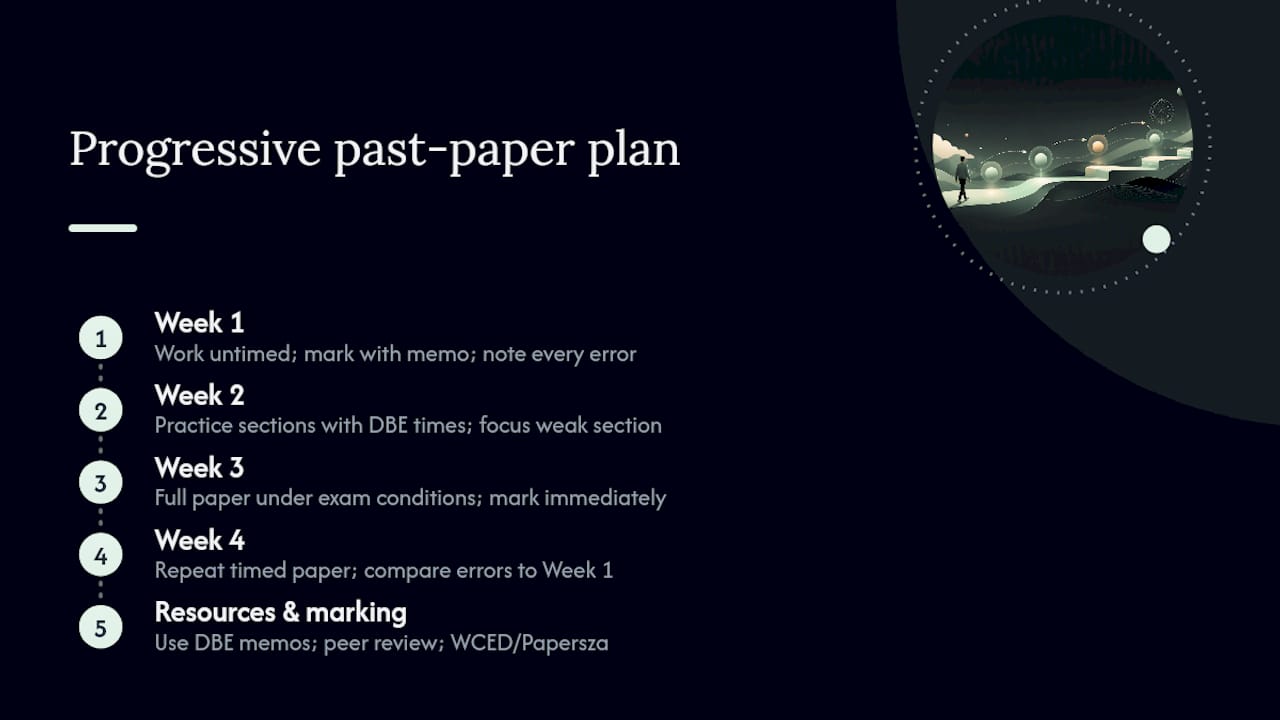
Passive re-reading of notes produces slow improvement. Timed practice against official papers, followed by self-marking with the memo, produces faster gains. A four-week plan that builds progressively:
Week 1: Download a past paper and work through one section at a time without a timer. After each section, mark your answers against the memo and note every error.
Week 2: Practise individual sections under the DBE suggested time (50/20/50 minutes). Focus on the section where your Week 1 errors were most frequent.
Week 3: Complete a full paper under exam conditions: 2 hours, no interruptions, no notes. Mark it with the memo immediately afterward.
Week 4: Repeat a full timed paper, then compare your error log from Week 1 to your current errors. The gap tells you what has improved and what still needs drilling.
The WCED ePortal publishes CAPS-aligned supplementary papers that give you extra unseen texts beyond the standard DBE November series. Using official DBE memos when self-marking helps you internalise exactly what examiners accept, including where minor language slips are penalised. Peer review adds a layer of objectivity: swap papers with a classmate and mark each other’s work against the memo before comparing notes.
Papersza hosts Grade 12 English past papers and memos organised by year and exam session, making it straightforward to find a specific paper and its corresponding memo without searching across multiple government portals.
How to read and annotate an unseen text in comprehension
The comprehension section tests how well you read under pressure, not just how much you know. A structured annotation habit makes the difference between a student who finds the answer quickly and one who re-reads the passage three times.
Read the questions before you read the text. This sounds counterintuitive, but knowing what you are looking for means you annotate purposefully rather than highlighting everything. As you read the text, bracket the sections that answer specific questions, underline key words that signal the writer’s attitude or purpose, and note the text type (informational, persuasive, narrative) in the margin.
For visual texts or advertisements, look at layout, colour references in the caption, and any slogan or tagline. These are often the source of inference questions. The RevisionDojo IB Paper 1 guide recommends spending 10–15 minutes on reading and annotation before writing a single answer, and circling dominant patterns or techniques. That ratio holds for NSC comprehension too: annotation time is not wasted time.
What language conventions does the NSC Paper 1 test?
Section C is where students either consolidate or lose marks through carelessness. The NSC CAPS curriculum specifies a set of language conventions that appear consistently across DBE papers:
Tense consistency is tested in editing and sentence construction tasks. A passage with a deliberate tense error requires you to identify and correct it, not just flag that something is wrong.
Subject-verb agreement appears in both editing and standalone sentence tasks. Collective nouns, indefinite pronouns, and compound subjects are the most common traps.
Punctuation in NSC Paper 1 includes comma use, apostrophes (possession vs. contraction), and direct speech punctuation. These are not advanced concepts, but students lose marks by applying rules inconsistently under time pressure.
Sentence types and construction tasks may ask you to combine two sentences, rewrite in the passive voice, or transform a direct quotation into reported speech. Each of these has a fixed grammatical rule. Practise the transformation types that appear most frequently in past papers.
The NSC also tests language in context: understanding how word choice, tone, and register function in a specific text. These questions appear in Section A but draw on the same language awareness that Section C tests directly.
How to use quotations effectively in your answers
A quotation that sits alone in an answer, unintroduced and unexplained, earns nothing beyond acknowledging the text exists. Effective quotation use follows three steps every time.
Introduce it. Name what the writer does before you quote: “The writer uses a rhetorical question to challenge the reader…” or “The narrator reveals the character’s anxiety when she says…”
Embed it. Short quotations (fewer than a line) should sit inside your own sentence, not stand alone. “The phrase ‘hollow and cold’ suggests the character’s emotional detachment” is stronger than quoting the phrase on its own line.
Explain it. After the quotation, say what it shows, proves, or suggests in relation to the question. This is the step most students skip, and it is the step that separates a 2-mark answer from a 4-mark one.
For longer quotations, use a colon to introduce them and indent if required by your school’s format. In NSC Paper 1, most comprehension answers require short embedded quotations rather than extended block quotes.
How to improve your summary writing before the exam
Summary is the section students most often underprepare because 10 marks feels small. But the skill of selecting and paraphrasing main ideas under a word limit is one of the cleaner marks available in the paper, and it is entirely learnable.
The core discipline is selectivity. Examiners want main ideas, not supporting examples or illustrative detail. Read the source text and ask: “If I had to explain this text’s argument in five sentences to someone who had not read it, what would I say?” Those five sentences are your summary.
Paraphrasing means rewriting the idea in your own words without changing its meaning. Copying the text’s phrasing verbatim, beyond a few necessary keywords, signals that you have not processed the content. A useful technique: cover the source text after reading a paragraph, then write the main idea from memory. What you write naturally is usually a paraphrase.
Brevity is a marking criterion in itself. If the task asks for eight points in eight lines, writing twelve lines does not earn bonus marks. It signals poor editing judgment. Count before you submit.
Common mistakes to avoid in each section
Section A (Comprehension)
- Answering a different question from the one asked. Re-read the question after writing your answer.
- Writing “I think” or “I feel” in analytical answers. The question asks about the text, not your opinion.
- Quoting without explaining what the quotation shows.
Section B (Summary)
- Including examples and illustrations rather than main ideas.
- Exceeding the word or line limit.
- Copying sentences verbatim instead of paraphrasing.
Section C (Language)
- Correcting only part of an error (fixing the verb but leaving the tense inconsistency in the same sentence).
- Writing only the corrected word rather than the full corrected sentence when a full sentence is required.
- Confusing similar transformation types (passive voice vs. reported speech).
Across all sections: not numbering answers correctly, failing to start each section on a new page, and leaving questions unanswered. An unanswered question scores zero; a partially correct answer often scores something.
A realistic perspective on Paper 1 preparation
Most students who struggle with Paper 1 are not struggling because they lack intelligence. They are struggling because they practise without feedback. Reading a past paper and checking your answers against the memo is not the same as reading a past paper and hoping you got it right. The memo tells you exactly what the examiner accepted and why. Use it every single time.
Improvement in Paper 1 is measurable and relatively fast when practice is targeted. Three timed papers with careful memo self-marking will show you more about your weak points than three weeks of unfocused revision. Focus on the section where you lose the most marks, drill the specific error types that keep appearing, and trust that the pattern recognition builds with repetition.
The students who improve most between their first practice paper and their final exam are not the ones who studied the hardest in general. They are the ones who studied the right things specifically.
Find Grade 12 English Paper 1 past papers on Papersza
Papersza is South Africa’s largest independent past-paper library, with over 8,315 documents spanning grades 3 to 12. For Paper 1 preparation, the most direct route is the Grade 12 English past papers and memos page, where papers are organised by year and exam session so you can match a question paper to its memo without hunting across multiple sites. No account or registration is needed.
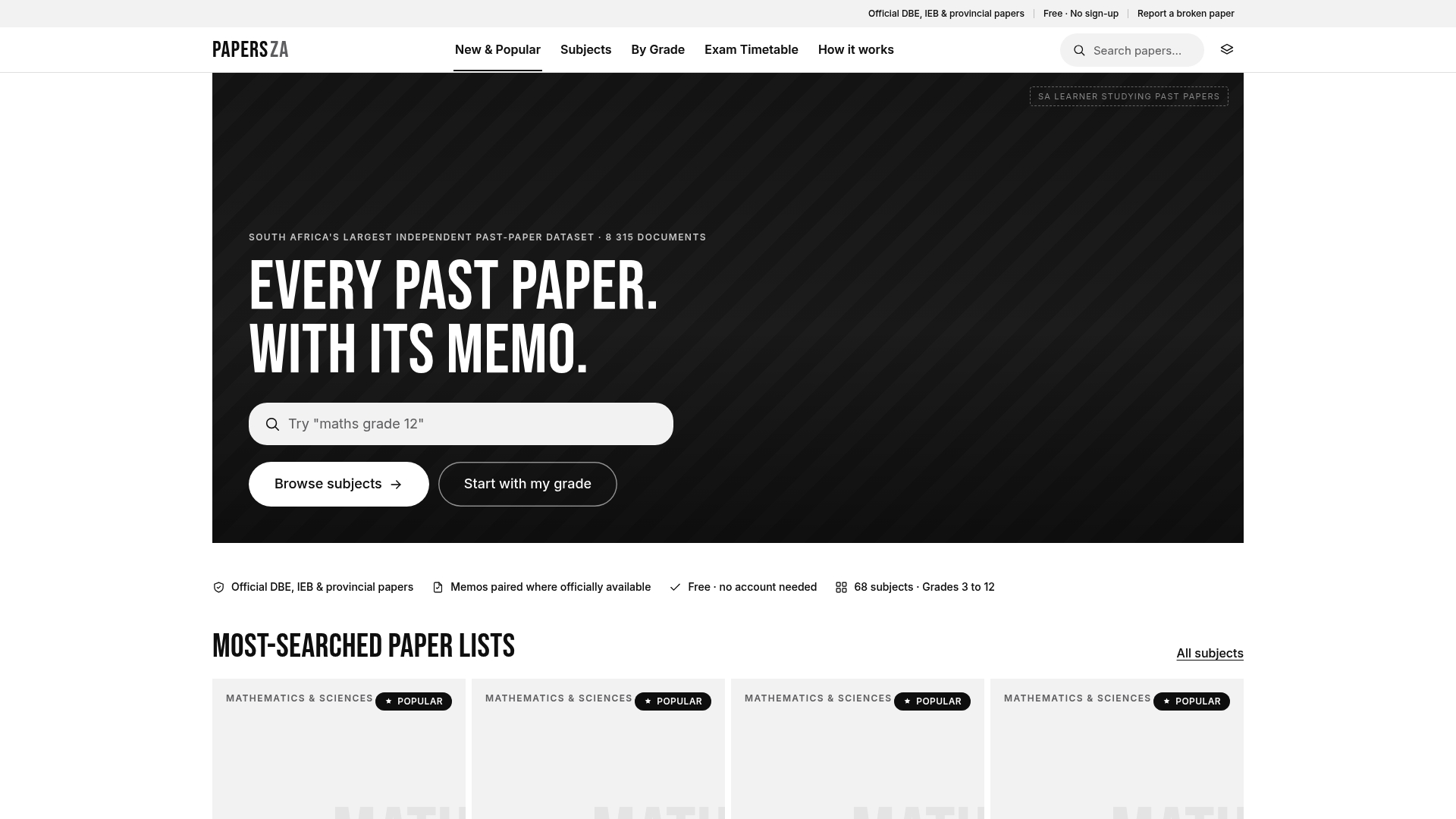
FAL learners can go straight to the English FAL Grade 12 archive, while HL learners have their own dedicated section. Every paper comes with the corresponding memo, which is the tool that turns a practice session into genuine feedback. Download a past Paper 1, set a 2-hour timer, write under exam conditions, then mark against the memo line by line. That single habit, repeated across four or five papers, is the most effective preparation available.
Sources
- English First Additional Language/P1 | DBE November 2024 (sample paper)
- NSC May/June 2025: ENGLISH FAL P1 | WCED ePortal
FAQ
What is the structure of English Paper 1 in the NSC?
The NSC English Paper 1 has three sections: Section A (Comprehension, 30 marks), Section B (Summary, 10 marks), and Section C (Language Structures and Conventions, 40 marks), totalling 80 marks in 2 hours.
How do I write a strong comprehension answer?
Lead with a direct point that answers the question, embed a short quotation from the text, and explain what the quotation shows. Avoid starting with “I think” and never quote without explaining.
What does English Paper 1 include in Section C?
Section C tests grammar, punctuation, sentence construction, editing, and language in context. Common tasks include correcting errors, transforming sentences, and identifying language features in a given passage.
How do I prepare for Paper 1 in English?
Practise full past papers under timed conditions (2 hours), then self-mark against the official DBE memo. Papersza provides free Grade 12 English papers and memos organised by year, making it straightforward to run realistic practice sessions.
Do past papers actually help for English Paper 1?
Yes. Repeated timed practice with memo self-marking builds familiarity with question types, trains your time management, and reveals recurring errors in language accuracy that unfocused revision misses.