English Paper 2 format: a guide for South African learners
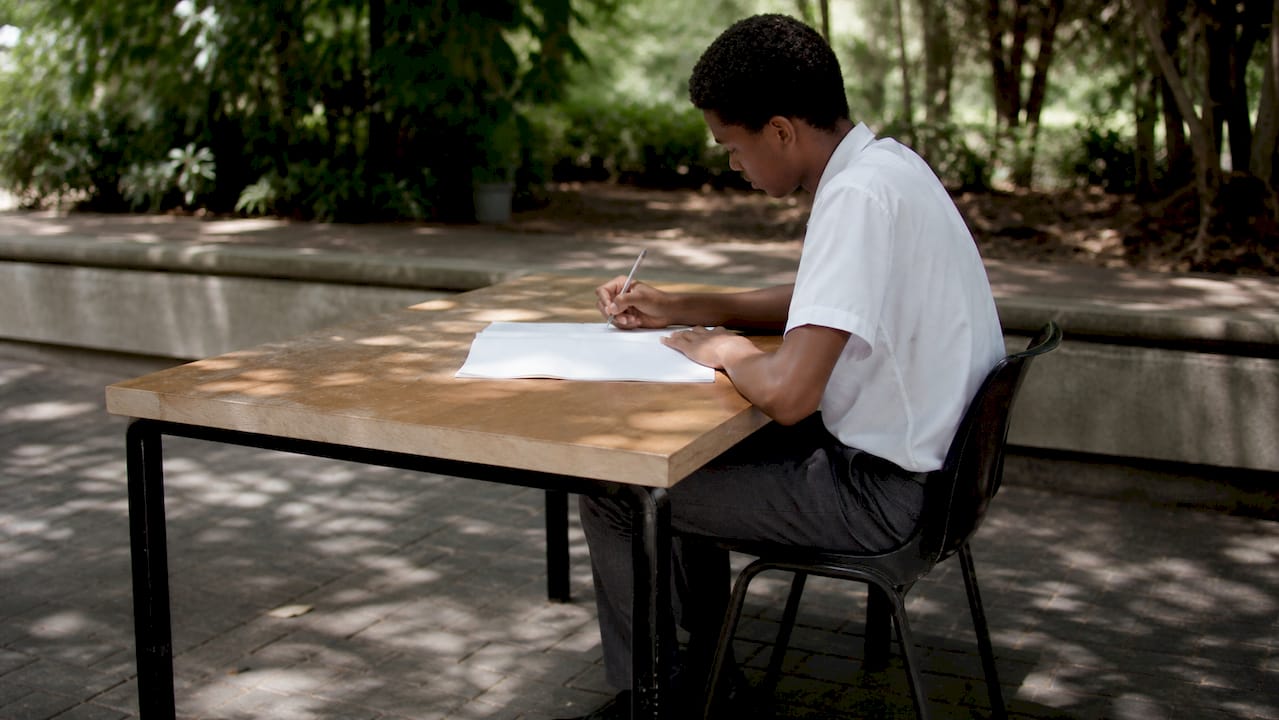
English Paper 2 is the two-hour writing paper split into two sections: directed/transactional writing and a composition. Each section carries equal weight.
Here is what you need to know at a glance:
- Section A (Directed/Transactional Writing): approximately 250–350 words, 25 marks. You respond to a stimulus text in a specific format (speech, letter, article, or report).
- Section B (Composition): approximately 350–450 words, 25 marks. You choose from several prompts and write a descriptive, narrative, or argumentative piece.
- Total: 50 marks, 2 hours.
Whether you follow the DBE curriculum, write under the IEB, or attend a school using the Cambridge IGCSE syllabus, the core English Paper 2 format holds: write well, write to the task, and manage your time.
Key takeaways
English Paper 2 is a two-hour, 50-mark writing paper with two equal sections: directed/transactional writing (Section A) and composition (Section B), each worth 25 marks.
| Point | Details |
|---|---|
| Paper 2 structure | Two sections: Section A (directed writing) and Section B (composition), 25 marks each. |
| Word counts | Section A: 250–350 words; Section B: 350–450 words. Stick to the range. |
| Marking criteria | Content, organisation, register, and accuracy are the four criteria across DBE, IEB, and Cambridge papers. |
| Time management | Allocate 55 minutes per section; use the first 10 minutes to read and plan both answers. |
| Practice method | Write timed past papers, then mark against the memo focusing on band descriptors. |
| Papersza | Free DBE, IEB, and provincial English past papers and memos at papersza.co.za, no account needed. |
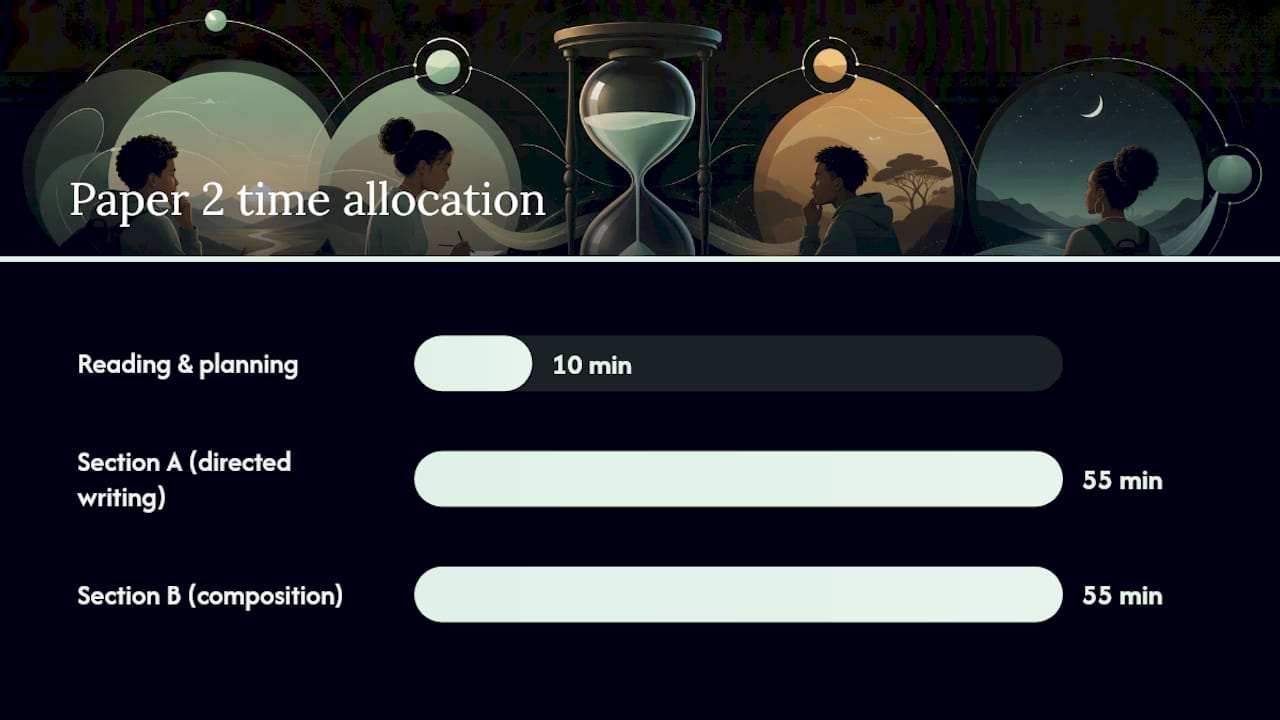
Table of Contents
- What does the English Paper 2 format actually contain?
- What examiners actually look for when marking Paper 2
- How to structure your Paper 2 answers step by step
- How to manage your two hours on exam day
- Where to practise using South African past papers and memos
- What markers wish every student knew
- Papersza gives you the past papers and memos you need, free
- Sources
- FAQ
What does the English Paper 2 format actually contain?
The Cambridge International syllabus (2024–2026) sets out the structure clearly: Paper 2 is a written paper, around two hours, 50 marks total. Section A tests directed writing with a specified word range and Section B tests composition with a specified word range. The CIE IGCSE Paper 2 overview confirms the same structure: Question 1 in Section A is compulsory and based on one or more reading texts; Section B offers a choice of four composition prompts.
Section A: directed/transactional writing
You read a stimulus (a passage, set of notes, or short article) and produce a response in a specific format. Common formats include:
- A formal letter (to a principal, editor, or organisation)
- A speech (to a school assembly or community meeting)
- A report (for a committee or school body)
- A newspaper or magazine article
The word count is 250–350 words. Going significantly under or over wastes marks and time. A sample prompt: “Using the information in the passage, write a speech to your school assembly arguing for or against the proposed changes to the tuck shop.”
Section A is a hybrid task. The Cambridge syllabus notes that directed writing assesses both reading objectives (selecting and using information from the stimulus) and writing objectives (register, organisation, accuracy). You are being marked on how well you read AND how well you write.

Section B: composition
Section B gives you a choice, typically four prompts. You pick one and write 350–450 words. Prompt types include:
- Descriptive: describe a place, person, or moment using sensory detail.
- Narrative: tell a story with a clear arc (beginning, conflict, resolution).
- Argumentative/discursive: argue a position on a given topic.
A sample descriptive prompt: “Describe the scene at a busy taxi rank early on a Monday morning.” A sample narrative prompt: “Write a story that begins with the words: ‘She had not expected to find the door open.’”
The Cambridge English B2 First format uses a similar two-part structure where Part 1 is compulsory and Part 2 offers choice, showing that fixed word ranges and task selection are standard across major English exams. Sticking to the word range keeps your answer focused and leaves time for proofreading.
Pro Tip: In Section A, weave specific details from the stimulus into your response rather than copying sentences verbatim. Markers reward selective use of evidence, not transcription.
What examiners actually look for when marking Paper 2
Markers work from a set of assessment criteria. Across DBE, IEB, and Cambridge-aligned papers, the core categories are consistent:
The four criteria you must satisfy:
- Content and relevance: Does your answer address the prompt? Have you used the stimulus (Section A) or developed your own ideas (Section B) appropriately?
- Organisation and cohesion: Is the writing logically structured with clear paragraphs, a recognisable opening, and a conclusion?
- Language and register: Is the tone appropriate for the audience and purpose? A formal letter to a principal reads differently from a speech to peers.
- Accuracy: Grammar, spelling, punctuation, and sentence construction.
The IBO English A: Literature Paper 2 guidance reinforces this: marker guidance emphasises directly addressing the given question above all else. The AP English Language exam similarly structures its free-response section around synthesis, rhetorical analysis, and argument — the same skills Paper 2 tests, just under different names.
Proofreading checklist (use in the last 5 minutes):
- Does every paragraph have a clear topic sentence?
- Is the register consistent throughout (formal stays formal)?
- Have you checked for subject-verb agreement errors?
- Are all proper nouns capitalised?
- Does the conclusion actually conclude, rather than just stop?
How to structure your Paper 2 answers step by step
Argumentative/directed response (Section A)
- Opening paragraph: State your purpose and position in 2–3 sentences. If writing a speech, open with a direct address (“Good morning, learners and staff…”).
- Body paragraph 1: Make your first point and support it with a specific detail from the stimulus.
- Body paragraph 2: Make your second point, again grounded in the stimulus. Use a linking phrase (“A further concern raised in the passage is…”).
- Body paragraph 3: Address a counterargument briefly, then refute it.
- Conclusion: One short paragraph that restates your position and ends with a call to action or memorable closing line.
PEEL paragraph example (Section A): Point: The tuck shop changes will reduce learner nutrition.
Explanation: Learners who rely on school meals for their main midday nutrition will be directly affected. Link: This is why the proposed policy requires urgent review.
Descriptive composition (Section B)
- Opening image: Drop the reader into a specific sensory moment. No backstory.
- Paragraph 2: Expand the scene using sound, smell, and texture.
- Paragraph 3: Introduce a human element or shift in atmosphere.
- Closing paragraph: Return to the opening image with a small but meaningful change.
Narrative composition (Section B)
- Hook: Start mid-action or with a line of dialogue.
- Rising action: Build tension through one clear conflict.
- Climax: The moment of highest tension or decision.
- Resolution and reflection: Brief, not over-explained.
Word-count distribution: for a 350-word narrative, aim for roughly 50 words on the hook, 150 on rising action, 80 on the climax, and 70 on resolution. For a 450-word descriptive piece, spread sensory detail evenly across three body paragraphs of about 120 words each, with a 60-word opening and 30-word close.
Pro Tip: Write your conclusion before you write your body paragraphs. Knowing where you are going prevents the most common Paper 2 failure: an answer that runs out of ideas halfway through.
How to manage your two hours on exam day
Time is the variable most students mismanage. Here is a practical split for a two-hour paper:
- Minutes 1–10: Read both sections. Read the Section A stimulus carefully. Choose your Section B prompt before you start writing anything.
- Minutes 11–65: Write Section A (55 minutes). Spend the first 5 of those minutes planning: jot down your format, audience, and three main points.
- Minutes 66–115: Write Section B (50 minutes). Spend 5 minutes on a brief outline.
- Minutes 116–120: Proofread both answers. Check register, paragraphing, and obvious spelling errors.
The most common time-wasting behaviours:
- Rewriting the introduction three times because it does not “sound right.”
- Spending 70 minutes on Section A and rushing Section B, which carries the same marks.
- Ignoring the word count and writing 500 words for a 350-word task.
Pro Tip: Write in pen from the start. Crossing out neatly is faster than erasing, and markers do not penalise a crossed-out line. Drafting in pencil first costs you 10–15 minutes you cannot afford.
Where to practise using South African past papers and memos
Timed practice with real past papers is the single most effective preparation strategy. The CIE IGCSE revision guidance is explicit: use memos to learn examiner wording and band descriptors, not just to check whether you got the answer right.
Recommended practice routine:
- Download a past paper from Papersza’s English Grade 12 page or the DBE/IEB official sites.
- Set a timer for exactly two hours. No phone, no notes.
- Write both sections under exam conditions.
- Mark your own work against the memo. Focus on the band descriptors, not just the model answer.
- Rewrite your weakest paragraph using the memo’s language as a guide.
- Repeat with a different paper the following week.
Memos are a teaching tool. Use them to identify the phrases examiners reward (“well-organised response,” “appropriate register maintained throughout”) and build those habits into your own writing. Copying a memo answer verbatim into an exam is academic dishonesty and will not help you anyway, since prompts change.
Practice milestones to hit before your exam:
- Complete your first full timed draft at least four weeks before the exam.
- Do at least two marked revisions of Section A answers using memo feedback.
- Memorise one structural template each for argumentative, descriptive, and narrative writing.
Papersza hosts English Grade 10 past papers as well, which are useful for building skills progressively before tackling Grade 12 difficulty. The HKDSE English Language sample materials offer a useful comparison: their Paper 2 splits tasks by percentage weighting, reinforcing why understanding mark allocation per section shapes how much time and effort you invest in each.
What markers wish every student knew
The scripts that score in the top band share one quality: they answer the question that was asked, not the question the student wished had been asked. That sounds obvious. In practice, under exam pressure, students drift. They write a beautiful descriptive paragraph in a formal letter. They argue a position the stimulus does not support. They use casual language in a report addressed to a school board.
Register is the fastest mark to lose and the easiest to protect. Before you write a single sentence in Section A, write these three words at the top of your planning space: audience, purpose, format. Then check every paragraph against them.
The other pattern worth noting: students who practise with memos consistently outperform those who only practise writing. Seeing how a marker phrases a band descriptor changes how you write. It is not about memorising model answers. It is about understanding what “well-organised” or “appropriate register” looks like in practice, so you can produce it deliberately rather than accidentally.
Papersza gives you the past papers and memos you need, free
The fastest way to improve your Paper 2 score is to write more Paper 2 answers and mark them against real memos. Papersza makes that straightforward: over 8,315 past exam documents, free to download, no account required. DBE, IEB, and provincial papers are all there, organised by subject, grade, and exam session.
Start with the English Grade 12 past papers and memos on Papersza. Download the question paper, set your timer, write under exam conditions, then open the memo and mark yourself honestly. That one routine, repeated consistently, closes the gap between knowing the format and performing in it. If you are still building your skills, the English Grade 10 collection is a solid starting point. No login, no cost, no friction.
Sources
- Cambridge International syllabus (2024–2026)
- IBO: English A literature – Paper 2 (specimen and guidance)
- Cambridge English: B2 First (format and writing guidance)
- AP Central: AP English Language and Composition exam (format overview)
- HKEAA: HKDSE English Language subject information (sample weightings)
FAQ
What does English Paper 2 look like?
English Paper 2 is a two-hour written exam with two sections: Section A (directed/transactional writing, 250–350 words, 25 marks) and Section B (composition, 350–450 words, 25 marks), totalling 50 marks.
What is usually in English Paper 2?
Section A gives you a stimulus text and asks you to respond in a specific format such as a letter, speech, or report. Section B offers a choice of composition prompts covering descriptive, narrative, and argumentative writing.
What topics are in English Paper 2?
Paper 2 does not test set literary texts. It tests writing skills: transactional formats (letters, speeches, reports) in Section A and creative or argumentative composition in Section B, assessed on content, organisation, register, and accuracy.
How do I structure a Paper 2 essay?
For Section A, use a clear opening that states your purpose, three focused body paragraphs that draw on the stimulus, and a concise conclusion. For Section B compositions, plan a hook, a logical middle with one clear conflict or focus, and a brief resolution or closing image before you write a single sentence.