Exam stress management for South African students: past papers

The most direct way to cut exam stress is to remove the unknowns. Use official DBE, IEB, or provincial past papers in a staged loop: attempt untimed first, then timed sections, then full timed mocks. After each attempt, mark strictly with the official memo, log every missed mark, rewrite your ideal answer in your own words, and re-test that subtopic. That cycle, repeated consistently, converts anxiety into preparation.
Start today in four steps:
- Select your subject, grade, and the most recent available paper.
- Attempt it untimed, focusing on understanding rather than speed.
- Mark it against the official memo and record every error in a dedicated log.
- Rewrite any missed answer in your own words before moving to the next paper.
The core principle: Exam anxiety is mostly uncertainty. Past papers and memos make the exam format, command words, and examiner expectations predictable. Predictability is the antidote.
Table of Contents
- Why does practising with past papers reduce exam anxiety?
- When should you start using past papers?
- How to run a single past-paper practice session
- How to use marking memos without memorising them
- How split timing builds stamina without spiking anxiety
- A reproducible 6–8 week practice plan
- What mistakes do students make with past papers?
- How Papersza supports the practice-first method
- Key takeaways
- The discipline nobody talks about
- Papersza: where to start your first practice session
- Useful sources
- FAQ
Why does practising with past papers reduce exam anxiety?
Familiarity removes fear. When you have seen the paper layout, read the command words, and understood what the examiner rewards, the exam hall holds far fewer surprises. That reduction in the unexpected is what cuts the stress response.
Formative practice using official past papers and memos identifies knowledge gaps and helps students allocate time correctly, which directly reduces performance anxiety. The mechanism is straightforward: you are not just rehearsing answers, you are learning what the examiner considers a complete response.
Past-paper practice also teaches command words such as discuss, evaluate, and analyse, each of which signals a specific type of answer. Students who misread command words lose marks not because they lack knowledge but because they answered the wrong question. Recognising those words in advance closes that gap.
Cambridge Assessment’s distinction matters here: there is a difference between training (optimising for discrete test tasks) and genuine education (building transferable knowledge). Students who only memorise memo phrasing are training, not learning. The goal is to use past papers to build real understanding, with the memo as a feedback tool, not a script.
When should you start using past papers?
Start several weeks before your assessments, not the week before. Students who begin incorporating past papers into revision early and move gradually from untimed to timed conditions consistently outperform those who attempt full mocks cold.
| Stage | Timing | Focus |
|---|---|---|
| Early (Weeks 1–2) | 6–8 weeks before exams | Untimed, topic-by-topic questions |
| Mid (Weeks 3–5) | Weeks 3 to 5 before exams | Timed individual sections |
| Final (Weeks 6–8) | Final two weeks before exams | Full timed mock papers |
Progression rules:
- Do not move to timed practice until you can answer untimed questions with reasonable accuracy.
- Introduce one timed section per session before combining sections.
- Reserve at least two unseen full papers for final-week mocks.
- Limit full mocks to two or three per week to avoid fatigue.
How to run a single past-paper practice session
The mark-and-refine loop matters more than the score. A student who attempts one paper carefully, marks it thoroughly, and rewrites missed answers learns more than one who rushes through five papers and only counts totals.
Session steps:
- Choose the paper. Select the most recent available paper for your subject and grade.
- Attempt it. Untimed in early weeks; timed once you are in the mid-stage.
- Mark strictly. Use the official memo. Award marks only where the memo awards them.
- Log every error. Record the question, the mark lost, and the reason (missing keyword, wrong structure, misread command word).
- Rewrite the answer. In your own words, not the memo’s phrasing.
- Re-test. Return to that subtopic within 48 hours using a question from a different year.
Pro Tip: When marking, cover your original answer first. Read the memo, identify what a full-mark response requires, then uncover your answer and mark it honestly. Students who mark their own work with the answer visible consistently overestimate their score.

How to use marking memos without memorising them
Memos are feedback tools. They show you what the examiner expected, not what you should copy word for word.
The trap: Students who memorise memo phrasing can reproduce a correct-sounding answer without understanding the underlying concept. When the question is rephrased even slightly, that answer fails. Overfitting to memo phrasing can harm real mastery — examiners reward understanding, not rehearsed strings.
Use memos this way instead:
- Identify missing marks. Find exactly which point you omitted and why.
- Extract examiner keywords. Note the specific terms the memo uses (e.g., homeostasis, opportunity cost) and learn what they mean, not just how they sound.
- Rewrite in your own words. A rewritten answer that earns the marks without copying the memo’s sentence structure is proof of genuine understanding.
- Avoid single-year overfitting. One year’s paper may use a narrow question angle. Cross-reference with two or three other years to confirm you understand the concept broadly.
How split timing builds stamina without spiking anxiety
Jumping straight to a three-hour mock when you have been studying in 30-minute blocks is a reliable way to produce panic, not performance. Build duration incrementally.
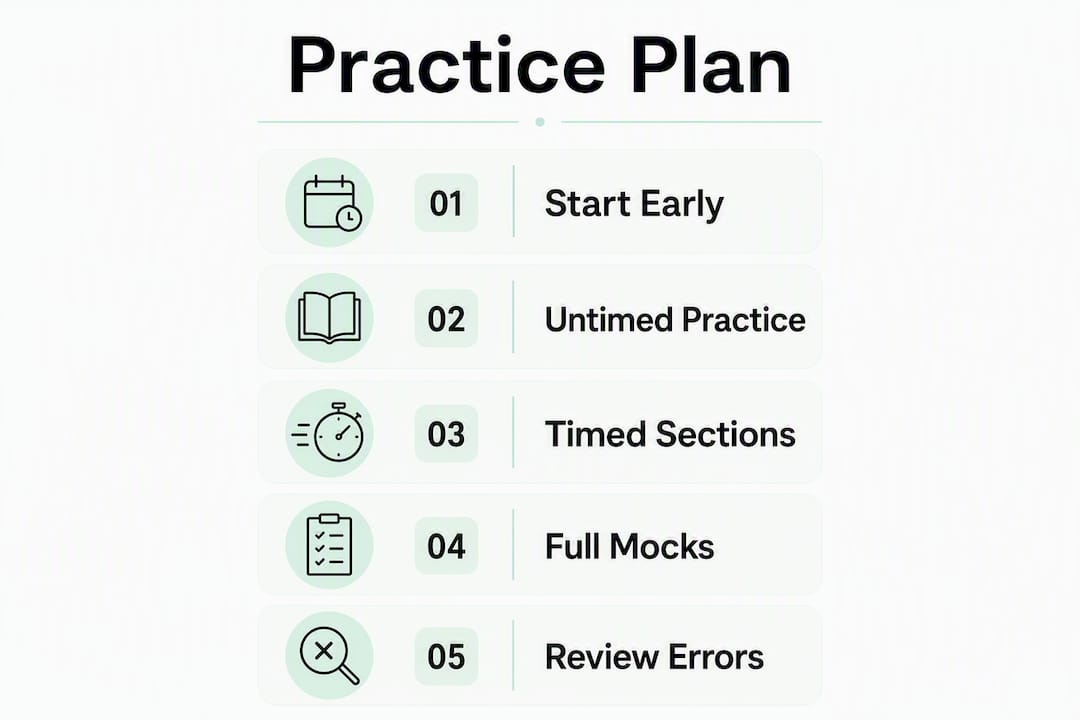
Timed practice improves time management in the exam hall and teaches realistic pacing, but only when the increase in duration is gradual. The timed practice tests approach works best when you treat each block as its own complete session before combining them.
| Block | Duration | Description |
|---|---|---|
| Single section | 20 min | One paper section, timed to its allocated marks |
| Two sections | 60 min | Two consecutive sections with a short break between |
| Half paper | — | First half of a full paper under exam conditions |
| Full paper | Full exam time | Complete paper, strict conditions, no interruptions |
Watch for mental fatigue signals during practice: faster but sloppier writing, difficulty re-reading your own sentences, or a drop in answer structure. When those appear, stop. Continuing through fatigue cements bad habits rather than building stamina.
A reproducible 6–8 week practice plan
Follow this structure to balance content review, targeted practice, and full mocks. Quality beats quantity: focused review of a few papers with careful marking outperforms rushing through many without analysis.
| Week | Session type | Target | Weekly checkpoint |
|---|---|---|---|
| 1–2 | Untimed topic questions | Cover all major topics | Every topic attempted at least once |
| 3–4 | Timed single sections | Accurate pacing per section | Memo-marked; error log started |
| — | Timed half-papers | Sustained focus for — | Error log reviewed; weak topics re-practised |
| 6 | First full mock | Complete paper, strict conditions | Score recorded; errors logged |
| — | Error-log revision | Re-test all logged subtopics | Logged errors reduced by half |
| 8 | Final full mock | Unseen paper, full conditions | Confidence check before exam |
Weekly checklist for teachers and parents:
- Has the student marked this week’s paper against the official memo?
- Are errors recorded in the log, not just counted?
- Has at least one rewritten answer been completed this week?
- Is the student moving to the next stage, or repeating the same stage without progress?
Pair this plan with spaced repetition between sessions to reinforce subtopics identified in the error log.
What mistakes do students make with past papers?
Most lost gains come from a handful of predictable errors. Spot them early and the practice becomes far more efficient.
The volume trap is the most common: students who do ten papers without careful marking learn less than those who do three papers with a full mark-and-refine loop after each one. More papers is not better practice. Better practice is better practice.
Common pitfalls and fixes:
- Memorising memo phrasing. Fix: rewrite every answer in your own words before moving on.
- Ignoring command words. Fix: underline the command word before writing a single sentence.
- Self-marking generously. Fix: mark with the memo visible but your answer covered.
- Skipping the error log. Fix: no session ends without at least one logged error and a rewritten answer.
- Only using the most recent paper. Fix: use three or more years to avoid overfitting to one question style.
- Simulating nothing. Fix: phone off, timer running, no notes for timed sessions.
Red flag for teachers and parents: if a student’s scores are rising but their error log is empty, they are not marking honestly.
How Papersza supports the practice-first method
Papersza provides the searchable DBE, IEB, and provincial past-paper dataset you need to follow this plan from the first untimed session through to final mocks.
The Papersza library holds a large collection of documents covering grades 3 to 12, organised by subject, grade, year, and exam session. Every paper is paired with its official memo where available. No account or registration is required, and all documents are free to download.
Three steps to start a practice cycle on Papersza:
- Find your paper. Go to your subject and grade page, for example Grade 12 English or Grade 9 English, and select the most recent year.
- Download the memo. Open the matching memo document before you mark anything.
- Run the mark-and-refine loop. Attempt, mark strictly, log errors, rewrite, re-test.
| Reader | Recommended starting page |
|---|---|
| Grade 12 student | Grade 12 subject page (e.g., Life Sciences, Business Studies, English) |
| Grade 9–11 student | Grade 9, 10, or 11 subject page |
| Parent (primary school) | Grade 3 or Grade 6 English page |
| Teacher | Subject page for the grade you teach; download three years of papers and memos |
Key takeaways
The single most effective approach to exam stress management is a staged past-paper practice loop: untimed first, then timed sections, then full mocks, with a strict mark-and-refine cycle after every attempt.
| Point | Details |
|---|---|
| Start early and stage up | Begin untimed 6–8 weeks out; introduce timed sections in weeks 3 to 5; save full mocks for the final two weeks. |
| Mark-and-refine beats volume | Three carefully marked papers with rewritten answers outperform ten papers counted and discarded. |
| Use memos as feedback | Extract examiner keywords and rewrite answers in your own words; never copy memo phrasing. |
| Build stamina with split timing | Progress from single sections to half-papers to full papers; stop when fatigue signals appear. |
| Papersza is your paper source | Over 8,315 free DBE/IEB/provincial papers and memos, grades 3–12, no account needed. |
The discipline nobody talks about
The students who reduce their exam anxiety most effectively are not the ones who study the longest. They are the ones who mark honestly. That is the uncomfortable part of this method: sitting with a memo and admitting you missed a mark you thought you had earned.
Most students skip that discomfort. They count their total, feel roughly okay about it, and move to the next paper. The error log stays blank. The same mistakes recur in the next mock, and the one after that.
The mark-and-refine loop only works if the marking is strict. Teachers can reinforce this by reviewing a student’s error log rather than their score sheet. Parents can ask “what did you rewrite this week?” rather than “how did you do?” Those two shifts in focus change the entire quality of practice.
One practical classroom tip: run a 20-minute group debrief after a timed section where students compare their answers against the memo aloud. The discussion of why a mark was or was not awarded builds examiner-language awareness faster than silent self-marking alone.
Papersza: where to start your first practice session
South Africa’s largest free past-paper library is the practical starting point for every stage of this plan. Papersza holds a substantial number of official DBE, IEB, and provincial documents across grades 3 to 12, all free to download with no registration required.
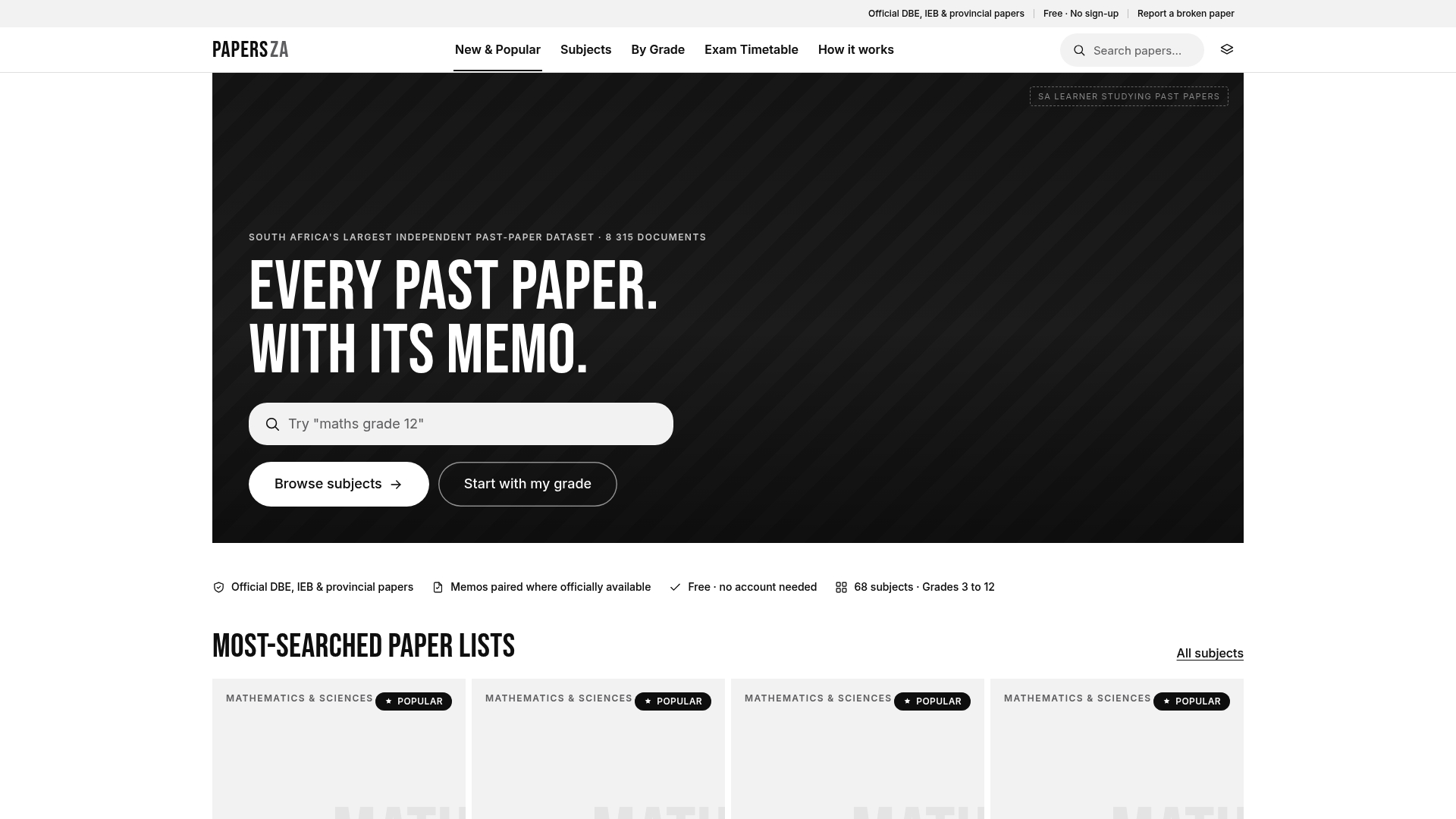
Three quick-start steps: open your subject’s grade page on Papersza, download the most recent paper and its memo, and run your first mark-and-refine session today. Grade 10 students can go directly to the Grade 10 English papers and memos page; Grade 11 learners can start at the Grade 11 English page. Every paper comes with the official memo, so the feedback loop is ready the moment you finish your first attempt.
Useful sources
- NSW Education: stress management and formative practice guidance — supports the formative-assessment rationale and the mark-and-refine loop.
- Cambridge Assessment: are past-paper questions always useful? — training vs. education distinction; caution against rote memo memorisation.
- Save My Exams: how to use past papers effectively — quality-over-quantity principle.
- Papersza: how it works — dataset size, editorial and sourcing policy, free access model.
FAQ
How early should students start using past papers?
Start six to eight weeks before assessments with untimed, topic-based questions, introduce timed sections in weeks 3 to 5, and save full mocks for the final two weeks as competence grows.
What is the mark-and-refine loop?
After attempting a paper, mark it strictly against the official memo, log every missed mark, rewrite the answer in your own words, and re-test that subtopic within 48 hours.
How do you use a memo without just memorising it?
Extract the examiner keywords and understand what they mean, then rewrite the answer in your own phrasing. If you can reproduce the marks without copying the memo’s sentences, you have genuinely learned the concept.
Where can South African students find free past papers and memos?
Papersza hosts over 8,315 official DBE, IEB, and provincial past papers and memos for grades 3 to 12, all free to download with no account required at papersza.co.za.
How many past papers should a student do per week?
Two to three carefully marked papers per week in the mid-to-final stage is more effective than rushing through more without analysis. Reserve at least two unseen full papers for final-week mocks.