Grade 11 promotion requirements: what South African learners need

A Grade 11 learner moves up to Grade 12 by meeting one clear DBE rule: offer and complete at least seven subjects, pass at least six of them, score 40% or higher in three subjects (one of them must be a Home Language), and 30% or higher in three other subjects. Every School-Based Assessment (SBA) and Practical Assessment Task (PAT) also has to be submitted and recorded for the subjects a learner takes.
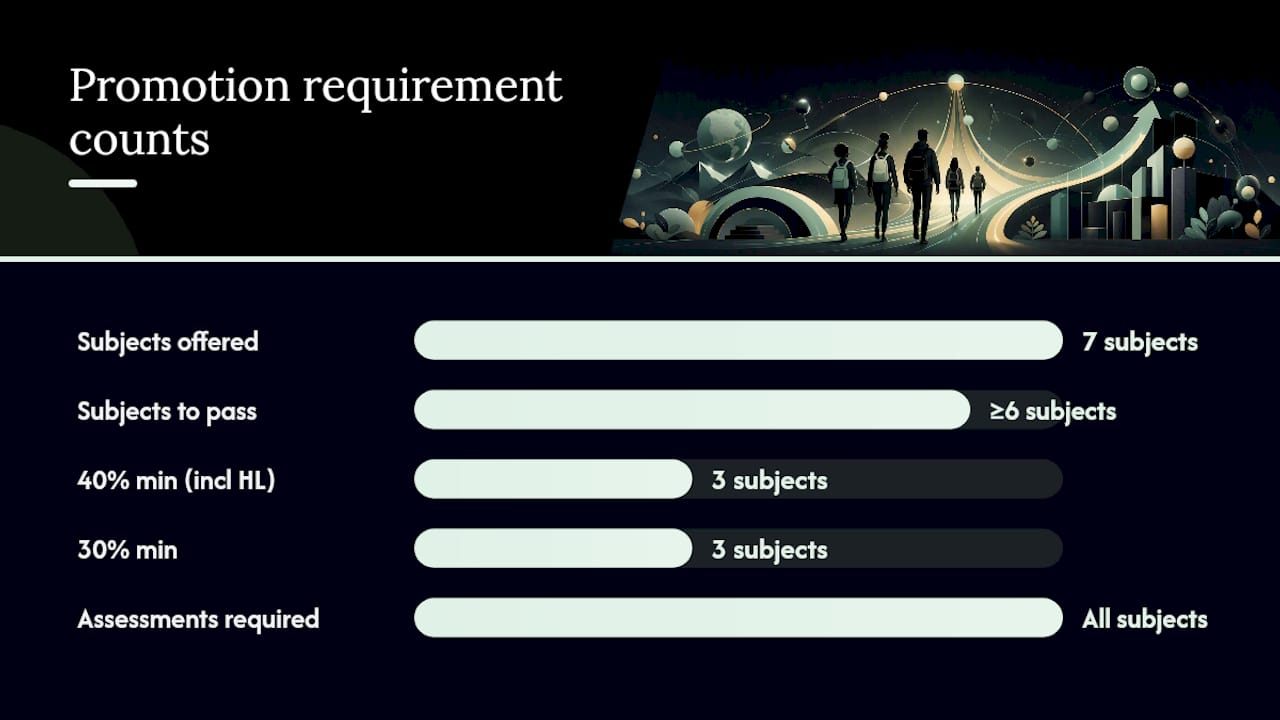
This is the Department of Basic Education’s national standard for Grades 10 to 12, and it applies the same way whether a learner is at a school in Limpopo or a top Johannesburg private school. The specifics matter because a single missing SBA can undo an otherwise strong exam mark.
Here is the threshold in full:
- Offer and complete a full set of subjects as required by policy
- Pass most of those subjects as required by policy
- Achieve passing marks in a specified number of subjects, including an official Home Language
- Achieve minimum marks in other subjects as set by policy
- Submit all required assessments for every subject offered
Condonation, the formal mechanism that lets a learner pass despite falling short on a technicality, is rare at this level and effectively reserved for Grade 12 NSC candidates in narrow circumstances. Progression, which moves a learner up despite not meeting the promotion mark, is a separate and far more tightly controlled process. The two terms get confused constantly, and that confusion causes a lot of unnecessary panic among parents in October and November.
Key takeaways
Grade 11 promotion to Grade 12 requires passing six of seven subjects, meeting the 40/30 mark split, and submitting every SBA and PAT on record.
| Point | Details |
|---|---|
| Know the exact threshold | Pass 6 of 7 subjects: 40%+ in three (one Home Language), 30%+ in three others. |
| SBAs count as much as exams | Missing or incomplete SBAs/PATs can disqualify a subject regardless of exam performance. |
| Promotion and progression differ | Progression moves a learner up despite unmet requirements, under strict, documented conditions. |
| Attendance can override marks | Poor attendance undermines the SBA record schools rely on for promotion decisions. |
| Practice with real papers | PapersZA offers free Grade 11 past papers and memos to target weak subjects before finals. |
Table of Contents
- Grade 11 promotion requirements explained in full
- How do SBAs and PATs affect Grade 11 promotion?
- What is the difference between promotion and progression?
- Do attendance and conduct affect promotion or progression?
- What happens if a Grade 11 learner doesn’t meet the requirements?
- A quick checklist before promotion decisions are finalised
- Where to check the official DBE wording yourself
- Using past papers to actually meet SBA and exam standards
- How schools actually apply these rules in practice
- Study smarter with free past papers from PapersZA
- Sources
- FAQ
Grade 11 promotion requirements explained in full
The seven-subject rule sits at the centre of everything. A Grade 11 learner has to be formally registered for, and complete, a full set of subjects across the year, passing most of them. That means a learner can technically fail one subject and still be promoted, provided the other six clear their thresholds and the failed subject isn’t one that triggers a compulsory pass (Home Language and, in most school policies, Mathematics or Mathematical Literacy carry heavier weight in practice, even if the formal rule treats subject counts generically).
The pass requirements include higher minimum marks in some subjects, including an official Home Language, and lower minimums in others, as set by official standards. This 40/30 split is deliberate: it forces a baseline of competence in language and core subjects while giving some room in electives where a learner might be stretching into unfamiliar territory, like a first attempt at Information Technology or Music theory.
The national policy document on programme and promotion requirements sets this out formally, with paragraph 29 carrying the core promotion requirements for Grades 10 to 12. If a school report or a provincial circular ever contradicts what a parent understands, this is the document to check first, because it is the actual regulatory text rather than a summary.
There’s one nuance worth flagging: some learners offer two Home Language subjects (common in schools that teach, say, isiZulu Home Language alongside English Home Language). Life Orientation, meanwhile, is compulsory for all learners but does not carry the same weighting implications as an academic Home Language or Mathematics subject in the promotion calculation, though it still counts toward the seven-subject minimum and still has to be passed.
How do SBAs and PATs affect Grade 11 promotion?
SBAs are not optional extras that sit quietly in the background of a report card. They are a compulsory, substantial component of the year mark for every subject a learner offers, and DBE policy requires them to be submitted before a promotion decision is even considered valid.
Weighting varies by subject, but continuous assessment (tests, assignments, orals, practicals, and PATs) typically makes up a meaningful share of the final mark, with the balance coming from the end-of-year exam. In subjects with a practical or performance component, like Music, Visual Arts, or the Life Orientation PAT, that split leans even further toward the SBA side.

An analysis of school-based assessment patterns in Gauteng schools found that continuous assessment forms a large share of a learner’s overall mark, and that poor termly performance is genuinely hard to reverse in a single final exam sitting. In plain terms: a learner who coasts through the year and hopes to “pull it back” in November is fighting arithmetic that usually doesn’t favour them.
Missing SBAs create a separate, harsher problem. A subject without a submitted SBA can be marked incomplete, which can disqualify that subject from the promotion count entirely, regardless of how well the learner might do in the exam. Schools are required to keep these records, but mistakes happen, folders get misfiled, and PATs occasionally go unmarked until someone asks.
Pro Tip: Ask your school for written confirmation of SBA and PAT completion at least three weeks before final exams start. If anything is missing, that gap is far easier to fix in October than it is in December when marks are already being finalised.
What is the difference between promotion and progression?
Promotion means a learner has genuinely met the DBE thresholds: seven subjects offered, six passed, the 40/30 mark split achieved, and all SBAs submitted. Progression is different. It’s an administrative safety valve that allows a learner who has not met those requirements to move up anyway, under strict and specific conditions set out in DBE regulation.
Progression isn’t automatic, and it isn’t a loophole a learner can request. It exists mainly to prevent learners from being stuck repeating grades indefinitely, and the regulations governing the National Curriculum Statement specifically cap how many times a learner can be retained in the Further Education and Training phase, which covers Grades 10 to 12. A learner can generally only be retained once at this phase, which is part of why progression exists as a mechanism at all.
Here’s how a school typically works through a progression decision:
- Subject teachers and the school’s assessment committee review the learner’s full-year record, including attendance and SBA history, not just the final exam mark.
- A formal progression meeting is held, and the reasons for the decision (attendance issues, incomplete SBAs, marginal exam performance) get documented in writing.
- The parent or guardian is informed, usually in a meeting, with the documented reasoning shared and the implications for Grade 12 explained.
According to DBE procedural guidance, this meeting and its documentation aren’t a formality schools can skip. Parents are entitled to ask for the minutes.
Do attendance and conduct affect promotion or progression?
Yes, and this is the part of the policy most families underestimate. A learner can have marks that technically clear every threshold and still run into trouble if attendance drops below what the school considers acceptable, because irregular attendance undermines the reliability of the SBA record itself. If a learner missed the tests, assignments, or practicals that feed the SBA, there’s often no mark to record in the first place.
Schools generally check the following before finalising a promotion or progression decision:
- Confirmed enrolment and attendance records for the full academic year
- Approved medical exemptions where a learner missed a PAT or practical component (a doctor’s note filed with the school, not just a verbal explanation)
- Evidence that SBA tasks were actually submitted, not just attempted
- A record of any remedial support offered during the year, which schools increasingly document to show they intervened before a learner reached crisis point
For parents, the practical move is simple: keep copies of every medical note submitted, and if a task was missed for a legitimate reason, get written confirmation from the school that the absence was recorded as excused. Verbal assurances from a teacher in March are easy to forget by November.
What happens if a Grade 11 learner doesn’t meet the requirements?
Three realistic outcomes exist, and they are not interchangeable.
The first is repeating Grade 11. This is the default outcome when a learner falls well short of the thresholds, particularly if SBAs are incomplete or attendance was a genuine problem. It’s not a punishment so much as an acknowledgment that the foundation for Grade 12 content isn’t there yet.
The second is progression, discussed above, and it comes with a real trade off. A learner progressed into Grade 12 without having met Grade 11’s academic requirements is stepping into harder content and higher exam stakes than they were ready for. Progression is meant to be a case-by-case decision made by the school’s subject staff, not a routine outcome, precisely because of that added risk.
The third, condonation, deserves a clear warning: it is not a routine fix at Grade 11 level. Condonation exists almost exclusively for Grade 12 NSC candidates under narrow, specific circumstances close to certification. Treating it as a backup plan for a Grade 11 shortfall is a misunderstanding that causes real disappointment in December.
Pro Tip: If your child is progressed rather than promoted, request three documents from the school: the minutes of the progression meeting, the attendance record used in the decision, and written confirmation of which SBAs/PATs were or weren’t completed. These become important if you want to appeal, seek tutoring, or simply understand what to fix before Grade 12 starts.
A quick checklist before promotion decisions are finalised
Before accepting a report card verdict at face value, work through this with your child:
- Confirm seven subjects were formally offered and completed for the year, not just attended
- Confirm every SBA and PAT was submitted and marked, subject by subject
- Count subject passes: at least six of seven, with 40%+ in three (one Home Language) and 30%+ in three others
- Check the attendance record against your own recollection of absences, especially medical ones
- If progression was mentioned at any point, ask for the progression meeting minutes in writing
At a parent-teacher meeting, three questions cut through most confusion fast: “Have all SBAs been marked and recorded for every subject?” “Is my child on track to pass six of seven subjects under the 40/30 split?” and “If there’s a risk of not meeting requirements, what does the school recommend, extra support, a subject change, or something else?”
Answering those honestly tells you whether you’re looking at a genuine repeat scenario, a fixable SBA gap, or a learner who’s actually fine and just needs reassurance.
Where to check the official DBE wording yourself
Reading the policy language directly avoids the telephone-game distortion that happens when a rule gets summarised, then re-summarised, by three different people before it reaches a parent WhatsApp group.
Look for these specific terms in the source documents: “programme and promotion requirements” (the core rule section), “provisos” (exceptions and edge cases), and “concessions” or “condonation” (the narrow relief mechanisms). Paragraph 29 of the national policy PDF is where the Grade 10 to 12 promotion rule itself lives; the surrounding paragraphs cover progression conditions. Always check the document’s revision date and cross-reference it against any provincial circular, since provinces sometimes add administrative detail (submission deadlines, specific forms) without changing the underlying DBE rule.
| Resource | What it covers | Best used for |
|---|---|---|
| DBE promotion requirements page | Summary of the Grade 10–12 rule | Quick confirmation of thresholds |
| National policy PDF (ProgPromReqNCS) | Full statutory paragraphs, including paragraph 29 | Verifying exact wording, resolving disputes |
| Regulations PDF (Nov 2015) | Assessment weighting, retention limits, concessions | Understanding progression and retention caps |
| Thutong resource portal | Provincial circulars and downloadable guidance | Local administrative dates and forms |
The Thutong resource portal is worth bookmarking specifically because provincial departments, including the Western Cape Department of Education, post circulars there that clarify local SBA deadlines and exam scheduling without altering the national rule itself.
Using past papers to actually meet SBA and exam standards
A study plan that works in practice looks like this: identify the two or three subjects where term marks are weakest, pull past papers for those subjects, attempt them under timed conditions, then self-mark against the official memo to spot exactly where marks are being lost, whether it’s a misread instruction, a calculation error, or a genuine content gap. Repeat that cycle weekly for the weak subjects rather than spreading effort evenly across all seven.
PapersZA hosts free past papers and memos across Grade 11 subjects, sourced from DBE, IEB, and provincial exam sessions, with no account needed to download. For a learner shoring up numeracy ahead of a PAT or exam, the Grade 11 Mathematics papers let them practice under realistic conditions instead of guessing what an exam actually asks. The same applies to Grade 11 English for language thresholds, History for content-heavy subjects, and Accounting for learners who need repetition on procedural questions.
Pro Tip: Don’t just complete a past paper, mark it against the memo the same day, while the reasoning is still fresh. A paper marked a week later teaches you far less than one marked within hours.
How schools actually apply these rules in practice
Policy documents describe the rule; schools apply it under real time pressure in October and November, and that gap between text and practice is where most confusion comes from.
Most schools convene an internal staff meeting to review borderline learners well before final reports go out, precisely because the DBE process expects documented, deliberate decisions rather than a teacher quietly bumping a mark. Provincial circulars sometimes add local deadlines on top of the national rule, like an earlier internal cutoff for SBA submission than the DBE technically requires, simply so the school has time to process appeals before certificates print.
The recurring pitfall isn’t dramatic failure, it’s small administrative drift: a PAT submitted late and never formally logged, a term test missed for a valid reason but never flagged as excused, a parent who assumes “progressed” means the same thing as “passed.” Schools that send early warnings when SBAs go missing tend to produce far fewer surprise progression cases in November, but not every school does this consistently, which is exactly why the checklist above exists. Treat the policy as the floor, and treat your own school’s communication as the thing you actually need to verify against it.
Study smarter with free past papers from PapersZA
Grade 11 promotion comes down to consistent subject mastery across seven subjects, not a lucky exam sitting, and that mastery is built through repetition on the actual style of question DBE, IEB, and provincial examiners set. PapersZA gives South African learners free access to official past papers and marking memos for Grade 11, with no account or sign-up required, so practice can start the moment a weak topic is identified rather than after a search for reliable material.
Pair a weak subject with its matching paper set: Accounting learners preparing for an SBA task can work through a recent November paper and memo together, marking their own attempt line by line against the official answer. Learners with practical components, like Music, can check the Grade 11 Music past papers for both theory and practical-adjacent questions. Start by browsing the full Grade 11 past papers library and building a weekly practice slot around whichever subject is closest to that 40% or 30% line.
Sources
For anything report-card related that seems inconsistent with what’s outlined here, these are the primary documents worth downloading directly rather than relying on a summary:
- Promotion requirements for Grade 10-12
- An exploratory analysis of school-based assessment before, during and after the COVID-19 pandemic in Gauteng (RESEP/SUN)
FAQ
What are the promotion requirements for Grade 11 students?
A Grade 11 learner must offer and complete at least seven subjects, pass six of them, score 40% or higher in three subjects (one being a Home Language) and 30% or higher in three others, with all SBAs and PATs submitted.
What’s the difference between promoted and progressed?
Promotion means a learner met every DBE threshold outright; progression means a learner is moved to the next grade despite not meeting those thresholds, following a formal, documented school decision under strict conditions.
Which qualification can I pursue with a Grade 11 result?
Grade 11 results themselves don’t determine university or diploma entrance; those endorsements are based entirely on final Grade 12 NSC outcomes, so Grade 11 functions as preparation rather than a qualifying result.
What are the promotion requirements for Grade 12?
Grade 12 uses the same 40/30 subject-mark structure as Grade 11, but condonation, a narrow allowance for marginal shortfalls, is available at this level in specific circumstances, unlike Grade 11 where it’s essentially not applied.
What happens if my child doesn’t meet Grade 11 promotion requirements?
The school will consider repeating the grade, applying progression under documented conditions, or arranging remedial support, and parents should request the progression meeting minutes and SBA records if that decision is made.