History essay marking rubric: your guide to Level 7

To reach Level 7 in a South African history essay, you need one thing above everything else: a clear thesis stated upfront and a sustained line of argument that connects every piece of evidence back to that thesis throughout the essay. The NSC marking guidelines assess essays on a global scale of marks, where markers assign a single level based on both content and presentation together.
Here is what the rubric requires you to show:
- Introduction with a thesis and roadmap: state your argument and signal how you will defend it.
- Structured body paragraphs: each opens with a topic sentence, uses evidence, and links back to the thesis.
- Balanced use of evidence: draw on sources and own knowledge; do not just list facts.
- Historical interpretation: explain what the evidence means, not just what happened.
- Appropriate historical terminology: causal, evaluative, and analytical vocabulary.
- Presentation: clear paragraphing, logical flow, and legible language mechanics.
The 50-mark global assessment maps these qualities to seven levels, with Level 7 at the top and Level 1 at the bottom.
Key takeaways
The single most important action in any NSC history essay is to state a clear thesis upfront and sustain that argument, with evidence and interpretation, through every paragraph to the conclusion.
| Point | Details |
|---|---|
| Thesis first, always | State your argument in one sentence in the introduction; every paragraph must defend it. |
| Read mark allocation before writing | The allocation tells you how many points to make and how long each answer should be. |
| Evidence must be interpreted | Listing facts earns Level 3; explaining what facts prove earns Level 5 and above. |
| Practise with official memos | Self-marking with DBE or IEB memos trains you to apply the rubric, not just answer questions. |
| Papersza for timed practice | Papersza’s free history past-paper collections include official memos for self-assessment with no registration needed. |
Table of Contents
- What does the official NSC/IEB marking matrix actually look like?
- What do markers mean by “presentation” versus “content”?
- How are marks allocated in an essay question?
- How do you answer source-based questions at each level?
- How do you plan and structure a history essay to meet the rubric?
- Common mistakes that lose marks and how to fix them
- How do you practise with official past papers and memos?
- Checklist: does your essay meet Level 7 criteria?
- What examiners actually reward, from a classroom perspective
- Papersza gives you the memos you need to practise the rubric
- Sources
- FAQ
What does the official NSC/IEB marking matrix actually look like?
The matrix is the primary tool markers use to assign a global mark. They read your essay as a whole, weigh content against presentation, and settle on a level. That level then determines your mark band. According to the DBE NSC marking guidelines, the scale works as follows:
| Level | Descriptor | Mark range (out of 50) |
|---|---|---|
| 7 | Outstanding: clear thesis, sustained argument, well-selected evidence, strong interpretation, excellent presentation | 41–50 |
| 6 | Meritorious: clear argument, good evidence use, mostly consistent, minor gaps in interpretation | 34–40 |
| 5 | Substantial: argument present but not always sustained, evidence used but some gaps, adequate presentation | 25–31 |
| 4 | Adequate: some argument, evidence listed more than analysed, basic structure | 18–24 |
| 3 | Moderate: limited argument, mostly narrative, weak evidence selection | 9–15 |
| 2 | Elementary: very little argument, largely descriptive, poor structure | 5–8 |
| 1 | Not achieved: no discernible argument, incoherent or irrelevant content | 0–4 |
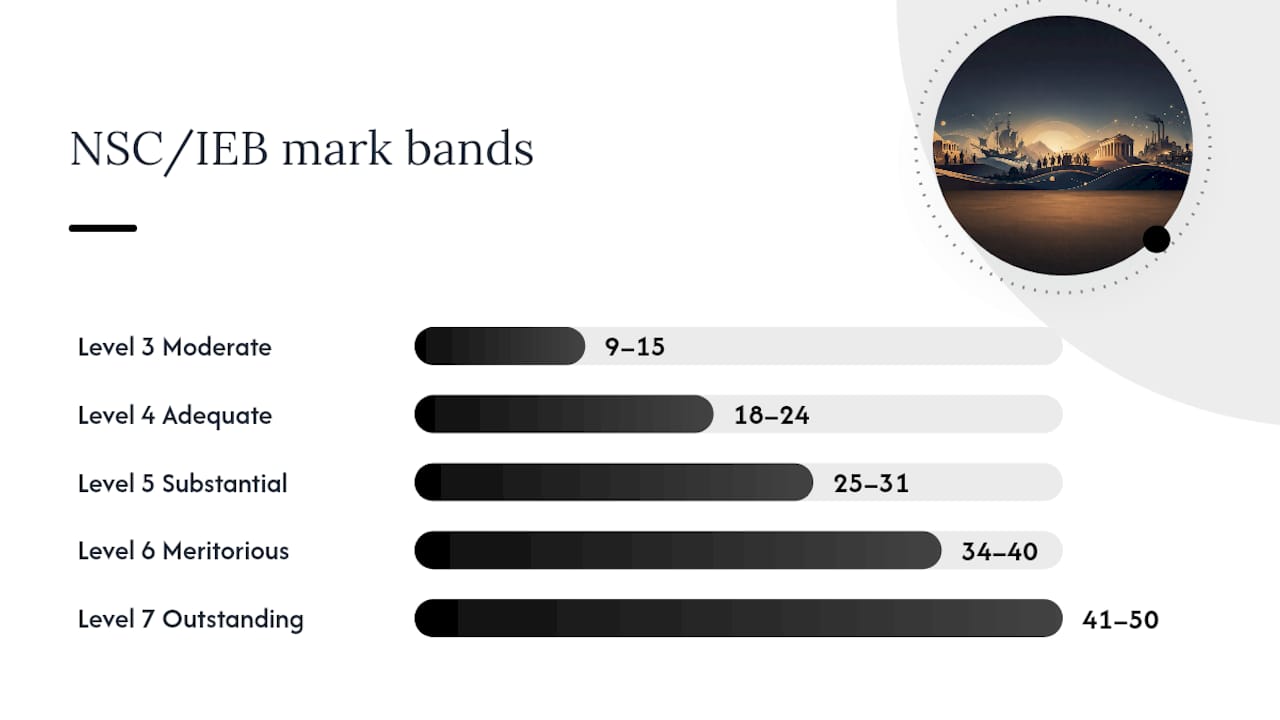
The difference between Level 7 and Level 6 comes down to consistency. A Level 6 essay has a clear argument but loses the thread in one or two paragraphs, or the conclusion does not quite follow from the evidence. A Level 7 essay sustains the argument from the first sentence to the last. The difference between Level 4 and Level 3 is whether any analytical attempt is visible: Level 4 shows some effort to explain evidence, while Level 3 simply retells events.
Presentation and content are assessed together in this global judgment. A beautifully written essay with no argument cannot reach Level 7, and a content-rich essay with chaotic paragraphing will be pulled down from the top band.
What do markers mean by “presentation” versus “content”?
These two terms trip up more students than almost anything else in the rubric. They are not the same thing, and fixing one without the other will not move you up a level.
Presentation covers how you organise and express your answer:
- Logical paragraph structure with clear topic sentences
- Coherent flow between paragraphs (signposting and linking sentences)
- Correct grammar, punctuation, and spelling
- Appropriate academic register and historical vocabulary
- Legibility and neatness
Content covers what you actually argue and prove:
- Selection of relevant, accurate historical evidence
- Interpretation: explaining what the evidence shows, not just what happened
- Argumentation: building a case rather than listing facts
- Balanced perspective where the question requires it
Consider the same fact: “The Sharpeville massacre occurred on 21 March 1960, when police opened fire on protesters, killing 69 people.” Written as a narrative, that sentence earns minimal marks. Written as evidence in an argument, it sounds like this: “The Sharpeville massacre of March 1960 demonstrated the apartheid government’s willingness to use lethal force against peaceful protest, which accelerated international condemnation and gave the ANC grounds to abandon non-violent resistance.” The second version interprets the fact and links it to a thesis. That is the content difference between Level 3 and Level 5.
The language markers expect includes causal connectors (“as a result,” “this led to,” “consequently”), evaluative vocabulary (“significantly,” “to a greater extent,” “this was the primary cause because”), and analytical framing (“this suggests,” “this demonstrates,” “the evidence indicates”). The University of Bristol’s history writing guidance stresses careful quoting and paraphrasing over block-copying, which applies equally to NSC source-based answers.
How are marks allocated in an essay question?
Essays carry 50 marks in the NSC history paper, and that total fits within a two-section paper: Section A covers source-based questions, and Section B contains the essay. The essay carrying full marks is assessed globally, meaning there is no separate sub-score for each paragraph. The marker reads the whole essay and assigns one level.
Mark allocation cues appear differently in source-based questions (see the next section), but for the essay itself, the total marks tells you how much time and depth to invest. An essay carrying full marks in a three-hour paper deserves roughly 40–50 minutes of writing time after planning.
Pro Tip: Before you write a single word, scan the question and the total marks. An essay carrying full marks needs a full introduction, at least three developed body paragraphs, and a conclusion. If you see you have 25 minutes left and only one paragraph written, you are behind. Adjust your pace before you run out of time, not after.
How do you answer source-based questions at each level?
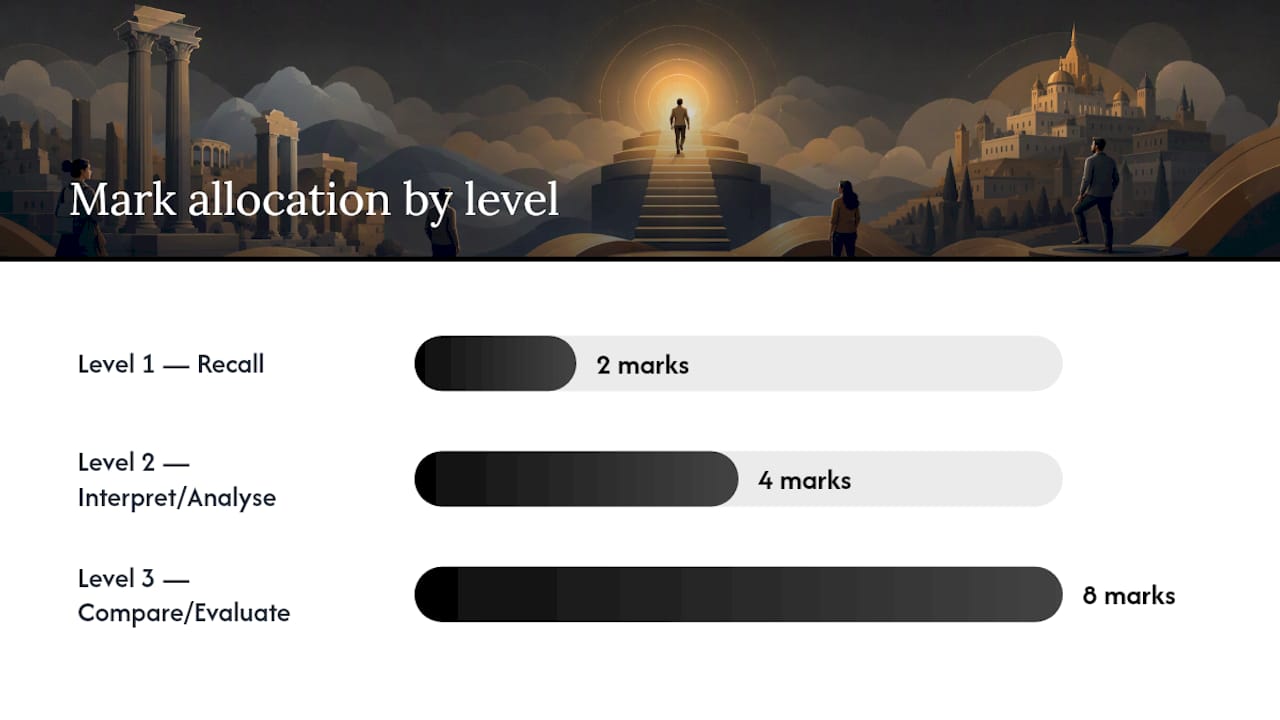
South African source-based questions are organised into three levels, each demanding a different cognitive task:
- Level 1: Recall or identify. The answer is directly in the source. (“What does Source A say about…?”)
- Level 2: Interpret or analyse. You explain what the source means or why something happened. (“Why does the author argue…?”)
- Level 3: Compare or evaluate. You weigh sources against each other or assess reliability and bias. (“How far do Sources B and C agree about…?”)
Reading the mark allocation tells you exactly how long your answer should be. Here is how it works in practice, following SAHistory’s source-based guidance:
- (1 x 2) = 2 marks: One point with a brief explanation. Two sentences maximum. Example: “Source A shows that the government used propaganda to justify apartheid. The poster depicts Black South Africans as a threat, reinforcing racial fear.”
- (2 x 2) = 4 marks: Two separate points, each with explanation. Four to six sentences. Do not write one long paragraph and hope the marker finds two points in it. State Point 1, explain it. State Point 2, explain it.
- Level 3 paragraph (8 marks): About eight lines of writing. Quote from both sources, identify the agreement or disagreement, explain why the sources differ (context, purpose, bias), and reach a conclusion. Do not just say “Source B agrees with Source C.” Show where, quote it, and explain what the difference reveals.
Two errors cost students marks here consistently. First, not quoting when the question asks you to quote. Second, writing a (2 x 2) answer as two separate paragraphs, so the marker cannot identify the two distinct points. Structure your answer to match the allocation.
Pro Tip: Write the mark allocation in the margin next to your answer as you go. If a question is worth (2 x 2), draw two boxes in your margin and tick each one as you make the point. This prevents you from submitting a four-mark answer with only one scoreable point.
How do you plan and structure a history essay to meet the rubric?
A strong essay plan takes five minutes and saves you from the most common Level 4 trap: a body that wanders away from the thesis. Here is a practical sequence:
Step 1: Write your thesis in one sentence. Answer the question directly. “The Soweto Uprising of 1976 was primarily caused by the imposition of Afrikaans as a medium of instruction, which crystallised broader resistance to Bantu Education.” That is a thesis. “The Soweto Uprising had many causes” is not.
Step 2: Write a three-point roadmap. List the three arguments you will make. Your introduction should state the thesis and signal these three points in one or two sentences.
Step 3: Use this paragraph template for each body paragraph:
- Topic sentence: state the argument for this paragraph.
- Evidence: cite a source or fact that supports it.
- Explanation: interpret the evidence and link it to the thesis.
- Mini-conclusion/signpost: close the paragraph and connect to the next point.
The University of Otago’s history essay guide recommends keeping your introduction to roughly 10% of your total word count and ensuring every paragraph advances the argument rather than restating it.
Step 4: Write a conclusion that evaluates, not summarises. Do not introduce new evidence. Restate your thesis in light of the argument you have made, and offer a brief evaluative judgment.
For a three-question paper, a rough time split looks like this: 10 minutes reading and planning, 40–45 minutes writing the essay, and 5 minutes checking. For the essay itself, aim for one paragraph every 8–10 minutes.
What your introduction must include for Level 7:
- A direct answer to the question (your thesis)
- A brief roadmap of your three main arguments
- Relevant historical context (one or two sentences, no more)
What your conclusion must include:
- Restatement of the thesis in new words
- A brief evaluative judgment on the relative weight of your arguments
- No new facts or sources
Common mistakes that lose marks and how to fix them
These errors appear repeatedly in NSC history scripts. Each one has a direct fix.
- Writing a narrative instead of an argument. Retelling events in chronological order earns Level 3 at best. Fix: start every paragraph with a claim, not a date.
- Weak or missing thesis. “This essay will discuss the causes of apartheid” is not a thesis. Fix: answer the question in one sentence before you write anything else.
- Misreading mark allocation. Writing six lines for a (1 x 2) question wastes time. Fix: count the marks, plan the length.
- Over-quoting from sources. Copying large chunks of a source without explanation earns nothing. Fix: quote one phrase, then explain what it shows.
- No link back to the question. Each paragraph ends without connecting the evidence to the thesis. Fix: end every paragraph with a sentence that uses the question’s key words.
- Ignoring counterarguments. Level 7 essays acknowledge complexity. Fix: include one paragraph that presents a counter-view and then refutes or qualifies it.
- Weak conclusion. Introducing new facts in the conclusion or simply listing what you said. Fix: evaluate, do not summarise.
- Poor time management. Spending 60 minutes on source questions and 20 minutes on the essay. Fix: allocate time before the exam and stick to it.
- Vague historical language. “Things got worse” instead of “repression intensified.” Fix: replace every vague word with a precise historical term.
- Plagiarism and incorrect quoting. Presenting a source’s words as your own, or quoting without attribution. Fix: use quotation marks and name the source (e.g., “According to Source A…”). The University of Bristol’s guidance on careful quoting and paraphrasing applies directly here.
How do you practise with official past papers and memos?
Deliberate practice with memos trains you to apply the rubric, not just to answer questions. There is a difference between writing an essay and writing an essay that a marker would score at Level 7. The memo shows you that gap.
Five-step practice plan:
- Choose a paper. Select a DBE or IEB history paper from a recent year. Papersza’s Grade 12 history collection and Grade 11 collection both include official papers paired with memos.
- Attempt under timed conditions. Set a timer. Do not check the memo first. Treat it as the real exam.
- Mark with the memo. Read the memo’s level descriptors and mark your essay globally. Be honest about which level your essay sits at.
- Annotate your errors. Mark every paragraph where you listed facts instead of arguing, where you missed a quote, or where your thesis disappeared.
- Reattempt the weak sections. Rewrite the two paragraphs that cost you the most marks. Compare the rewrite to the memo again.
Key resources for this practice:
- DBE NSC marking guidelines: the official source for level descriptors and mark bands.
- SAHistory source-based skills guide: detailed guidance on answering each level of source question.
- WCED exam resources: provincial memos and exemplars from the Western Cape Education Department.
- North West provincial marking guide: a sample provincial matrix that mirrors the DBE format, useful for classroom practice.
- A structured revision plan can help you schedule timed paper attempts across the weeks before your exam.
Pro Tip: Teachers: run a 20-minute marking workshop. Give students an unmarked exemplar essay and the level descriptors. Ask them to assign a level and justify it in two sentences. Then reveal the official mark. The gap between student judgment and official mark is the most productive teaching moment in history exam prep.
Checklist: does your essay meet Level 7 criteria?
Use this before submitting or when self-marking a practice essay. Answer yes or no to each item.
- [ ] My introduction contains a clear, direct thesis that answers the question.
- [ ] My introduction signals the three main arguments I will make.
- [ ] Every body paragraph opens with a topic sentence that states an argument.
- [ ] Every body paragraph uses at least one piece of evidence (source or own knowledge).
- [ ] Every body paragraph explains what the evidence means and links it to the thesis.
- [ ] I have acknowledged a counterargument or complexity somewhere in the essay.
- [ ] My conclusion restates the thesis in new words and offers an evaluative judgment.
- [ ] My conclusion introduces no new facts or sources.
- [ ] I have used precise historical terminology throughout (causal, evaluative, analytical language).
- [ ] My paragraphs are clearly separated and logically ordered.
- [ ] I have not copied large chunks of source text without explanation.
Rating guide: 10–11 yes answers places your essay in Level 7 territory. 8–9 suggests Level 6, with one or two structural or interpretive gaps to close. 6–7 points to Level 5, usually because the argument is present but inconsistent. Below 6 indicates the essay is still primarily narrative (Level 3–4).
Teachers moderating self-assessments: pair this checklist with the official memo and an exemplar answer. Where a student marks themselves at Level 7 but the memo places them at Level 5, the discrepancy is almost always in the “links evidence to thesis” items. That is the conversation to have.
What examiners actually reward, from a classroom perspective
The rubric is clear on paper, but what does it look like in practice? After years of marking NSC history scripts, the pattern is consistent: the essays that reach Level 7 are not necessarily the ones with the most facts. They are the ones where the student never loses sight of the question. Every paragraph feels like it is answering the same question, just from a different angle.
The single most common reason a script drops from Level 6 to Level 5 is a body paragraph that reads like a mini-essay on a related topic rather than a direct contribution to the thesis. The student knows the content, but the argument drifts. Markers notice this immediately, and the global level drops.
One classroom-tested trick for exam conditions: write your thesis on the top of your planning page, then glance at it before you start each new paragraph. Ask yourself, “Does what I am about to write prove this thesis?” If the answer is no, either cut the paragraph or reframe it so it does. This takes ten seconds and prevents the drift that costs students a full level.
Papersza gives you the memos you need to practise the rubric
Free access to official past papers and their marking memos with no account required is what Papersza offers every South African student. The History Grade 12 past papers and memos collection pairs actual NSC question papers with the official memos that show exactly how markers apply the level descriptors.
A practical workflow: open a Grade 12 history paper on Papersza, attempt the essay under timed conditions, then open the memo and apply the global assessment to your own script. The memo’s level descriptors tell you precisely where your argument fell short. For scaffolded practice, the Grade 11 history collection lets you build confidence before tackling matric-level papers. Teachers can use both collections to run the marking workshop described above, with no subscription or login needed. Start with the Papersza history library and download your first paper today.
Sources
- National Senior Certificate (NSC) marking guidelines (DBE)
- How to answer source-based questions (SAHistory technical skills guide)
- Provincial assessment grade 10 marking guideline (North West province)
- A guide to writing history essays (University of Otago)
- Writing better history essays (University of Bristol)
- WCED exams and marking resources (Western Cape Education Department)
FAQ
What is the highest mark band in the NSC history essay rubric?
Level 7 is the highest level, corresponding to a mark range of 41–50 out of 50. It requires a clear thesis, a sustained line of argument, well-selected evidence, strong interpretation, and excellent presentation throughout the essay.
How many marks does a history essay carry in the NSC exam?
History essays carry 50 marks, assessed globally using the Level 1–7 matrix described in the DBE NSC marking guidelines.
What is the difference between Level 1, 2, and 3 source-based questions?
Level 1 asks you to recall or identify information directly from the source. Level 2 asks you to interpret or analyse the source. Level 3 asks you to compare sources or evaluate their reliability, usually requiring about eight lines of writing and direct quotation from both sources.
How do I use a marking memo to improve my history essays?
Attempt a past paper under timed conditions, then apply the memo’s level descriptors to your own essay. Identify which paragraphs lack a clear argument or fail to link evidence to the thesis, rewrite those sections, and compare again. Papersza’s history collections pair papers with official memos to make this process straightforward.
What does “global assessment” mean in history essay marking?
Global assessment means the marker reads your entire essay and assigns a single level based on the overall quality of content and presentation combined, rather than awarding separate marks for each paragraph or criterion.