How to calculate your APS score for university

Your APS score is the number South African universities use to decide whether you qualify for a programme. It stands for Admission Point Score, and it is calculated directly from your Grade 12 (NSC or IEB) results. Get it right, and you know exactly where you stand before you apply.
Table of Contents
- How to calculate your APS score: the core method
- Step-by-step: calculating your APS score with an example
- Key takeaways
- FAQ
How to calculate your APS score: the core method
Most South African universities use a 7-point scale that converts your subject percentages into points, then adds those points together. The standard scale looks like this:
- 80–100% = 7 points
- 70–79% = 6 points
- 60–69% = 5 points
- 50–59% = 4 points
- 40–49% = 3 points
- 30–39% = 2 points
- 0–29% = 1 point
Your total APS is the sum of your six best subjects, which must include your compulsory language of teaching and learning. Life Orientation is excluded from the calculation at most universities. A diploma pathway typically requires an APS of 18–24, a bachelor’s degree entry sits around 26–34, and specialised fields often demand 35 or above. Your APS opens the door, but it is not the only key.
Step-by-step: calculating your APS score with an example
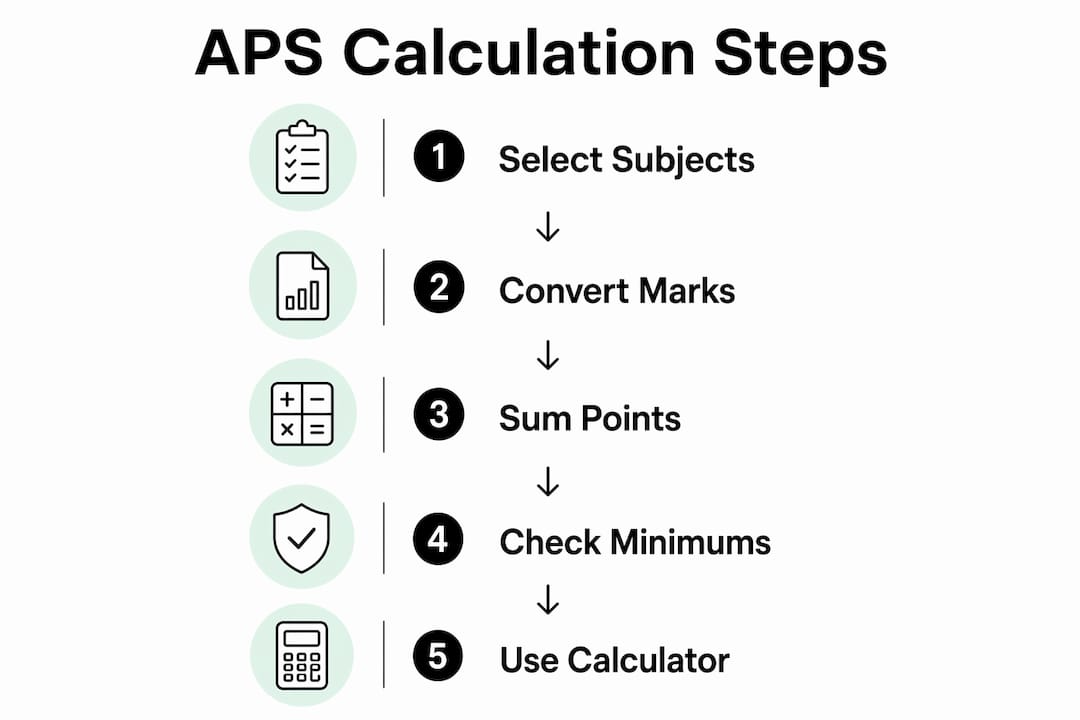
Follow these steps to determine your score accurately.
-
List your Grade 12 subjects. Write down all your subjects and their final percentage marks. Include your home language and first additional language.
-
Remove Life Orientation. At the University of Johannesburg and most other institutions, Life Orientation does not count toward your APS total. Set it aside.
-
Select your six best subjects. From the remaining subjects, pick the six with the highest percentage marks. Your compulsory language must be among them.
-
Convert each percentage to APS points using the scale above.
-
Add the six point values together. That total is your APS score.
Example calculation:
| Subject | Mark | APS Points |
|---|---|---|
| English Home Language | 72% | 6 |
| Afrikaans FAL | 65% | 5 |
| Mathematics | 58% | 4 |
| Accounting | 81% | 7 |
| Business Studies | 67% | 5 |
| History | 74% | 6 |
| Total APS | 33 |
This learner qualifies for bachelor’s degree entry at most universities.

University-specific variations matter. UCT uses a different weighted system, and UNISA applies percentage-based criteria rather than the standard point scale. Some institutions include Life Orientation partially or use subject weighting. Always check the specific university’s admissions page.
A high APS alone does not guarantee admission. Subject minimums apply: scoring an overall 35 but falling below the required level in Mathematics or Physical Sciences can still disqualify you from an engineering programme. National Benchmark Test results and available seats also factor into final decisions.
Pro Tip: Use an APS calculator on the university’s own website or a verified education portal to avoid common errors like including Life Orientation or dropping the wrong subject.
Practising past papers in your six core subjects is one of the most direct ways to push your marks up. Papersza offers free access to Grade 12 past papers across all major subjects, including English, Accounting, and Business Studies, with memos included so you can check your own work.
Key takeaways
Your APS score is the sum of points from your six best Grade 12 subjects, converted using a standard percentage-to-point scale, with Life Orientation excluded at most universities.
| Point | Details |
|---|---|
| Standard scale | Percentages convert to 1–7 points; 80–100% earns the maximum 7 points. |
| Subject selection | Use your six best subjects; Life Orientation is excluded at most universities. |
| Score ranges | Diploma, bachelor’s degree, and specialised fields require progressively higher APS levels. |
| Beyond the APS | Subject minimums and National Benchmark Tests also affect admission outcomes. |
| University variations | UCT, UNISA, and others use different systems; always verify with the institution. |
FAQ
What does APS stand for in South Africa?
APS stands for Admission Point Score. It is a rating system developed for the NSC and IEB that converts subject achievement levels into a numerical total used for university admissions.
Is Life Orientation included in the APS calculation?
Life Orientation is excluded from the APS at most South African universities, including the University of Johannesburg. Always confirm with your specific institution, as a small number of universities handle it differently.
What APS score do you need for a bachelor’s degree?
At most universities, an APS of 26–34 is typically required for bachelor’s degree entry, though the exact threshold varies by institution and programme.
Can a good APS score guarantee university admission?
No. Meeting the APS threshold is necessary but not sufficient. Subject-specific minimums, National Benchmark Test results, and available seats all influence whether an application succeeds.
Where can I find an official APS calculator?
Most South African university websites publish their own APS calculators. North-West University’s APS calculator covers NSC, ISC, and SACAI results and includes a conversion table for foreign qualifications.