Life sciences essays for grades 10–12: exam-ready templates

Use this 3-part skeleton in every Life Sciences essay you write: a one-sentence introduction that states your argument, three body paragraphs each built on cause→mechanism→result, and a synthesis conclusion that links the process to a broader biological principle. That structure maps directly onto how DBE and IEB examiners award marks, which is why it works.
Your 2-minute pre-writing routine:
- Read the question twice and underline the key biological process being asked about.
- Jot three bullet points, one per body paragraph, each starting with a cause word (“When…”, “As a result of…”, “This leads to…”).
- Write one synthesis sentence at the bottom of your plan: “This process is significant because…”
- Start writing. Do not skip the plan, even under time pressure.
Sample intro sentence: “Meiosis is a form of cell division that produces genetically unique haploid gametes through the processes of crossing over and independent assortment.”
Sample synthesis sentence: “The genetic variation produced by meiosis is the raw material for natural selection, which drives the evolution of populations over time.”
That plan takes two minutes. The essay it produces can score in the top band.
Key takeaways
Structured, synthesis-driven Life Sciences essays consistently score higher because they match the exact mark allocation DBE and IEB examiners use: roughly 15 marks for biological content and 2–3 marks for synthesis and presentation.
| Point | Details |
|---|---|
| Use the 2-minute skeleton | Plan three CMR bullet points and one synthesis sentence before writing a single paragraph. |
| Build every paragraph on CMR | State the cause, explain the mechanism, state the biological result — every paragraph, every time. |
| Target synthesis marks | End your conclusion with a sentence linking the process to a broader biological principle, not a restatement. |
| Self-mark against official memos | DBE and IEB memos show the exact phrasing and keyword sequence examiners credit. |
| Papersza for free practice papers | Download Life Sciences past papers and memos by grade at Papersza — no account needed. |
Table of Contents
- How do you structure a Life Sciences essay for the exam?
- Why synthesis earns more marks than a list of facts
- What are the most common Life Sciences essay topics in grades 10–12?
- Annotated sample essays: see exactly where marks come from
- How to practise with past papers and memos every week
- What should you do in the exam room, minute by minute?
- What separates a 70% essay from a 90% essay?
- Where to find DBE and IEB past papers and memos for free
- Sources
- FAQ
How do you structure a Life Sciences essay for the exam?
Each part of a Life Sciences essay has a specific job. The introduction names the process and signals your argument. Each body paragraph explains one step or mechanism. The conclusion synthesises, not summarises.
Introduction (3–5 sentences)
State the biological process, define any key terms, and indicate the direction of your answer. Examiners credit a clear, focused opening.
Sentence starters that work:
- “During [process], [organism/cell] undergoes…”
- “[Term] is defined as the process by which…”
- “The [system/organ] responds to [stimulus] by…”
- “When [condition] occurs, the body maintains homeostasis through…”
- “Genetic variation arises as a result of…”
- “[Process] plays a central role in [biological function] because…”
- “The relationship between [A] and [B] can be explained by…”
Body paragraphs (one mechanism per paragraph)
Each paragraph follows the same internal logic: topic sentence → cause → mechanism → result → link back to the question. This cause→mechanism→result (CMR) pattern is the highest-yield writing habit you can build. Examiners follow a checklist; CMR hits every item on it.
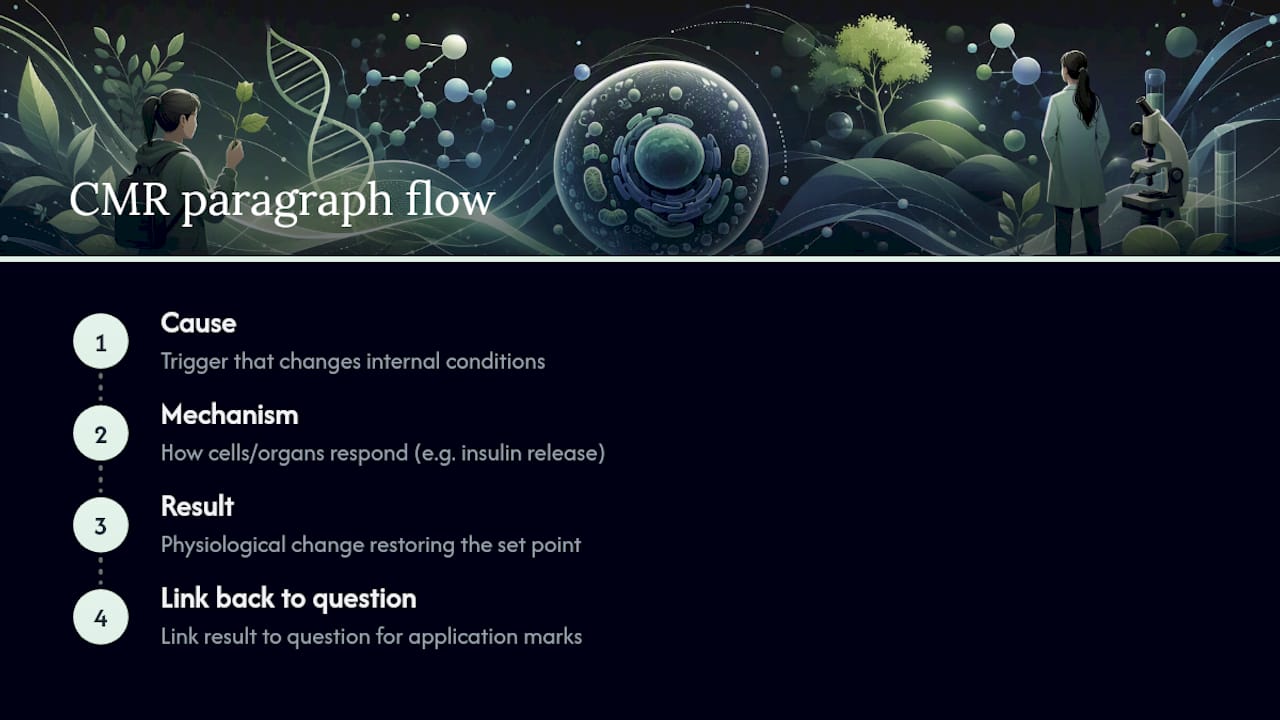
A body paragraph on negative feedback might read: “When blood glucose levels rise after a meal (cause), the beta cells of the islets of Langerhans secrete insulin (mechanism), which stimulates liver cells to convert glucose to glycogen, lowering blood glucose back to the set point (result). This illustrates the principle of negative feedback in homeostatic control.”
Notice how the last sentence links the mechanism back to the concept in the question. That link is where application marks live.
Conclusion (3–5 sentences)
Three conclusion templates that demonstrate synthesis rather than repetition:
- “The [process] described above is significant because it [broader biological consequence], which ultimately [ecological/evolutionary/physiological implication].”
- “Without [process], [organism/system] would be unable to [function], demonstrating the interdependence of [two biological systems].”
- “The ability of [organism] to [process] reflects the principle of [concept], which is central to understanding [topic area].”
10 scientific terms that trigger examiner marks
Precise vocabulary signals understanding. Build a personal glossary around these:
- Crossing over and chiasma (meiosis questions)
- Negative feedback (homeostasis and endocrine questions)
- Glucagon and insulin (blood glucose regulation)
- Eutrophication (environmental science topics)
- Allele frequency (evolution and genetics)
- Transcription and translation (DNA and protein synthesis)
- Synaptic transmission (nervous system)
- Osmoregulation (excretion and water balance)
Pro Tip: Using life-centred metaphors — describing hormones as “chemical messengers in a communication network” rather than “switches” — often produces clearer cause→effect explanations that examiners can follow and credit.
Why synthesis earns more marks than a list of facts
Most learners lose marks not because they lack knowledge, but because they present facts as a list rather than as a connected argument. Understanding how examiners allocate marks changes how you write.
A typical DBE or IEB Life Sciences essay is marked out of 17–20 marks. Roughly 15 of those marks go to biological content: the correct facts, processes, and sequences. The remaining 2–3 marks go to synthesis and presentation. That split sounds small, but those synthesis marks are the difference between a C and an A.
Self-marking checklist
Use this after every practice essay:
- Did I define the key biological process in the introduction?
- Does each body paragraph have a cause, a mechanism, and a result?
- Did I use at least three precise scientific terms per paragraph?
- Does my conclusion link the process to a broader biological principle (not just restate the introduction)?
- Is my handwriting legible and are my headings/subheadings clear? (Presentation marks are real.)
Pro Tip: After writing a practice essay, open the official DBE or IEB memo and read the examiner’s phrasing. Memos show the exact sequence of keywords that attract marks. Copy those phrases into your personal glossary and use them in the next practice essay.
What are the most common Life Sciences essay topics in grades 10–12?
Certain topics appear in DBE and IEB papers with enough regularity that you can prepare structured notes for each one before the exam. The list below is ranked by frequency of appearance across past papers.
Most-tested topics:
- Meiosis and genetic variation (crossing over, independent assortment, haploid gametes)
- DNA, transcription, and translation (the “Code of Life” cluster)
- Homeostasis and negative feedback (blood glucose, body temperature, osmoregulation)
- Endocrine system and human reproduction (hormones, menstrual cycle, pregnancy)
- Evolution and human origins (natural selection, fossil evidence, hominid features)
- Genetic engineering (recombinant DNA, GMOs, ethical considerations)
- Eutrophication and environmental science topics (nutrient loading, algal blooms, oxygen depletion)
Paper 1 vs Paper 2: Paper 1 focuses on life processes in plants and animals, homeostasis, and environmental studies. Paper 2 covers the “Code of Life” cluster: DNA, meiosis, genetics, and evolution. Essay questions in both papers test application of knowledge, not just recall.
20 practice essay questions (Paper 1 and Paper 2 style)
Paper 1 style:
- Describe the role of negative feedback in the regulation of blood glucose levels in humans.
- Explain how the human body responds to an increase in body temperature.
- Discuss the process of osmoregulation in the human kidney, including the role of ADH.
- Describe the hormonal control of the menstrual cycle from day 1 to ovulation.
- Explain how the nervous system and endocrine system work together to maintain homeostasis.
- Discuss the causes, effects, and management of eutrophication in a South African water body.
- Describe the process of photosynthesis and explain how environmental factors affect the rate.
- Explain the role of the lymphatic system in immunity, including the function of B and T cells.
- Describe the process of human fertilisation and early embryonic development.
- Discuss the adaptations of xerophytes to reduce water loss.
Paper 2 style:
- Explain how meiosis produces genetic variation in sexually reproducing organisms.
- Describe the process of DNA replication and explain why accuracy is critical.
- Explain how a protein is synthesised from a DNA template (transcription and translation).
- Discuss the evidence for evolution using fossil records and comparative anatomy.
- Explain how natural selection leads to adaptation in a population over time.
- Describe the structure of DNA and explain how base pairing ensures accurate replication.
- Discuss the ethical and biological implications of genetic engineering in agriculture.
- Explain the inheritance of a sex-linked trait using a suitable example and genetic diagrams.
- Describe the process of crossing over and explain its significance for genetic variation.
- Discuss the features of early hominids and explain how they differ from modern Homo sapiens.
For each of these questions, you can find matching past papers and official memos on Papersza’s Grade 12 collection and the Grade 11 collection. The Via Afrika Grade 12 study guide also provides sample questions with marking guidance that aligns with these topics.
Annotated sample essays: see exactly where marks come from
Grade 11 sample: meiosis and genetic variation (shorter)
Question: Explain how meiosis produces genetic variation. (10 marks)
Sample answer with annotations:
"Meiosis is a type of cell division that produces four haploid daughter cells from one diploid parent cell. [Content mark: correct definition of meiosis and ploidy]
During prophase I, homologous chromosomes pair up and crossing over occurs at points called chiasmata. Sections of non-sister chromatids are exchanged, producing chromosomes with new combinations of alleles. [Content marks: crossing over, chiasma, new allele combinations — 3 marks]
During metaphase I, homologous pairs align independently at the metaphase plate. The orientation of each pair is random, so different combinations of maternal and paternal chromosomes are distributed to daughter cells. This is called independent assortment. [Content marks: independent assortment, random orientation — 2 marks]
As a result of both crossing over and independent assortment, each gamete produced by meiosis carries a unique combination of alleles. When two gametes fuse at fertilisation, the resulting zygote has a genotype that has never existed before. [Application mark: links meiosis to fertilisation outcome]
The genetic variation produced by meiosis is the foundation for natural selection, because variation within a population allows some individuals to be better adapted to their environment than others. [Synthesis mark: links meiosis → variation → natural selection → evolution]"
Examiner comment: This answer earns the synthesis mark because the final sentence connects the described mechanism to a broader evolutionary principle, not just to the question’s immediate scope.
Grade 12 sample: blood glucose regulation (full-length)
Question: Describe the hormonal regulation of blood glucose levels in humans and explain the importance of this process. (17 marks)
Before and after: quick fix
Weak paragraph: “Insulin is released when blood glucose is high. It causes cells to take up glucose. Blood glucose goes down.”
Exam-ready paragraph: “When blood glucose rises above the set point (cause), beta cells in the islets of Langerhans secrete insulin (mechanism). Insulin binds to receptors on liver and muscle cells, stimulating glycogenesis and increasing cellular glucose uptake, which returns blood glucose to the set point (result). This negative feedback response prevents the cellular damage associated with sustained hyperglycaemia.”
The second version adds cause, names the mechanism precisely, states the result, and links to a consequence. That is the difference between 1 mark and 4 marks on the same paragraph.
How to practise with past papers and memos every week
A structured weekly routine converts past papers from something you look at into something that actually improves your marks. Here is a 4-week plan:
- Week 1: Choose one essay topic from the most-tested list. Write a timed essay (25 minutes) without notes. Then open the DBE or IEB memo and compare your answer point by point. Highlight every mark you missed and write the correct phrasing in your glossary.
- Week 2: Repeat with a different topic, but this time write your 2-minute skeleton first. After comparing with the memo, focus on whether your synthesis sentence matched the examiner’s expected conclusion.
- Week 3: Write two essays in one sitting (simulating exam conditions). Time yourself strictly. After marking both against memos, identify your weakest topic and spend 30 minutes revising only that topic’s CMR chain.
- Week 4: Write a full timed paper (both essays if the paper includes two). Self-mark using the memo. Calculate your mark out of 17 or 20 and track whether it improved from Week 1.
Self-marking checklist (tick each box)
- Correct biological definition in the introduction
- At least three distinct content points per body paragraph
- CMR structure present in each paragraph (cause, mechanism, result)
- Precise scientific vocabulary used (no vague terms like “the body does something”)
- Synthesis sentence in the conclusion that links to a broader principle
- Legible handwriting and clear paragraph breaks (presentation marks)
- Answer matches the mark allocation (roughly one clear point per mark)
Finding the right papers: Papersza’s Grade 10 Life Sciences collection is the right starting point for building foundational essay skills. For Grade 11 and 12 practice, the Grade 11 and Grade 12 collections on Papersza pair each paper with its official memo, so you can self-mark immediately after writing.
Official DBE and IEB memos are the authoritative standard for self-marking. They show the exact phrasing and sequence of keywords examiners use, which is information you cannot get from a textbook alone.
What should you do in the exam room, minute by minute?
Time management in a Life Sciences exam is a skill you practise separately from content knowledge. Here is a guide for a 2-hour paper that includes an essay component.
Timing guide:
- Minutes 1–5: Read all questions. Choose your essay question if there is a choice. Underline the key biological process.
- Minutes 5–7: Write your 2-minute skeleton (three bullet points + one synthesis sentence).
- Minutes 7–32: Write the essay. Aim for one paragraph per 8 minutes.
- Minutes 32–35: Reread and proofread.
- Remaining time: Complete the rest of the paper, returning to the essay if you have spare minutes.
Diagram checklist:
- Only draw a diagram if the question asks for one, or if it genuinely saves you words and adds clarity.
- Every diagram must be labelled with correct scientific terms (not “the thing that does X”).
- Use a pencil for diagrams; ink for all written answers.
- A well-labelled diagram of meiosis I or a negative feedback loop can earn marks on its own.
Three-point proofreading check:
- Did you answer the actual question asked, not a related one you know better?
- Does every body paragraph have a result sentence (not just a cause and mechanism)?
- Is your synthesis sentence in the conclusion genuinely linking to a broader principle, or is it just restating the introduction?
Pro Tip: If you run out of time, write your synthesis sentence as a standalone final line even if the body paragraphs are incomplete. Examiners can award the synthesis mark independently of the content marks.
What separates a 70% essay from a 90% essay?
The gap between a competent essay and a top-band essay is almost never about knowing more facts.
That distinction matters in practice. Same facts, completely different mark.
The other recurring error is a conclusion that summarises instead of synthesising. “In conclusion, meiosis produces genetic variation through crossing over and independent assortment” is a summary. “The genetic variation produced by meiosis provides the raw material for natural selection, which is the mechanism by which populations adapt to changing environments over time” is a synthesis. The second sentence earns the mark; the first does not.
Practice beats memorisation every time. A learner who writes one timed essay per week and marks it against the official memo will outperform a learner who reads the textbook three times. The memo shows you exactly what the examiner wanted. Reading it after your own attempt is the fastest feedback loop available.
Where to find DBE and IEB past papers and memos for free
Papersza is the fastest place to find official DBE and IEB Life Sciences past papers and memos for Grades 10–12, all free to download without creating an account.

Three steps to get your practice paper: go to Papersza, select Life Sciences from the subject list, choose your grade, then download the paper and its memo together. The memo is the key part. Read how Papersza works if you want a walkthrough of the search and download flow. Every document on the site comes directly from the DBE, IEB, or provincial education departments, so you are always practising against the real standard.
Sources
FAQ
How do you get full marks in a Life Sciences essay?
Cover every required content point using the cause→mechanism→result structure, use precise scientific vocabulary, and end with a synthesis sentence that links the process to a broader biological principle. Presentation marks (legibility, clear paragraphs) also count toward the 17–20 mark total.
What topics come up in Paper 1 and Paper 2 of Life Sciences?
Paper 1 covers life processes, homeostasis, the endocrine system, human reproduction, and environmental topics such as eutrophication. Paper 2 focuses on DNA, meiosis, genetics, evolution, and human origins.
Where can I find Life Sciences past papers and memos for free?
Papersza hosts free downloadable DBE and IEB Life Sciences past papers and memos for Grades 10–12, organised by grade and year, with no registration required.
What are good essay topics to practise for Life Sciences?
Meiosis and genetic variation, blood glucose regulation, negative feedback and homeostasis, the hormonal control of the menstrual cycle, eutrophication, and the evidence for evolution are among the most frequently tested essay topics across DBE and IEB papers.
What is the difference between a summary and a synthesis in a Life Sciences conclusion?
A summary restates what you wrote in the body. A synthesis connects the described process to a broader biological principle, such as linking meiosis to natural selection or linking negative feedback to the survival of the organism. Only the synthesis earns the dedicated synthesis marks on the examiner’s checklist.