How to manage exam time: seat-side system and templates
The most effective way to manage exam time is a short, repeatable in-exam routine you can rehearse before you ever sit the paper: survey the paper → pace your first pass → mark and skip hard questions → return on a second pass → use the final 10 minutes to review and fill blanks. That five-step loop, applied consistently, is what separates students who finish with time to check from those who run out of paper halfway through the last essay.
Here is the routine at a glance:
- Survey (5 min): Flip through every page, count questions, note the marks.
- First pass: Answer every question you can do quickly and confidently.
- Mark and skip: Circle or star anything that stalls you beyond your per-mark budget.
- Second pass: Return to starred questions with remaining time.
- Final 10 minutes: Stop starting new questions. Check, correct, and fill blanks.
Pro Tip: Set a hard 5-minute survey limit before you write a single word. Students who skip the survey and dive straight into Question 1 often discover a high-value essay on the last page with 8 minutes left.
Key takeaways
Managing exam time well comes down to one repeatable system: survey the paper, set checkpoints based on marks, execute two passes, and protect the final 10 minutes for review.
| Point | Details |
|---|---|
| Use the minutes-per-mark formula | Divide working time (total minus 10-minute buffer) by total marks to get your pacing rate. |
| Survey before you write | Spend the first 5 minutes counting questions, noting marks, and marking easy/hard questions. |
| Set visible checkpoints | Write 2–3 checkpoint times on your answer sheet so you can track pace without mental calculation. |
| Apply the skip-and-return rule | If a question exceeds double its time budget, write key bullet points, circle it, and move on. |
| Protect the final 10 minutes | Stop starting new questions; use this time to check answers and fill any blanks. |
Table of Contents
- What preparation actually saves you time on exam day
- What to do in the first 5–10 minutes of any exam
- How to divide exam time: formulas, worked templates, and sample timing
- Answer tactics by question type
- How to recover if you are behind, stuck, or panicking
- A practical 4-week practice plan and timed drills
- Printable one-page checklist and exam-day time-plan template
- The part most students get wrong about exam timing
- Sources
- FAQ
What preparation actually saves you time on exam day
The students who manage exam time well on the day have almost always done one specific thing in the weeks before: they practised under timed conditions with real papers, not just re-read their notes.
Build your pacing baseline before the exam
Start by measuring your writing speed. Time yourself writing a one-page answer and count the words. Most students write roughly a moderate number of lines in a 10-minute handwritten session. Knowing your speed tells you whether a 20-mark essay question is realistic in 25 minutes or whether you need to write in tighter, more direct sentences.
Then run timed section drills: pick one section from a past paper, set a timer for the marks-based time budget (more on the formula below), and stop when the timer goes off, regardless of whether you have finished. That discipline is the point. Practising one section at a time before attempting full papers builds pacing instinct without overwhelming you early in your prep.
Papersza hosts over 8,315 official DBE, IEB, and provincial past papers across grades 3–12, all free and without registration. Find the paper you need in seconds, download the memo, and you have a complete timed-practice set ready to go.
Night-before and morning-of checklist
- Pack two pens, a pencil, and an eraser (pen failure mid-exam is a real time-sink).
- Check the exam timetable so you know the exact start time and duration.
- Do a 10-minute warm-up the morning of: write a short paragraph or solve two quick problems to get your hand and brain into gear.
- Eat something with slow-release energy (oats, not energy drinks).
- Arrive early enough to settle, not just on time.
Pro Tip: The night before, write your time-allocation formula on a sticky note and read it once. You want the minutes-per-mark calculation to feel automatic when you sit down.
What to do in the first 5–10 minutes of any exam
Those opening minutes are the highest-leverage time in the whole paper. Spend them planning, not answering.
How to survey the paper fast
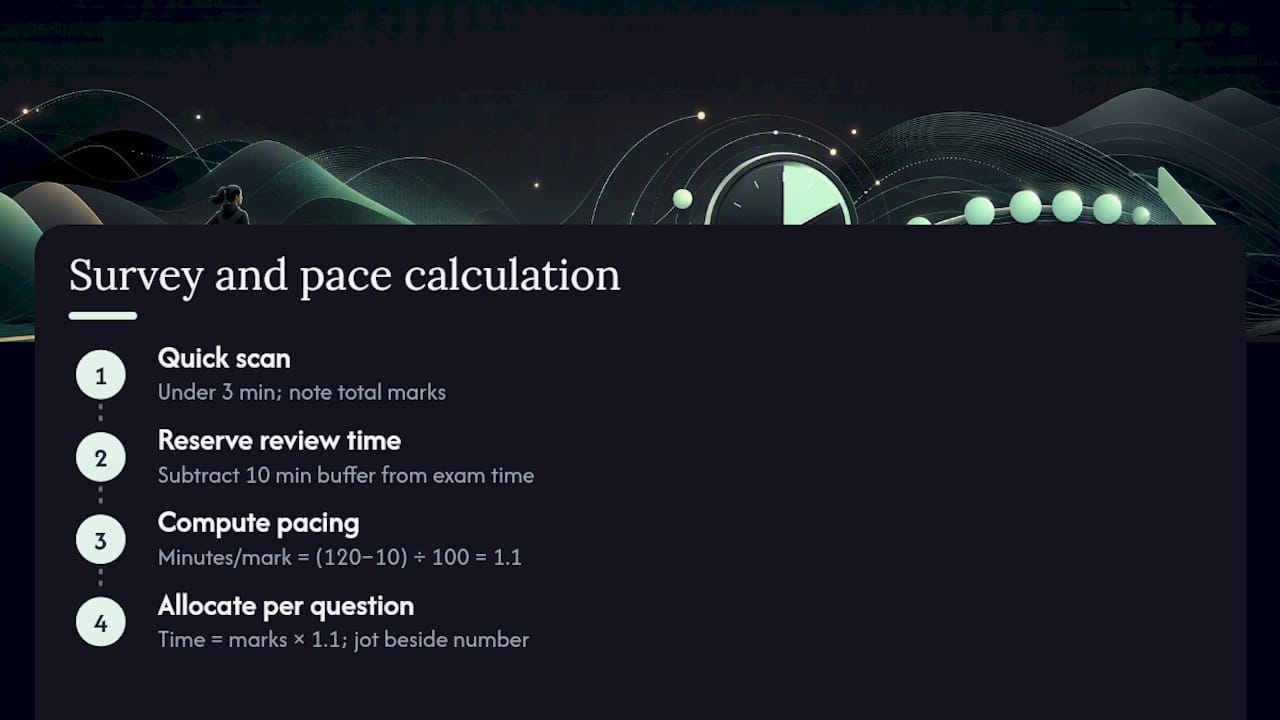
Flip through every page without stopping to read questions in full. You are looking for three things: the total number of questions, the marks attached to each, and any question that is unusually long or unusually high-value. Jot the total marks in the top corner of your answer sheet. This takes under three minutes for most papers.
Now convert marks into minutes using the formula:
Minutes per mark = (Total exam time − 10 minutes review buffer) ÷ Total marks
For a 120-minute paper worth 100 marks: (120 − 10) ÷ 100 = 1.1 minutes per mark. Essay and short answer question times should be roughly proportional to their marks based on the pacing formula. Write those target times next to each question number on the paper itself.
Set two or three visible checkpoints
Pick two or three time checkpoints and write them on the top of your answer sheet. For a 120-minute paper, something like: 45 min: Section A done. 90 min: Section B done. 110 min: stop new questions. Glance at the clock at each checkpoint. If you are behind, you know immediately and can adjust, rather than discovering the problem in the last five minutes.
Mark questions before you start
As you survey, mark each question:
- ✓ Easy: answer immediately on the first pass.
- ~ Medium: attempt on the first pass, but do not overrun.
- ✗ Hard/unknown: skip on the first pass, return second.
This system, described in detail by the LongTermMemory pacing guide, removes the decision-making burden mid-exam. You are not deciding whether to skip a question under pressure; you already decided during the survey.
How to divide exam time: formulas, worked templates, and sample timing
The minutes-per-mark formula is more reliable than guessing time-per-question, especially on mixed-format papers where a 1-mark MCQ and a 15-mark essay sit in the same section. Dividing time by marks keeps your pacing proportional to what the marker actually rewards.
Worked example: 120-minute mixed paper (100 marks)
- Total time: 120 minutes
- Review buffer: 10 minutes
- Working time: 110 minutes
- Minutes per mark: 110 ÷ 100 = 1.1 min/mark
Sample timing templates by exam type
Adjust the buffer upward for essay-heavy papers because transfer errors (writing the right answer in the wrong section) are more costly and harder to spot quickly.
Pro Tip: Write your checkpoint times on the exam paper in pencil at the start. Checking a clock and mentally calculating how far behind you are wastes 30–60 seconds every time. Pre-written checkpoints make the check instant.
Answer tactics by question type
Multiple-choice questions
- Read the question stem before looking at the options.
- Eliminate obviously wrong answers first; you are often choosing between two, not four.
- Watch for absolute qualifiers: “always,” “never,” “only.” These are usually wrong.
- Pace at roughly 1 minute per mark. If a question takes longer than that, mark it and move on.
- Never leave an MCQ blank if there is no penalty for guessing.
Short answers and calculations
Show your working even when the answer is wrong. Partial credit for method is real. Write in concise, direct sentences: one point per sentence, no padding. For calculations, label every step with the formula you are using. If you get a strange answer, note “I believe this is incorrect but cannot find the error” and move on rather than spiralling.
Essays
Spend 3–5 minutes planning before you write a single sentence of the essay itself. A rough skeleton looks like this:
- Intro (2–3 sentences): State your argument and the main points you will cover.
- Body paragraph 1: Topic sentence → evidence → link back to the question.
- Body paragraph 2: Same structure, different point.
- Body paragraph 3 (if time allows): Counterargument or nuance.
- Conclusion (2–3 sentences): Restate the argument, no new information.
A marker reading 200 essays in a sitting rewards clear structure. A well-organised average answer often scores higher than a brilliant but chaotic one. Planning long answers briefly before writing is one of the most consistent pieces of advice across exam technique guides, and it works because it prevents the most common time-sink: writing yourself into a corner and having to restart.
How to recover if you are behind, stuck, or panicking
Falling behind does not mean failing. It means you need a decision framework, not more effort on the same question.
The skip-and-return rule
If a question has consumed more than double its per-mark time budget and you are not close to finishing, stop and move on. Write a bullet point or two of what you know, circle the question number, and return if time allows. A partial answer with key terms visible often earns more credit than a blank.
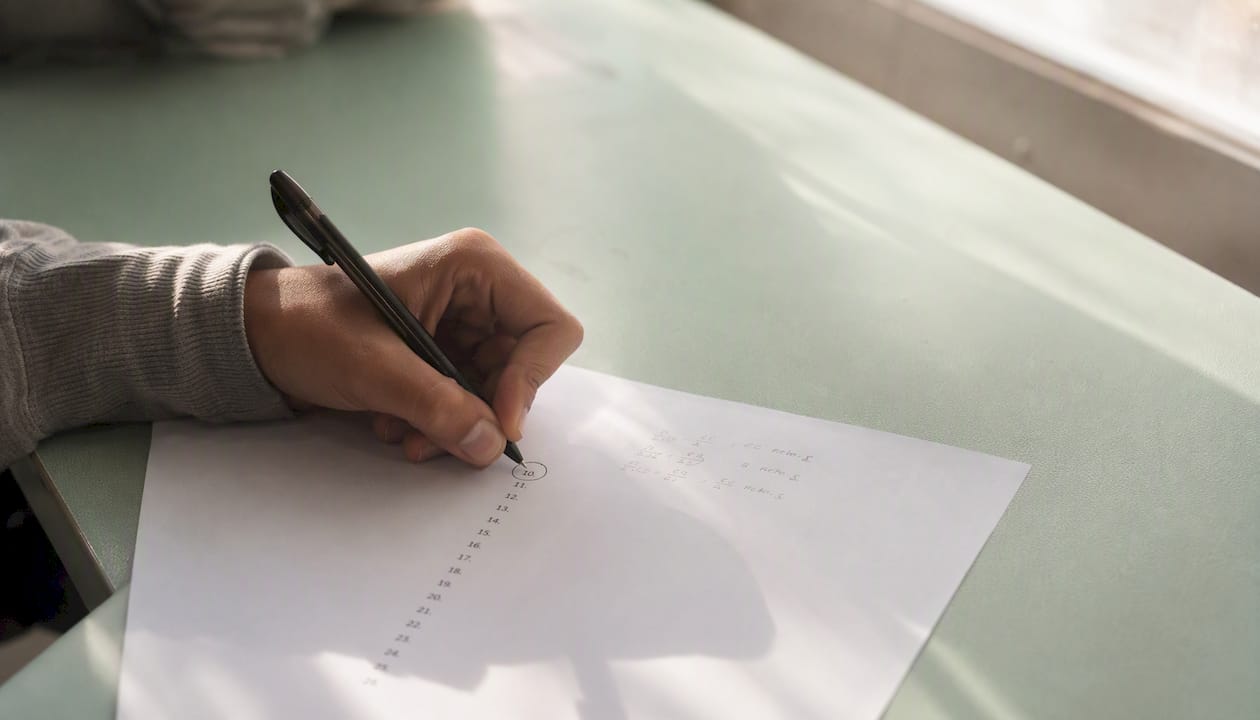
The decision flow is simple: stuck for more than double the time budget → write key points as bullets → circle → move on → return in second pass → triage by marks value.
Converting blanks into partial credit
A blank earns zero. Three bullet points showing you understand the concept earn something. If you genuinely do not know the full answer, write what you do know: the relevant formula, the key term, the main argument. Markers are trained to award credit for demonstrated understanding, not just complete answers.
Calm-reset when panic hits
Stop writing. Take three slow breaths. Look at your checkpoint times to confirm how much time you actually have left. Panic distorts time perception; students in a spiral often believe they have five minutes when they have twenty. Stopping new questions in the final 10 minutes and shifting entirely to checking and filling blanks recovers more marks than rushing through one more question.
A practical 4-week practice plan and timed drills
The evidence for timed, repeated practice is strong. Meta-analytic research shows that retrieval practice and spaced practice reliably improve retention compared with single-session study. Timed past-paper drills are both: you retrieve under pressure, and spacing them across weeks locks in the learning.
4-week schedule
Week 1 — Section drills: Pull one section per day from a past paper. Set the timer for the marks-based budget. Stop when it goes off. Log your minutes-per-question in a notebook.
Week 2 — Half-paper sits: Complete half a paper under timed conditions. Compare your actual time per section against your target. Adjust your template if a section type consistently overruns.
Week 3 — Full timed papers: Sit a complete past paper with no interruptions. Use the survey-checkpoint-review routine every time. Mark against the memo immediately after.
Week 4 — Mixed and pressure sits: Mix papers from different years or subjects. Focus on the skip-and-return rule and the final 10-minute review.
Papersza’s library of past papers gives you the raw material for every week of this schedule, organised by subject, grade, and year, with memos included. For Grade 12 students, the Grade 12 past papers folder covers all subjects in one place.
Timed drills
- 20-minute MCQ sprint: 20 MCQs, 1 minute each, mark immediately.
- 30-minute essay outline drill: Write a full essay plan (no prose) for three different questions in 30 minutes.
- Handwriting speed set: Write continuously for 10 minutes, count lines, repeat weekly to track improvement.
Log your data. If you consistently overrun on essays by 5 minutes, your per-mark rate for essays needs to go up in your template.
Printable one-page checklist and exam-day time-plan template
Copy this onto a single sheet the night before, or write the time-plan section directly onto your exam paper during the survey phase.
Exam-day checklist
- [ ] Pens (×2), pencil, eraser packed
- [ ] Arrival time confirmed (at least 15 minutes early)
- [ ] Exam duration and total marks known
- [ ] Minutes-per-mark formula memorised: (Time − 10) ÷ Total marks
- [ ] Checkpoint times written on answer sheet during survey
- [ ] Questions marked ✓ / ~ / ✗ during survey
- [ ] First pass: answer ✓ and ~ questions only
- [ ] Second pass: return to ✗ questions
- [ ] Final 10 minutes: stop new questions, check, fill blanks
- [ ] Every question has at least something written
Sample time-plan (copy into your exam paper)
Total time: ___ min   Total marks: ___   Min/mark: ___
Checkpoint 1: ___ min → Section ___ complete
Checkpoint 2: ___ min → Section ___ complete
Stop new questions at: ___ min
Review until: end
Tools worth having: a reliable pen with a comfortable grip (hand fatigue is real in a 3-hour paper), a spare pen, and a watch or clock you can see without turning around. If you need extra answer sheets, exam centres manage these separately from your main paper, so request one early rather than waiting until the last minute.
The part most students get wrong about exam timing
The standard advice is “practise past papers.” That is correct but incomplete. What actually builds timing instinct is practising past papers with a strict stop rule: when the timer goes off, you stop, even mid-sentence. Most students practise past papers and then give themselves “just five more minutes.” Those five minutes are the problem. They train you to overrun.
The survey step is similarly undervalued. Students treat it as optional, something to do if they have spare time. It is the opposite: it is the step that makes every other minute more efficient. A student who surveys the paper and writes checkpoint times spends the rest of the exam executing a plan. A student who skips the survey spends the rest of the exam improvising one.
The final 10-minute rule is where the most marks are recovered or lost. Checking high-value answers and fixing transfer errors consistently recovers more points than attempting a new question you barely started. The instinct to keep writing is strong; the discipline to stop and check is what separates a good result from a great one.
Sources
- PubMed entry (testing/spaced practice literature)
- Manage Timed Exams — Open edX documentation
- How to Manage Your Time in an Exam: 10 Expert Tips
- Time management in exams | Latimer Tuition
- How to Manage Time Effectively During an Exam - Tutor Doctor Australia
FAQ
How do you manage time during an exam?
Survey the paper first, convert marks into a minutes-per-mark budget, set two or three checkpoint times, answer easy questions first, and stop starting new questions in the final 10 minutes to check and fill blanks.
What is the minutes-per-mark formula?
Subtract a 10-minute review buffer from your total exam time, then divide by the total marks available. On a 120-minute, 100-mark paper that gives you 1.1 minutes per mark.
What are the five core time management skills for exams?
Planning (survey and checkpoint-setting), prioritisation (easy-first ordering), pacing (minutes-per-mark budgeting), adaptability (skip-and-return when behind), and review (final 10-minute check). These five skills map directly onto the survey-to-review routine described throughout this article.
What should you do if you run out of time on a question?
Write the key points as brief bullet notes, circle the question number, and move on. Partial answers showing relevant knowledge earn partial credit; a blank earns nothing.
How far in advance should you practise timed past papers?
Start section drills at least four weeks before the exam and build to full timed papers by week three. Spacing practice across weeks, rather than cramming it into the final days, is what the retrieval practice research shows produces durable retention.