Grade 12 Mathematics Paper 2 topics: your full checklist

Mathematics Paper 2 covers four topic areas: Euclidean geometry, analytical geometry, statistics and regression, and trigonometry. Those are the DBE’s own breakdown, and every past paper you’ll ever sit follows it.
One exam note before you plan your studying: the paper runs to a fixed time and mark total, comes with a formula/statistical tables sheet, and permits only a non-programmable, scientific calculator.
- Euclidean geometry: triangles, circles, proofs, constructions
- Analytical geometry: lines and circles in coordinate form
- Statistics and regression: scatter plots, correlation, spread
- Trigonometry: triangle solving, identities, graphs, bearings
Want to see exactly how these show up in real exams? Grade 12 past papers on PapersZA are the fastest way to find out.
Key Takeaways
Mastering Mathematics Paper 2 means drilling four fixed topic areas and practising them under real exam timing with official memos.
| Point | Details |
|---|---|
| Four topics only | Paper 2 covers Euclidean geometry, analytical geometry, statistics and regression, and trigonometry. |
| Interpretation earns marks | Statistics and regression questions reward written explanations of slope and correlation, not just calculations. |
| Proofs need structure | Geometry answers should follow Given, RTP, then step-by-step reasons to capture method marks. |
| Time yourself often | Sit full three-hour papers under real conditions and mark strictly against the memo. |
| Practise with PapersZA | Download free official Grade 12 DBE and IEB papers and memos at PapersZA for targeted, memo-checked practice. |
Table of Contents
- What does the Mathematics Paper 2 exam actually look like?
- Which Euclidean geometry topics come up in Paper 2?
- What analytical geometry skills does Paper 2 test?
- How are statistics and regression questions marked?
- What trigonometry topics and question types appear in Paper 2?
- How should you plan your Paper 2 study schedule?
- How do you use past papers and memos to prepare?
- What examiners actually look for in your answers
- Where to find Grade 12 Paper 2 past papers fast
- Where to verify the syllabus and find more practice material
- Sources
- FAQ
What does the Mathematics Paper 2 exam actually look like?
Paper 2 typically runs for a fixed time and total marks, split across questions that move from straightforward calculation to multi-step reasoning. The DBE exam guidelines confirm you’ll be given an information sheet with formulae and statistical tables. You won’t need to memorise the regression formula or the sine rule from scratch, but you do need to know where each one sits on that sheet and when to reach for it.
Only non-programmable, non-text-storing scientific calculators are allowed, and exam rules require you to clear the memory before you walk in.
- Roughly 3 hours, 150 marks
- Formula and statistical tables sheet supplied
- Scientific calculator only, memory cleared beforehand
Pro Tip: Spend the first five minutes of reading time mapping which questions are pure calculation and which need diagrams or proofs. Tackle the calculation ones first to bank marks before your hand starts cramping on geometry sketches.
Which Euclidean geometry topics come up in Paper 2?
Euclidean geometry is where marks get lost fastest, not because the maths is hard but because the reasoning has to be written a specific way. You need triangle properties (isosceles, similar, congruent), the full set of circle theorems, and the logic behind similarity and congruence proofs. Constructions like perpendicular bisectors and angle bisectors still appear, and angle-chasing across combined figures is almost guaranteed.
Expect four question formats: short one-line reasoning steps, full multi-line proofs, construction instructions, and applied problems that stack two or three theorems on top of each other.
- Triangle properties and similarity/congruence conditions
- Circle theorems (tangent, chord, cyclic quadrilateral rules)
- Angle-chasing across combined shapes
- Formal proofs and geometric constructions
Examiners penalise proofs that jump steps or state a conclusion without the matching reason. Structure every proof the same way: state what’s given, state what you’re proving, then list each step with its reason written right next to it.
Pro Tip: Write “Given,” “RTP” (required to prove), and “Proof” as literal headings in your answer. Examiners scan for structure before they check your logic, and a labelled answer earns partial marks even if you stall halfway through.

What analytical geometry skills does Paper 2 test?
Analytical geometry puts algebra and geometry on the same coordinate grid, and Paper 2 expects fluency, not just familiarity. You need the equation of a straight line (gradient and intercept forms), the distance and midpoint formulae, the equation of a circle, and how to find where two lines or a line and a circle intersect.
Typical tasks include finding the equation of a line through two given points, calculating where a line cuts a circle, solving closest-point or perpendicular-distance problems, and combining coordinate work with a Euclidean geometry proof in one question.
- Equation of a line: gradient, intercept, point-gradient form
- Distance formula and midpoint formula
- Equation of a circle and completing the square to find its centre
- Intersections between two lines, or a line and a circle
Build a fixed calculator routine for these before exam day: know your calculator’s keystrokes for solving simultaneous equations and computing distances so you’re not fumbling menus under time pressure. Efficient keystrokes save real minutes when a question stacks three sub-parts on top of each other.
How are statistics and regression questions marked?
Statistics questions test whether you understand what a number means, not just whether you can calculate it. You’ll construct and read scatter plots, calculate a correlation coefficient, find a regression line, and explain what its slope and intercept actually represent in context. Central tendency and spread (mean, median, variance, interquartile range) show up too, often through boxplots or histograms.
Examiners commonly ask for a sentence, not a number: something like “for each additional hour studied, the mark increases by approximately X,” which means a correct calculation with no interpretation sentence attached often loses marks.
- Scatter plots and identifying the type of correlation
- Correlation coefficient and line of best fit (regression)
- Mean, median, variance, and interquartile range
- Boxplots, histograms, and outlier identification
Interpretation questions are where students who understand the topic pull ahead of students who just memorised the formulae, since examiners frequently test the meaning of a slope or the strength of a correlation rather than the raw calculation alone. Use your calculator’s regression mode to get the numbers fast, then spend your remaining time writing the context sentence properly.
What trigonometry topics and question types appear in Paper 2?
Trigonometry combines pure skill questions with applied problems, and Paper 2 tests both. You need the Sine and Cosine Rules for solving triangles, the standard trig identities, solving trig equations over a given interval, sketching and transforming trig graphs, and applied bearings problems involving height, distance, or navigation.
Question types generally follow a pattern: a short identity-proof, an equation to solve within a stated range, a graph to sketch or read off, and a longer applied problem tying two or three of these together, sometimes with a diagram you have to label yourself.
- Sine Rule, Cosine Rule, and area of a triangle formula
- Trig identities and solving equations within a given interval
- Sketching and transforming trig graphs
- Bearings and applied 2D/3D problems
Keep your calculator in degree mode unless a question explicitly says radians, and always check your solution falls inside the stated interval. Losing marks to an extraneous solution or a wrong angle mode is one of the most common, and most avoidable, mistakes on this paper.
Pro Tip: Write the Sine Rule, Cosine Rule, and the compound angle identities on a single index card and recite them daily for two weeks before the exam. They’re on the formula sheet, but knowing them cold means you spend zero seconds hunting for them mid-question.
How should you plan your Paper 2 study schedule?
Rotating through topics beats grinding one subject for a week straight, especially since Paper 2 loves combining geometry, coordinate work, and trig in a single question.
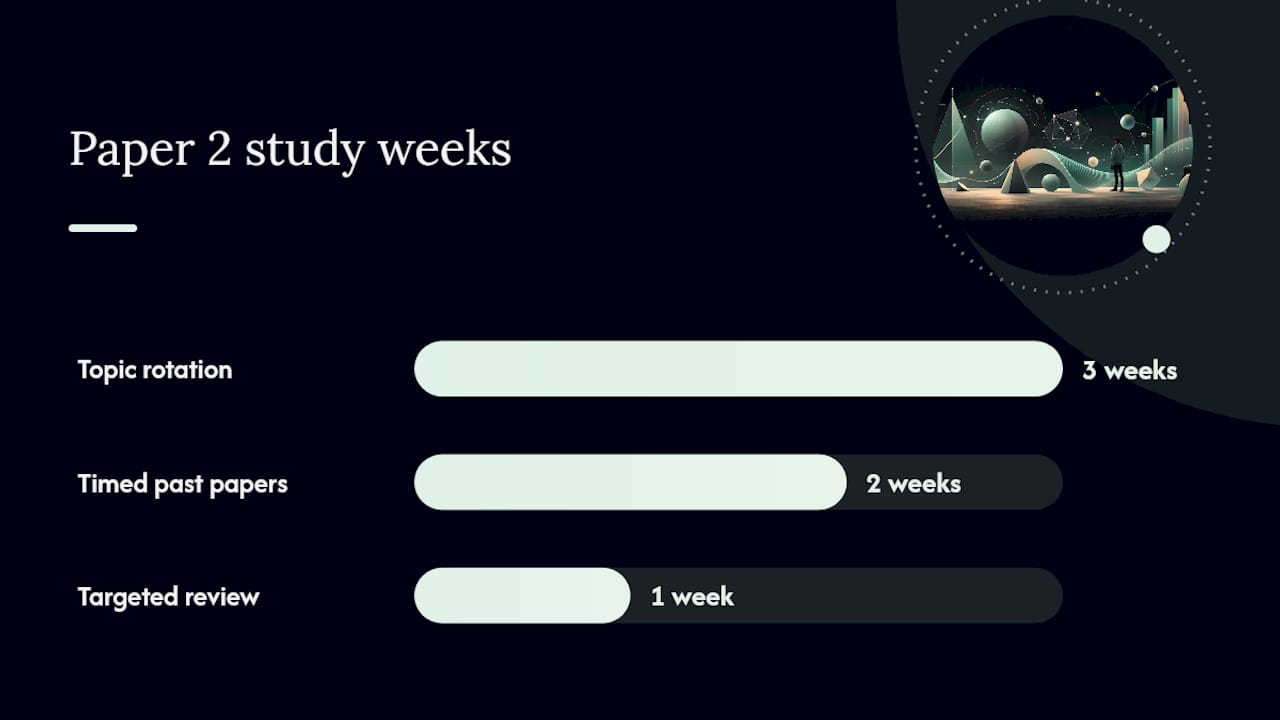
- Weeks one to three: work through Euclidean geometry, analytical geometry, statistics, and trigonometry in rotation, spending two to three days per topic before moving on.
- Weeks four to five: switch to full timed past papers under real exam conditions, marking every attempt against the official memo.
- Final week: target only the question types that keep tripping you up, using your memo corrections as your topic list.
Timing yourself matters more than most students think. Sit a full three-hour paper without your phone nearby, mark it honestly against the memo, then write a short note on exactly where each mark was lost.
Pro Tip: Keep a running “correction log” of every mark you lose to a silly mistake versus a genuine gap in understanding. After three or four past papers, that log tells you precisely where your last two weeks of studying should go.
How do you use past papers and memos to prepare?
Pick a Grade 12 Mathematics Paper 2 from a recent year, sit it under timed conditions, then mark it yourself against the official memo before you check any explanation online. PapersZA hosts DBE and IEB papers with matching memos, all free to download with no account needed.
Use the memo to learn the examiner’s expected method and notation, not just to check whether your final answer matches. Marking this way reveals exactly which steps carry method marks even when your final answer is wrong.
- Select a recent Grade 12 Paper 2 and time yourself strictly
- Mark against the memo, line by line, not just the final answer
- Log every mistake by topic and retest that topic a week later
- Rotate through several years’ papers to spot repeating question patterns
What examiners actually look for in your answers
Structure and labelling carry more weight than most students expect. A neat, labelled diagram with the given information marked on it earns marks before you’ve written a single equation, and clear reasoning next to each geometry step often matters more than the final number.
Method marks exist precisely because examiners want to see your thinking, not just your answer. Correct your past papers properly, write clearly, and don’t rush the presentation.
Where to find Grade 12 Paper 2 past papers fast
Buying a printed study guide or hunting through scattered PDF links online costs you time you don’t have in matric year. PapersZA gets you straight to the source: official DBE and IEB Grade 12 Mathematics past papers with their matching memos, searchable by year, free to download, no account required.
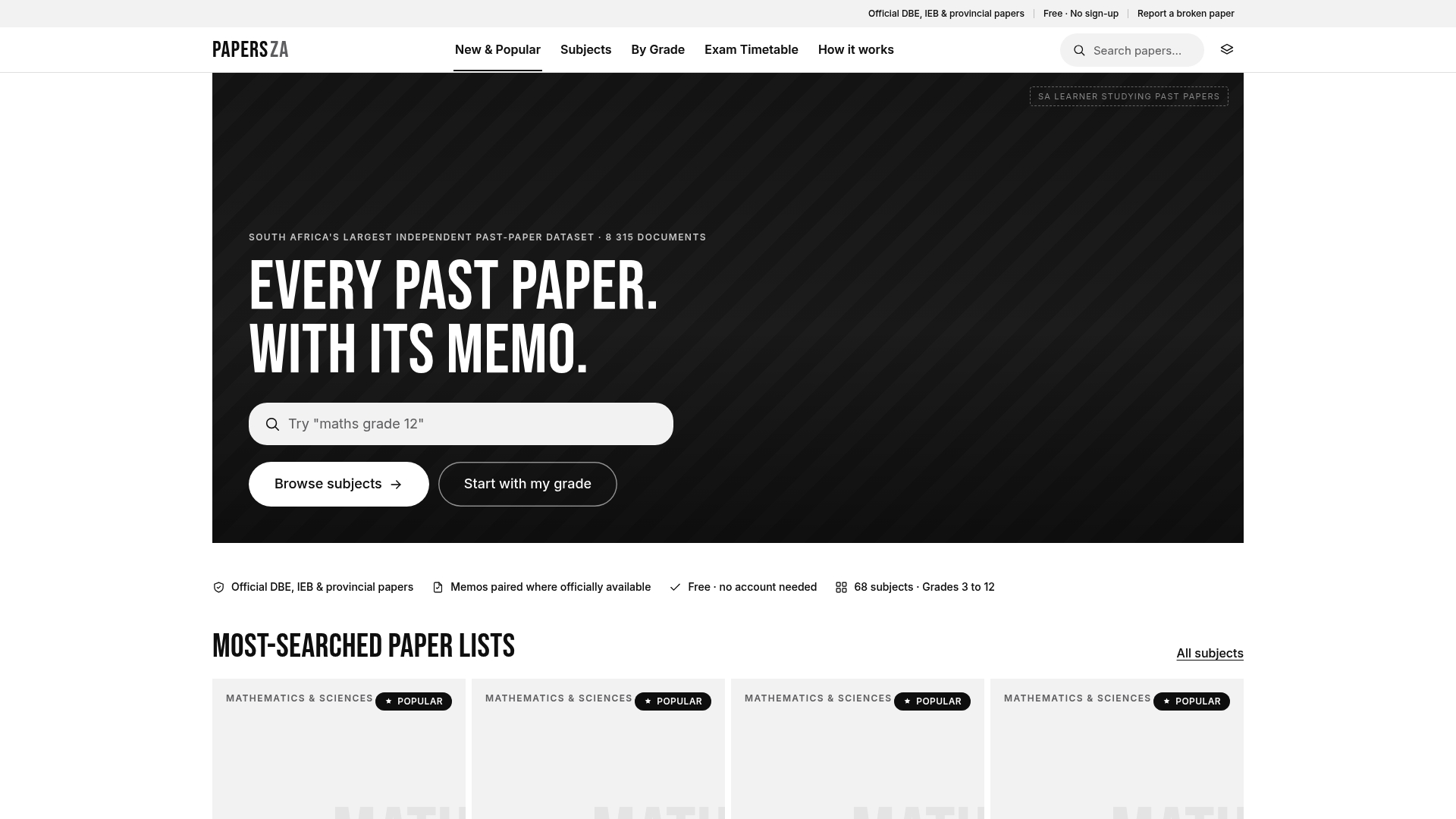
That directness matters more than it sounds. Instead of digging through forum links or paying for a bundled study pack, you search by grade and subject, download the paper and memo together, and start timing yourself within minutes. The Grade 12 hub covers every subject if you’re juggling Paper 2 alongside other exams, and the how-it-works page shows first-time users exactly how the search works. If your algebra or graph skills feel shaky going into analytical geometry, the Grade 11 archive is worth a detour before you tackle a full Paper 2. Start with last year’s paper, mark it against the memo, and let your mistakes set tomorrow’s study list.
Where to verify the syllabus and find more practice material
For exact syllabus wording and formula sheet content, go straight to the DBE’s Mathematics page and the exam guidelines document, both official and specific to South Africa. For hands-on practice, the Grade 12 Mathematics archive on PapersZA gives you real past papers and memos.
- DBE Mathematics page: official topic list and subject requirements
- DBE exam guidelines: confirms format, formula sheets, and calculator rules
- PapersZA Grade 12 hub: free past papers and memos for timed practice
- Cambridge 9709 syllabus: useful international comparison for how Paper 2-style topics get grouped
Sources
FAQ
What topics are in Mathematics Paper 2?
Paper 2 covers Euclidean geometry, analytical geometry, statistics and regression, and trigonometry, following the DBE’s official subject list.
Is a formula sheet provided in Paper 2?
Yes. The DBE exam guidelines confirm candidates receive an information sheet with formulae and statistical tables, so you don’t need every formula memorised.
What calculator can I use in Paper 2?
Only a non-programmable, non-text-storing scientific calculator is permitted, and its memory must be cleared before the exam starts.
How is Euclidean geometry tested differently from other topics?
Euclidean geometry relies heavily on written proofs and labelled diagrams, so marks depend on structured reasoning (Given, RTP, step-by-step reasons) rather than a single final answer.
Where can I find real Grade 12 Paper 2 past papers to practise?
PapersZA hosts free official DBE and IEB Grade 12 Mathematics past papers with matching memos, downloadable without an account.