Three moves that lift your Maths Literacy mark this week

Three things move a Grade 12 Mathematical Literacy mark faster than anything else: lock down Paper 1 basics, run one full past paper under timed conditions every week, and write out full method on every Level 3 and 4 question, even when you’re not sure of the final answer. That last habit alone recovers marks most learners throw away.
Here’s why those three matter more than the rest. Each paper is 3 hours long and worth 150 marks, and Levels 1 and 2 together make up roughly 60% of the total mark. Get those right consistently and a pass is within reach before you’ve solved a single hard question.
- Secure Paper 1 basics: finance, measurement, and data handling fundamentals.
- Do one full timed past paper weekly, self-marked with the memo.
- Write complete method on every Level 3 and 4 question, with units and a short justification.
Do this now: download a Grade 12 Mathematical Literacy past paper and memo from PapersZA and attempt Question 1 under timed conditions, tonight.
Key Takeaways
Passing Grade 12 Mathematical Literacy comes down to mastering Level 1 and 2 basics, practising weekly under timed conditions, and writing full method on every answer.
| Point | Details |
|---|---|
| Prioritise Levels 1 and 2 | These make up roughly 60% of the total mark across both papers. |
| Practise weekly under real time pressure | Sit one full past paper a week and self-mark against the memo. |
| Show complete method | Method marks are awarded even when the final arithmetic is wrong. |
| Keep an error log | Record the specific mistake, not just the topic, and fix it within 48 hours. |
| Use PapersZA for practice papers | Free Grade 12 Mathematical Literacy past papers and memos, no account needed. |
Table of Contents
- Maths literacy exam tips: know the structure before you study
- What topics should you focus your maths literacy study tips on?
- How do past papers and memos improve your score?
- Why does showing your working matter so much?
- How should you structure a six-week revision plan?
- Where can you get reliable help beyond self-study?
- A small daily habit that actually moves the mark
- Where to find every past Maths Literacy paper you need
- Sources
- FAQ
Maths literacy exam tips: know the structure before you study
You can’t plan revision time well if you don’t know what you’re up against. The NSC Mathematical Literacy exam has two papers, each 3 hours long and worth 150 marks, for a total of 300 marks across the subject. Your final mark combines exam and school-based assessment, and the pass mark is set at a standard minimum level.
Marks are also split across four cognitive levels, and this is the detail most learners never check: Level 1 is 30%, Level 2 is 30%, Level 3 is 20%, and Level 4 is 20%, each with a five percentage point margin either way.

A majority of every paper focuses on Levels 1 and 2. That’s the practical reason drilling basics beats chasing the hardest questions in a textbook.
What topics should you focus your maths literacy study tips on?
The CAPS content for Grade 12 groups into five areas, and each one shows up in a recognisable question format year after year. The DBE revision booklet covers all five with model questions and model answers.
Finance: simple vs compound interest, loan repayments, hire purchase, tax and PAYE calculations, budgets and break-even scenarios. Expect at least one full finance question per paper.

Data handling: reading bar graphs, pie charts, and scatter plots; calculating mean, median, mode, and range; interpreting a five-number summary.
Measurement: conversions between units, perimeter, area, volume, and scale, usually wrapped in a real-world context like painting a wall or filling a tank.
Maps, plans, and other representations: reading floor plans, using scale to estimate real distances, and interpreting seating plans or timetables.
Probability: usually a smaller, standalone section testing basic likelihood and relative frequency.
Finance and data handling tend to carry more weight across both papers, while maps and probability appear in smaller, more predictable doses. Pull three or four questions on each topic from past papers and time yourself before checking the memo.
How do past papers and memos improve your score?
Past papers work because they show you the exact phrasing examiners use, not the softened version in a textbook. The workflow matters more than the volume of papers you attempt.
- Warm up for 30 to 60 minutes on isolated skills, one topic at a time, before touching a full paper.
- Sit a full timed past paper once a week, using a real clock and no interruptions.
- Self-mark against the memo line by line, not just the final number.
- Keep an error log: write down what went wrong and why, not just that you lost marks.
- Re-practise the weak topic from the log within 48 hours, using fresh questions from a different past paper.
Memos are also a teaching tool, not just an answer key. Compare your step order to the memo’s step order. Examiners often reward the sequence, not just the destination, so if your logic skipped a step, that’s your fix for next week.
Pro Tip: Learn your calculator’s M+, M-, and MR memory keys before exam season. The DBE recommends mastering these functions because storing a subtotal mid-calculation cuts down retyping, and retyping is where most careless errors creep in.
Your best source for repeat practice is the Grade 12 Mathematical Literacy past paper collection on PapersZA, paired with the DBE revision booklet for topic exemplars.
Why does showing your working matter so much?
Mathematical Literacy rewards process, not just the right final number. On Levels 3 and 4 especially, examiners award marks for clearly written method and justification, meaning a wrong final answer with correct method still earns most of the marks available.
A reliable structure for any multi-step question: identify what’s being asked, write the formula you’ll use, substitute the numbers, show every calculation step, then conclude with correct units and a short sentence saying why your answer makes sense in context.
Three habits quietly cost learners marks every year: leaving out units, rounding too early in a multi-step calculation instead of at the final answer, and skipping intermediate steps because “the answer is obvious.” None of those save real time, and all three lose marks that were sitting there for the taking.
Here’s roughly what a Level 4 recommendation answer should look like:
Monthly repayment on Loan A is R2,450; on Loan B it is R2,180. Loan B costs R270 less per month. I would recommend Loan B, because the lower monthly repayment reduces strain on the household budget, even though the total interest paid over the loan term is slightly higher.
Before submitting any answer, run through three checks: are the units correct, is the method fully visible, and does the final number make sense given the context. A distance of 4,000 km for a school trip down the road is a red flag, and catching that costs you ten seconds.
How should you structure a six-week revision plan?
Six weeks is enough time to move a mark meaningfully if the structure is right. Weeks 1 and 2 focus on basics and Paper 1 style questions: finance and measurement drills, calculator practice, and one timed past paper. Weeks 3 and 4 shift to Paper 2 contexts: data handling, maps and plans, and probability, still with weekly timed practice. Weeks 5 and 6 mix full timed past papers from both papers, targeting whatever topics your error log flags as weakest.
Daily sessions of 30 to 60 minutes beat occasional long cramming blocks, and consistent sleep supports memory retention better than a late night the night before a test. On exam day, a rough guide is about 1.2 minutes per mark, so a 6 mark question should take roughly 7 minutes. If you’re stuck past that, mark it, move on, and return if time allows.
Parents can help without being maths experts: check that past papers are actually being completed each week, confirm SBA tasks are submitted on time, and protect study time from other commitments during the final six weeks.
Where can you get reliable help beyond self-study?
Your subject teacher is the right person for SBA queries and topic clarification; school support classes and peer study groups work well for accountability and talking through method. Accredited tutors help when a specific topic keeps stalling despite repeated practice.
- Use the DBE revision booklet for topic exemplars and model answers.
- Try Thutong’s exemplar papers for extra exposure to question style.
- Pair memos with your error log, focusing on method language, not just final answers.
A small daily habit that actually moves the mark
Learners chase big revision sessions and skip the small habit that compounds fastest: five minutes every evening spent reviewing one question you got wrong that day, and writing down exactly why. Not the topic, the specific mistake. “Rounded too early” or “forgot to convert units” is more useful to future-you than “finance was hard.”
Working through PapersZA’s past papers alongside this habit builds a pattern most learners never see coming: by week four, the errors you’re logging start repeating less, because you’ve already caught them once.
Aim for something realistic rather than perfect. If Paper 1 becomes genuinely solid, that alone gives you a floor to build the rest of your mark on, and that’s a far better target than trying to master everything at once.
Where to find every past Maths Literacy paper you need
There are other routes to exam readiness: a private tutor, a school revision class, a printed study guide. All of them work, but none give you free, unlimited access to real exam papers the moment you need them at 9pm on a Tuesday.
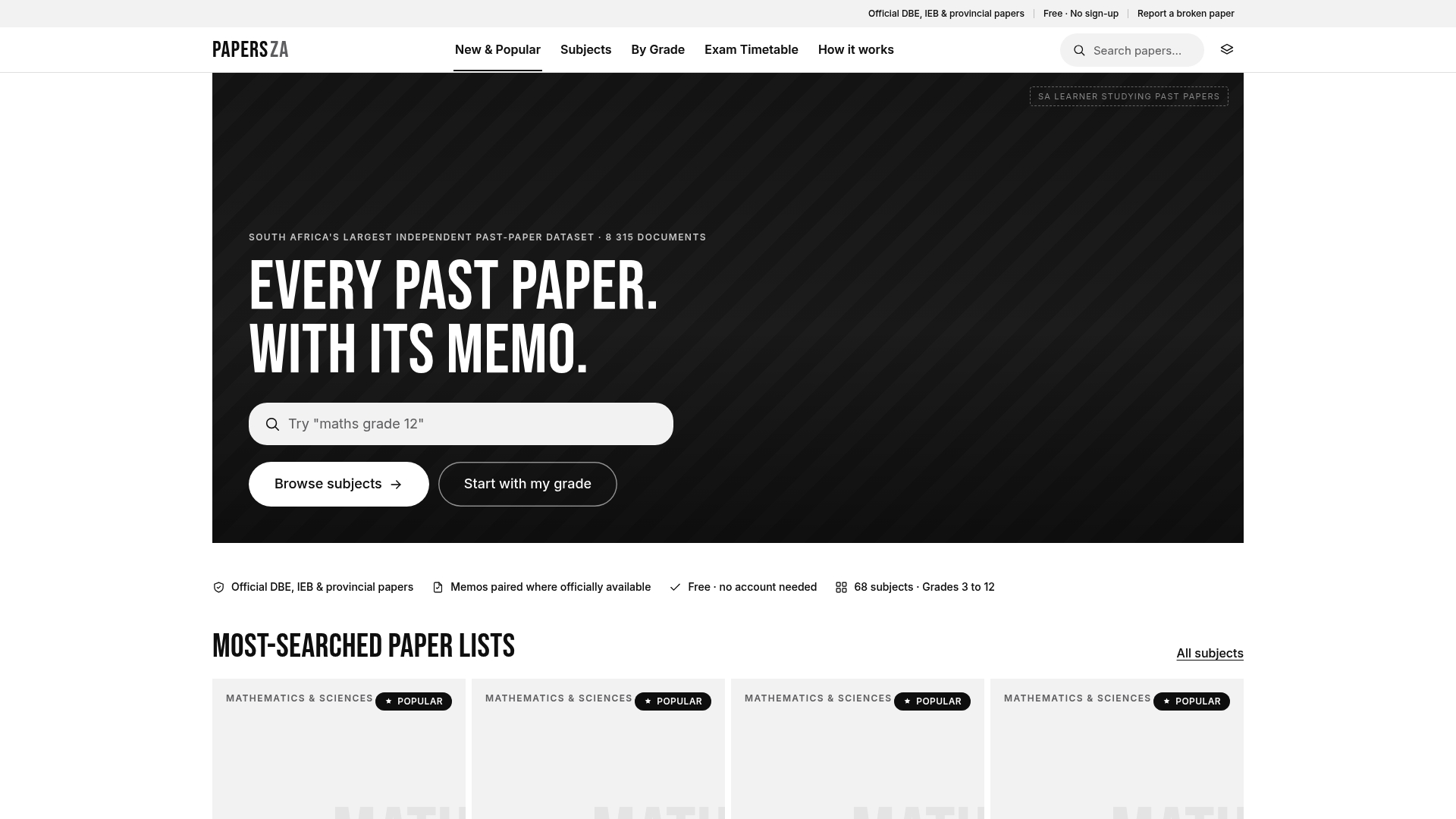
Papersza hosts every Grade 12 Mathematical Literacy past paper and memo, organised by year, so you can build the exact weekly practice routine described above without hunting across multiple sites or paying for access. No account, no sign-up, no paywall between you and the paper you need tonight.
Download this week’s Grade 12 Mathematical Literacy past paper, time yourself against the clock, then self-mark using the memo. If you’re a parent new to the site, the how PapersZA works page walks through exactly how to search, download, and use the memos properly.
Sources
- DBE: Mathematical Literacy (Grade 12) — examination information and related documents
FAQ
How can I prepare for a maths literacy test?
Focus your first pass on Level 1 and 2 basics across finance, measurement, and data handling, then sit weekly timed past papers from PapersZA and self-mark against the memo.
How do I get close to full marks in a maths exam?
Consistent full marks require complete method on every question, correct units, and a short justification on reasoning questions, since Levels 3 and 4 examiners specifically reward that structure.
How can I pass maths literacy?
How can I understand maths literacy more easily?
Read the full real-world context before calculating anything, underline the key numbers and units, and identify exactly what’s being asked before choosing a formula.
What calculator skills do I actually need?
A basic calculator is sufficient. Learn the M+, M-, and MR memory functions so you can store intermediate results and avoid retyping numbers during multi-step questions.