Matric pass requirements: the complete 2026 guide

What are the matric pass requirements in South Africa?
To earn a National Senior Certificate (NSC), the official South African matric qualification, you must meet minimum standards set by the Department of Basic Education across at least seven subjects. The core matric pass requirements come down to this:
-
Pass at least six subjects (out of seven offered)
-
Score at least 40% in Home Language
-
Score at least 40% in two other subjects
-
Score at least 30% in three additional subjects
-
Complete Life Orientation (compulsory, but excluded from APS and pass-level calculations)
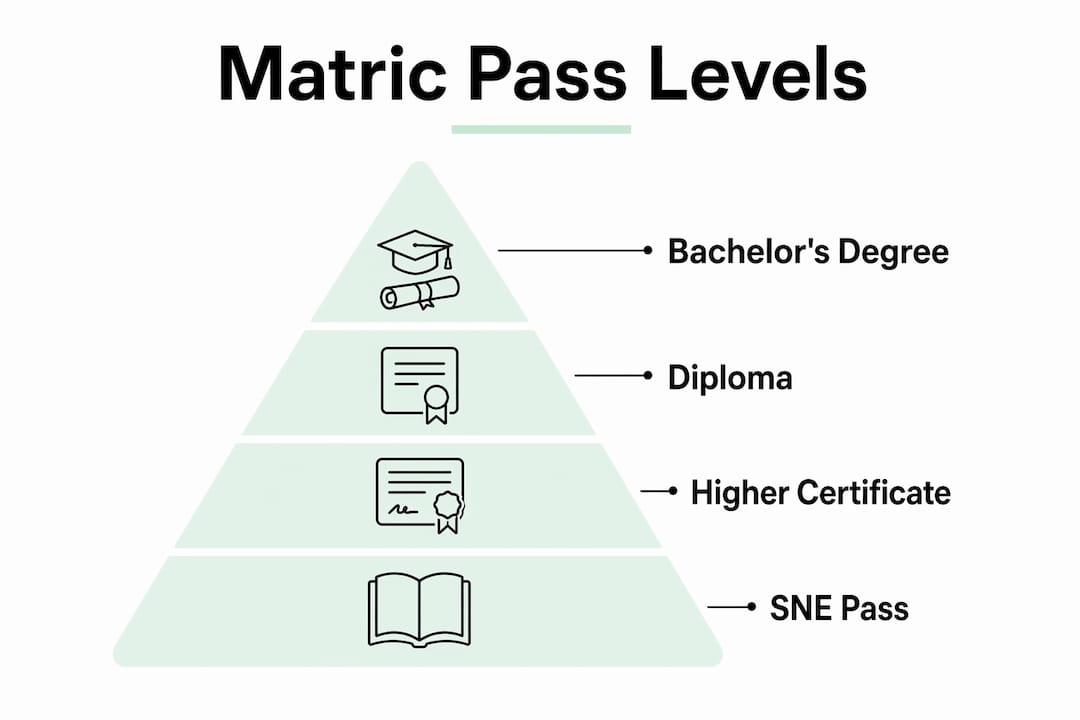
There are three main pass levels: Higher Certificate, Diploma, and Bachelor’s Degree pass, each opening different post-school study options. Failing Home Language or passing too few subjects results in failure of the NSC regardless of other results.
Table of Contents
- How do the three matric pass levels differ?
- What are the minimum subject scores you need?
- What is APS and why does it matter for university?
- How to find official past matric papers and memos
- What happens if you get a conditional or supplementary pass?
- Which bodies oversee matric exams in South Africa?
- Do matric pass requirements differ by province or school type?
- Key takeaways
- FAQ
How do the three matric pass levels differ?
The pass level you achieve shapes what you can study after school. Here is exactly what each one requires, per the Western Cape Government’s NSC guidelines:
Higher Certificate pass
- At least 40% in Home Language
- At least 40% in two other subjects
- At least 30% in three additional subjects
- Pass at least six subjects
This level gives access to Higher Certificate programmes at colleges and some universities of technology. It is a starting point, not a ceiling.
Diploma pass
- At least 40% in Home Language
- At least 40% in three other subjects (excluding Life Orientation)
- At least 30% in two other subjects
- Pass at least six subjects
A Diploma pass opens doors to diploma programmes at universities of technology and TVET colleges. The key difference from a Higher Certificate pass is one additional subject at 40%.
Bachelor’s Degree pass
- At least 40% in Home Language
- At least 50% in four subjects (excluding Life Orientation)
- At least 30% in one other subject
- Pass at least six subjects
This is the highest matric pass level and the one required to apply to a university for a degree. High-credit subjects such as Mathematics, Life Sciences, Accounting, and Physical Sciences carry particular weight here. A Bachelor’s pass allows university application but does not guarantee admission — universities set their own additional criteria.
A fourth category, the SNE (Special Needs Education) pass, applies to learners in special needs programmes and requires 30% in an official language and 30% in four other subjects.

What are the minimum subject scores you need?
The percentage thresholds are straightforward once you see them laid out, but a few details catch students off guard.
- Home Language: minimum 40% — non-negotiable across all pass types
- Other subjects: 40% or 30% depending on the pass level you are targeting
- You may fail one subject and still qualify for the NSC, provided all other minimum requirements are met
- Failing Home Language below 40% means failing matric, full stop
- Failing more than one subject also results in NSC failure
Failing one subjectExaminations.aspx) does not automatically end your matric result — the rules allow for one subject failure while still qualifying, which surprises many students and parents.
One persistent misconception: Mathematics is not compulsory to pass matric. Mathematical Literacy counts as a valid subject for the NSC, and students can meet all pass requirements with it. That said, specific university programmes, particularly in engineering, commerce, and health sciences, may require Mathematics specifically. So the choice between Mathematics Grade 12 and Mathematical Literacy depends heavily on your intended career path.
Life Orientation marksExaminations.aspx) cannot compensate for weak performance elsewhere. Strong results in Life Orientation will not lift your APS or push you into a higher pass category.
What is APS and why does it matter for university?
Passing matric gets you the NSC. Getting into a competitive degree programme is a different conversation, and that is where the Admission Point Score (APS) comes in.

APS is a points system universities use to assess academic eligibility beyond the NSC pass level. Each subject mark translates into a points value on a standardised scale, and universities set minimum APS thresholds for each faculty or programme. A Bachelor’s pass is the entry ticket; your APS determines whether you actually get in.
Key points about APS:
- Life Orientation is excluded from APS calculations entirely
- APS is calculated from your six best subjects (excluding Life Orientation)
- Higher marks in high-credit subjects like Mathematics and Physical Sciences push APS scores up significantly
- Competitive programmes such as Medicine, Law, and Engineering typically require APS scores well above the institutional minimum
- A Bachelor’s pass allows you to apply to university but does not guarantee admission; universities independently apply APS and subject-specific requirements
Pro Tip: Check the specific APS requirements for your target programme at each university before finalising your subject choices in Grade 10. Switching from Mathematical Literacy to Mathematics in Grade 12 is not an option.
How to find official past matric papers and memos
Practicing with real past papers is one of the most effective ways to prepare for matric exams. Seeing the actual question formats, understanding how marks are allocated, and working through official marking memos gives you a genuine edge.
Papersza is South Africa’s largest independent library of past exam papers, hosting over 8,315 documents covering grades 3 to 12. Papers span DBE, IEB, and provincial sources, and most come paired with detailed marking memos.
- No account or registration required — download directly
- Papers are organised by subject, grade, year, and exam session
- Covers all major matric subjects including English Home Language, Mathematics, Mathematical Literacy, Life Sciences, Accounting, and more
- Memos allow genuine self-assessment, not just practice
Pro Tip: Work through a past paper under timed exam conditions, then mark it using the official memo. The gap between what you thought you answered and what the memo awards marks for is exactly where your study focus should shift.
Students, parents, and educators can navigate Papersza by selecting a subject and grade to find the relevant papers immediately. The exam timetable on the site also helps with scheduling study sessions around actual NSC exam dates.
What happens if you get a conditional or supplementary pass?
Not every matric result is a clean pass or fail. Two outcomes sit in between.
A supplementary pass means you narrowly missed the requirements in one subject. The Department of Basic Education offers supplementary exams, typically in February/March, where students can rewrite that subject to meet the full NSC requirements. Passing the supplementary exam upgrades your result to a full NSC pass.
A conditional pass is issued when a student has met most requirements but falls short in one area. The result is held conditionally until the outstanding requirement is met, usually through a supplementary exam or subject rewrite.
Students who do not pass matric also have structured options. The Second Chance Matric Support Programme run by the Department of Basic Education provides support for rewrites, and TVET colleges offer National Certificate (Vocational) programmes as an alternative pathway into further education and employment.
Which bodies oversee matric exams in South Africa?
The Department of Basic Education (DBE) is the primary authority governing NSC examinations nationally. It sets the curriculum, examination standards, and pass requirements that apply across all nine provinces.
Two main examination bodies operate within this framework:
- Umalusi is the quality council that accredits and moderates matric examinations, certifying that results meet national standards before they are released.
- The Independent Examinations Board (IEB) administers matric exams for independent schools. IEB results are benchmarked against NSC standards and are accepted by all South African universities.
Provincial education departments, such as the Western Cape Education Department and the Northern Cape Department of Education, administer the NSC exams within their provinces under DBE oversight. The Matriculation Board at the University of South Africa (UNISA) handles endorsement requirements for certain university admission pathways.
Do matric pass requirements differ by province or school type?
The core NSC pass requirements are national and uniform. Whether you write matric in Limpopo, the Western Cape, or KwaZulu-Natal, the minimum percentages and subject counts are identical. Provincial education departments administer the exams but do not set different pass thresholds.
Where differences do appear:
- IEB schools follow the same pass-level structure as the NSC but use their own exam papers. IEB results are widely regarded as rigorous and are accepted at all South African universities.
- CAPS curriculum applies nationally, meaning subject content is standardised regardless of province.
- Adult learners aged 21 and older who did not complete matric during school can pursue the amended Senior Certificate, a separate qualification that provides a matric-level credential through a different examination pathway.
- SNE learners follow modified promotion requirements as outlined by the DBE.
The practical implication: if you move provinces mid-school career, your matric requirements do not change. The NSC is a national standard.
Key takeaways
To pass matric in South Africa, you need at least six subjects passed, 40% in Home Language, and the right mark distribution across remaining subjects to qualify for your target pass level.
| Point | Details |
|---|---|
| Six subjects minimum | Pass at least six of seven subjects; failing more than one means failing the NSC. |
| Home Language is critical | A score below 40% in Home Language results in automatic NSC failure. |
| Three pass levels | Higher Certificate, Diploma, and Bachelor’s passes each require progressively higher marks. |
| Life Orientation excluded | Life Orientation is compulsory but does not count toward APS or Diploma/Bachelor’s calculations. |
| APS determines university entry | A Bachelor’s pass opens the door; your APS score and subject marks determine whether you get in. |
FAQ
What is the minimum percentage needed to pass matric?
You need at least 40% in Home Language and 30% in most other subjects, though the exact distribution depends on which pass level you are targeting. A Bachelor’s pass requires 50% in four subjects.
What are the four types of matric pass?
The NSC recognises a Higher Certificate pass, a Diploma pass, a Bachelor’s Degree pass, and an SNE (Special Needs Education) pass, each with different mark and subject requirements.
Is 40% a pass in matric?
It depends on the subject. 40% is the minimum for Home Language and counts as a pass in other subjects for a Higher Certificate. For a Bachelor’s pass, four subjects must reach 50%.
Does failing one subject mean failing matric?
Not necessarily. You may fail one of your seven subjects and still qualify for the NSC, provided all other minimum pass requirements are met across your remaining subjects.