Matric results 2026 release date: what students and parents need to know

The 2026 NSC results (covering the 2025 November examinations) were announced by the Minister on 12 January 2026, with individual results available on the DBE portal from 06:00 on 13 January 2026. The full-year 2026 NSC examinations (written in October/November 2026) will follow the same pattern, with a ministerial announcement expected in mid-January 2027.
Here is what to do right now:
- Check your result at the DBE results portal from 06:00 on the release morning using your examination number.
- Collect your Statement of Results from your school or exam centre — this is the only document universities and bursary providers accept.
- Verify your personal details (name, ID number, subject marks, endorsement) on the statement before leaving.
- Apply for a re-mark or re-check within the short window that opens on the same day results are released.
- Contact your school or district office immediately if your result does not appear online.
Table of Contents
- Which official bodies publish matric results and how announcements are made
- How to check your 2026 matric results step by step
- What to do right after you get your result
- Where to find past papers and study resources for re-sits
- Key takeaways
- What to realistically expect on results day
- Free past papers for your re-sit, right now
- Useful sources
- FAQ
Which official bodies publish matric results and how announcements are made
Three layers of official communication cover every NSC release.
The Department of Basic Education (DBE) issues the primary ministerial announcement, publishes the national pass rate and provincial breakdown, and opens the candidate-level results portal. The DBE release pageExaminations/ReleaseofNSCExamsResults.aspx) carries the official date and links to the portal.
Gov.za hosts the Minister’s speech, media statements, and the confirmation of newspaper publication. The gov.za results guidance page is the clearest single-page summary for families who want to know where to look.
Provincial education departments (Gauteng, Western Cape, KwaZulu-Natal, and others) publish local guidance, correction timelines, and sometimes their own portals. The Western Cape Education Department, for example, advises learners on how to request corrections after results are released.
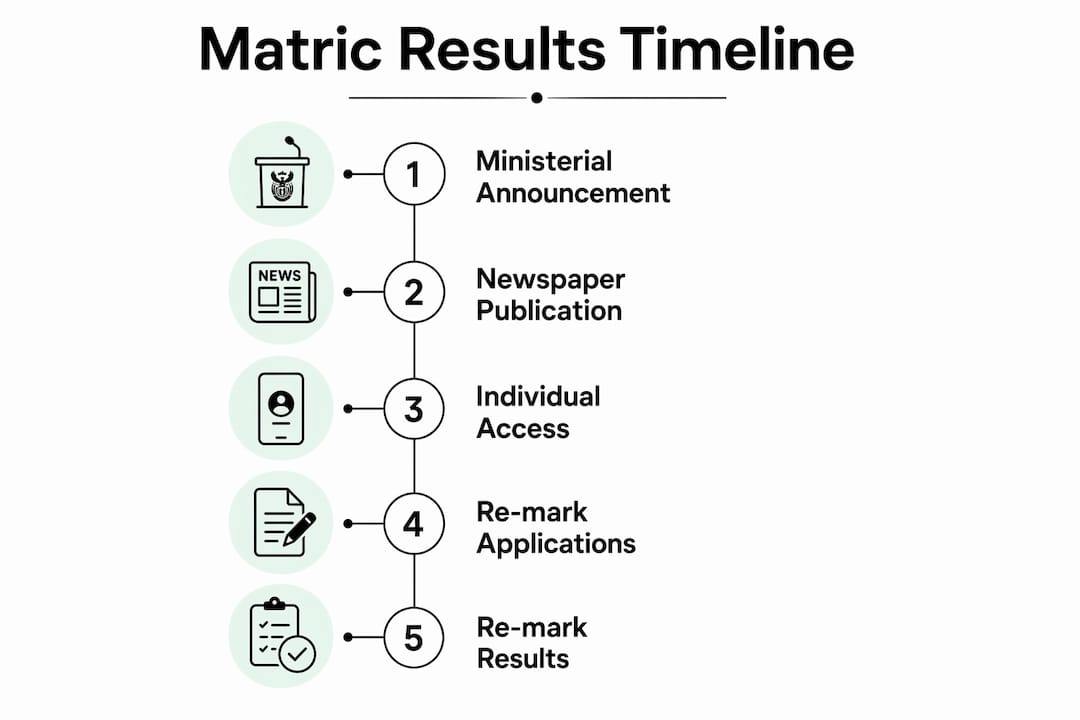
The release follows a two-step pattern every year: the Minister announces the national summary first, then individual access opens on the DBE portal the following morning. Newspapers receive results in a pseudonymised format showing only exam numbers and marks, never names or ID numbers, so they are useful for a quick scan but not for formal verification.
Pro Tip: To confirm an announcement is genuine, check that the URL starts with education.gov.za or gov.za. Any other site republishing results is secondary and may contain errors.
How to check your 2026 matric results step by step
The DBE portal is the fastest official channel, and it opens at roughly 06:00 on the morning after the ministerial announcement.
- Go to the DBE results portal at education.gov.za/MatricResults/ExamResults.aspx. Have your examination number ready — it is printed on your admission letter.
- Enter your examination number in the search field and submit. Your subject marks and overall result will display on screen.
- Try SMS or USSD if the site is slow. The DBE and some mobile networks offer SMS-based result lookups; check the DBE’s release-day media statement for the current shortcode or USSD string, as these can change between years.
- Visit your school or exam centre if online channels are congested. Schools receive results directly and can confirm your outcome while you wait for the portal to recover.
- Contact your district or provincial office if your result does not appear at all. Schools and provincial offices hold the primary records and can issue or confirm a Statement of Results independently of the online portal.
Once you have your result on screen, check four things immediately: your full name, your ID or exam number, each subject mark, and whether your certificate carries a Bachelor’s, Diploma, or Higher Certificate endorsement. An error on any of these needs to be flagged before you submit any application.
Pro Tip: Download or screenshot your online result as a backup, but remember that the printed Statement of Results from your school is the document that counts for formal applications.
What to do right after you get your result
Collect your Statement of Results first
The DBE is clear: the Statement of ResultsExaminations/ReleaseofNSCExamsResults.aspx) is available from your school or exam centre from 13 January 2026 (for the 2025 cohort), and it is the only accepted official document for university admission and bursary applications. An online screenshot does not substitute for it.

Apply for a re-mark or re-check quickly
The window is short. Based on the 2025 cohort, re-mark and re-check applications opened on 13 January 2026 and closed on 27 January 2026, with re-mark results released from 13 March 2026. Fees reported for that cohort were R120 for a re-mark and R30 for a re-check. Treat these as indicative; confirm the current fees and closing date with the DBE when the 2026 results are released.
| Milestone | Indicative date (based on 2025 cohort) |
|---|---|
| Ministerial announcement | 12 January 2026 |
| Individual results available (DBE portal) | 13 January 2026 from 06:00 |
| Re-mark / re-check window opens | 13 January 2026 |
| Re-mark / re-check window closes | 27 January 2026 |
| Re-mark results released | From 13 March 2026 |
A re-check means your script is rescanned and totalled again; a re-mark means an examiner re-marks it from scratch. Re-marks take longer and cost more, but they are the right choice if you believe a subject was marked incorrectly rather than just totalled wrong.
Pro Tip: If you are applying to university while waiting for a re-mark result, notify the admissions office in writing. Most institutions will hold a conditional offer pending the outcome.
Where to find past papers and study resources for re-sits
If your result means a re-sit, past papers are the most direct preparation tool available. Papersza hosts over 8,315 official DBE, IEB, and provincial documents spanning grades 3 to 12, all free to download without an account.
For Grade 12 re-sits, the most-used subject pages are:
- Mathematics Grade 12 past papers and memos — full papers with marking memos going back several years.
- English Grade 12 past papers and memos — useful for both language papers and for checking marking standards.
- Afrikaans Grade 12 past papers and memos — covers both Home Language and First Additional Language.
The most effective way to use past papers after results day is to work through the memo first, identify where your marks were lost, and then practise those specific question types under timed conditions. Memos show exactly what markers award marks for, which is more useful than re-reading a textbook.
The exam timetable page on Papersza lists official session dates, so you can plan a re-sit schedule from the day you decide to register.
Key takeaways
The 2026 NSC results follow a consistent pattern: ministerial announcement first, individual access from 06:00 the next morning, and a short re-mark window that closes within two weeks.
| Point | Details |
|---|---|
| Official release timing | Ministerial announcement on 12 January 2026; individual results on DBE portal from 06:00 on 13 January 2026. |
| Statement of Results | Collect the printed statement from your school — it is the only document accepted for university and bursary applications. |
| Re-mark / re-check window | Based on the 2025 cohort: opens 13 January, closes 27 January; fees were R120 (re-mark) and R30 (re-check). |
| Missing results | Contact your school or provincial office immediately; they hold primary records independently of the online portal. |
| Papersza for re-sits | Free Grade 12 past papers and memos at papersza.co.za — no account needed, available immediately after results day. |
What to realistically expect on results day
The DBE portal handles enormous traffic the moment it opens. Slowdowns in the first hour are normal, not a sign that something is wrong with your result. Schools receive results directly and can confirm your outcome while you wait for the portal to stabilise, so heading to your school early is often faster than refreshing a browser.
Newspaper listings are worth a glance if you want a quick confirmation, but they show only your exam number and marks. They cannot tell you your endorsement level or flag an error in your personal details, so they are a starting point, not a final check.
Once you have your statement in hand, the priority order is: verify personal details first, then decide on re-mark or re-check before the window closes, then submit university or bursary applications. These deadlines run in parallel, not in sequence, so plan accordingly.
Pro Tip: University application deadlines and re-mark result dates (typically mid-March) do not align. Submit your application on your current result and update it if the re-mark improves your marks — do not wait.
The national pass rate for the 2025 cohort was 88%, with KwaZulu-Natal (90.6%), Free State (89.33%), and Gauteng (89.06%) leading the provinces. That context matters: a result below the national average is not a dead end, and the May/June re-sit opportunity exists precisely for learners who need another attempt.
Free past papers for your re-sit, right now
If you need to improve a subject or attempt a re-sit, Papersza gives you the fastest route to real exam practice. South Africa’s largest independent past-paper library holds over 8,315 official documents — DBE, IEB, and provincial — covering grades 3 to 12, all free, no account required.
Start with the subjects that matter most for your next step. The English SAL Grade 12 page and the Mathematics Grade 12 page each carry multiple years of papers paired with detailed marking memos. Not sure where to begin? The how it works page walks you through finding the right paper in under a minute. Every document is available immediately — no waiting, no subscription, no cost.
Useful sources
The DBE confirms that the Statement of Results is available from the school or exam centre where the candidate wrote, and that this is the official document required for university admission and bursary applications.
Official DBE and government pages:
- DBE NSC results release pageExaminations/ReleaseofNSCExamsResults.aspx) — official release dates and Statement of Results guidance.
- DBE exam results portal — candidate-level result lookup.
- Gov.za check matric results — plain-language guidance on how and where to check.
- Gov.za newspaper publication statement — confirms pseudonymised format in accredited newspapers.
- Minister Siviwe Gwarube’s 2025 NSC results speech — official announcement and provincial breakdown.
Provincial portals:
- Gauteng matric results portal — Gauteng-specific result lookup and re-mark results.
- Western Cape Education Department — local guidance on corrections and administrative timelines.
Study resources:
- Papersza Grade 12 past papers — free DBE, IEB, and provincial papers with memos, no account required.
FAQ
What time will matric results be available online?
Individual results go live on the DBE portal at approximately 06:00 on the morning after the ministerial announcement. For the 2025 cohort, that was 06:00 on 13 January 2026.
Will matric results be published in newspapers in 2026?
Yes. Accredited newspapers receive results in a pseudonymised format showing only exam numbers and marks, not names or ID numbers, to protect learner privacy.
How do you check matric results in South Africa?
Use your examination number on the DBE results portal, via SMS or USSD if available, or collect your Statement of Results directly from your school or exam centre.
Which province performs best in matric results?
Based on the 2025 NSC results announced in January 2026, KwaZulu-Natal led with a 90.6% pass rate, followed by Free State at 89.33% and Gauteng at 89.06%, against a national pass rate of 88%.
Where can I find past papers to prepare for a re-sit?
Papersza hosts over 8,315 official past papers and memos for grades 3 to 12, free to download with no account needed, at papersza.co.za.