Matric study timetable for Grade 12: printable templates

Your matric study timetable works best when it starts with the official exam dates and a printable planner you can fill in today. Pin the NSC exam timetable from the Department of Basic Education (DBE) or the Independent Examinations Board (IEB), then download a blank weekly planner and slot your subjects in before the week is out.
A timetable that actually holds up through the year has five core elements:
- Official exam dates anchored first — work backwards from each paper to set priority weeks
- Timed study blocks of 45–60 minutes per subject, not vague “study” labels
- Subject rotation across days so you never spend a full day on one topic
- Weekly review slot (Sunday evening works well) to check what was done vs. planned
- Buffer slots on at least two afternoons per week to absorb missed sessions without panic
Table of Contents
- How do you build a matric study timetable step by step?
- Printable timetable templates you can copy right now
- What should you actually do in each study slot?
- How many hours should you study at each stage of the year?
- Common timetable mistakes Grade 12 students make
- What should your timetable look like in the final two weeks?
- Key takeaways
- Why a living timetable beats a rigid one
- Free past papers, memos, and printable timetables from Papersza
- Useful sources and downloadable resources
- FAQ
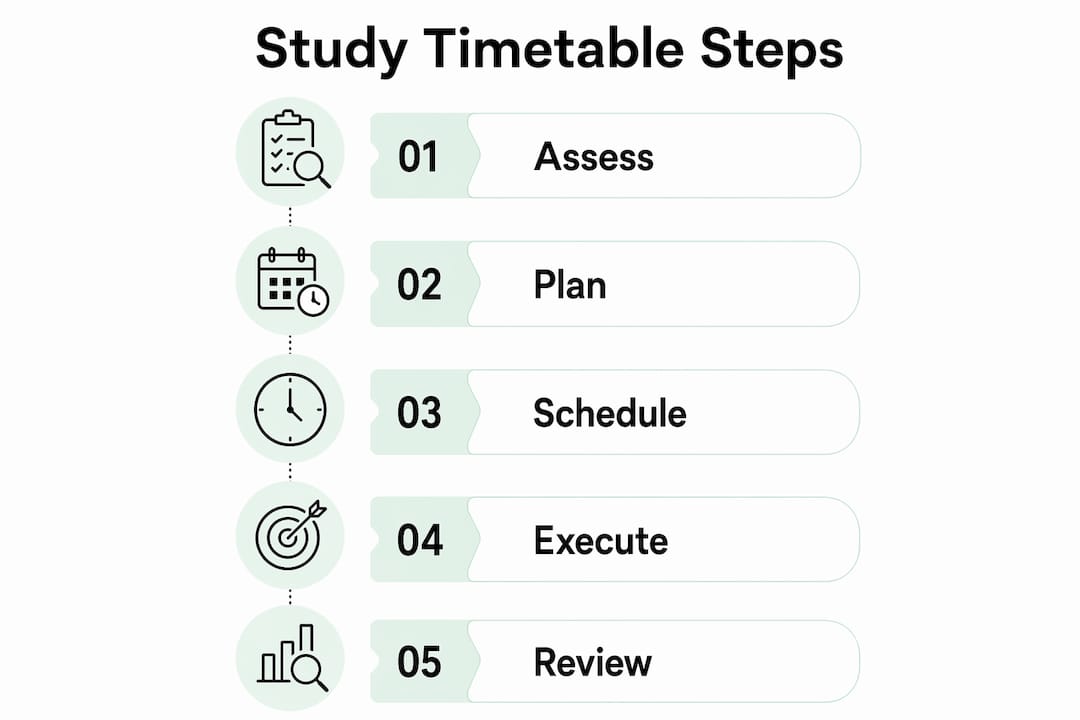
How do you build a matric study timetable step by step?
A timetable built in the right order takes less than an hour to set up and is far more likely to survive contact with real life.
-
Get the official exam dates first. The DBE publishes the NSC exam timetableExaminations/ExamTimetable.aspx) each year; IEB students should check the IEB portal. Print or screenshot the dates and stick them somewhere visible. Every other decision flows from these dates.
-
Run a time audit. Draw a blank seven-day week and block out school hours, travel, meals, family commitments, and a minimum of eight hours of sleep per night. What remains is your real study time. Most Grade 12 students find a few usable hours on weekdays and more on weekends once commitments are mapped honestly.
-
Rank your subjects by difficulty and exam weight. Put your weakest subjects and highest-credit papers at the top. These get the first and best slots in your day, not the leftovers.
-
Write specific task labels, not vague ones. “Maths: Trig past paper P1, timed 40 min” is a task. “Study Maths” is a wish. Specific labels cut the time you waste deciding what to do when you sit down.
-
Rotate subjects across days. Spending six hours on one subject in a single day produces diminishing returns after the first two. Alternate between subjects within a day and across the week.
-
Build in buffer slots and a weekly review. Assign at least two short catch-up blocks per week (Friday or Saturday afternoons are popular) and a fixed Sunday evening review. These two habits are what prevent schedule collapse after a bad week.
-
Schedule timed past-paper practice from Term 3 onwards. Past papers under exam conditions are the single most effective preparation tool. Block at least one timed paper per subject per week from the start of Term 3.
Pro Tip: Treat your first timetable as a one-week experiment. Run it, record what you actually completed, and adjust the following week based on real data, not optimism.
The South African academic calendar shapes when you shift focus. Terms 1 and 2 are for building content knowledge. Term 3 is when past-paper practice should start dominating. Term 4 is almost entirely past papers under timed conditions, with memo review after each one.
Printable timetable templates you can copy right now
Four template types cover every stage of the year. Use the right one for where you are.
- Daily template — best for exam week or any week when you need hour-by-hour control
- Weekly template — the workhorse for Terms 2–3; shows all subjects across seven days at a glance
- 8-week block plan — maps the shift from content learning to past-paper practice; use it from mid-Term 3
- Exam-week template — day-by-day, subject-by-subject; fill it in the Sunday before each exam week starts
Sample daily timetable (copy and adapt)
| Time | Activity | Subject / Task |
|---|---|---|
| — | Morning prep | Breakfast, review yesterday’s flashcards |
| — | School | — |
| — | Session 1 | Weakest subject: worked examples or past-paper questions |
| — | Break | Walk, snack |
| — | Session 2 | Second priority subject: notes or memo review |
| — | Break | — |
| — | Session 3 | Third subject or buffer / catch-up slot |
| — | Personal time | — |
| — | Session 4 (optional) | Flashcards, summary notes, or reading |
| — | Wind down | No screens; prep for tomorrow |
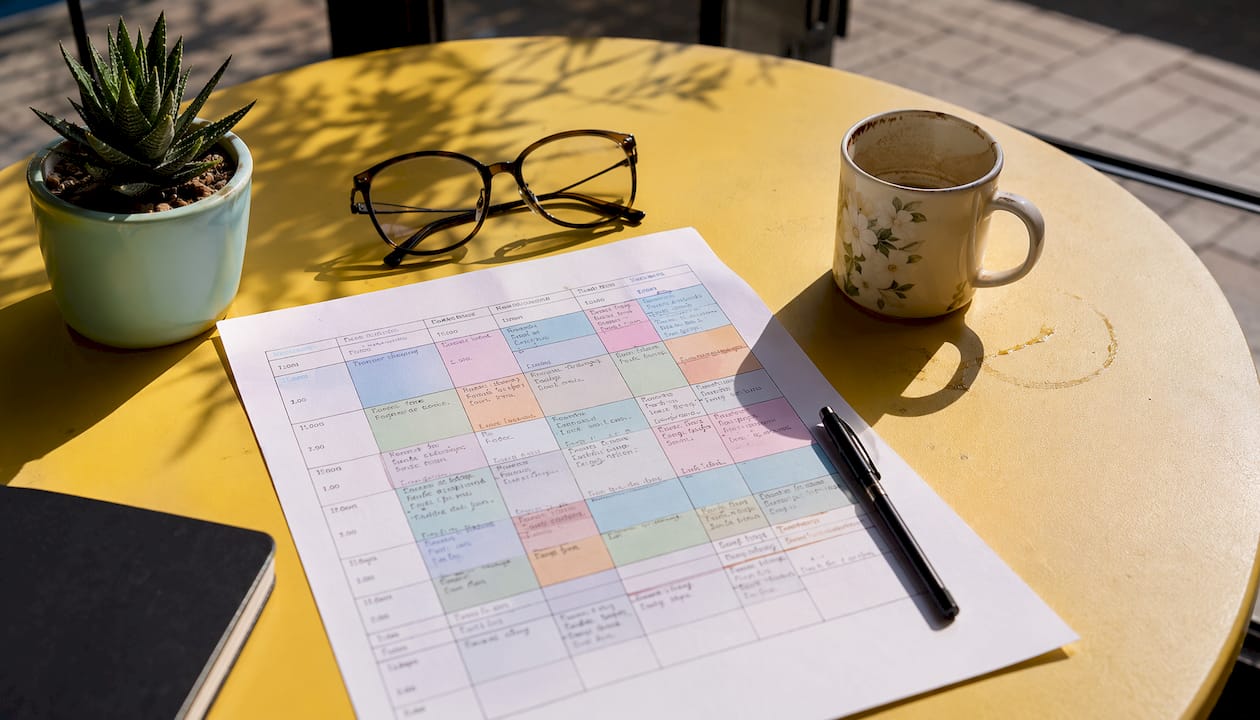
Sample weekly planner (Term 3 example)
| Monday | Tuesday | Wednesday | Thursday | Friday | Saturday | Sunday | |
|---|---|---|---|---|---|---|---|
| Afternoon 1 | Maths P1 timed | Life Sciences notes | English essay plan | Maths P2 timed | Buffer / catch-up | Accounting past paper | — |
| Afternoon 2 | Business Studies | Physical Sciences | History source work | Life Sciences past paper | Buffer / catch-up | Free | Weekly review |
| Evening | Flashcards | Summary notes | Memo review | Flashcards | Rest | Rest | Plan next week |

Specific task phrasing matters. Instead of “Accounting,” write “Accounting: Income Statement past paper, timed 45 min, mark with memo.” Specific labels reduce start-up time and decision fatigue at the start of each session.
For the 8-week block plan, the split shifts progressively: weeks 1–3 are roughly 70% new content and 30% practice; weeks 4–6 flip to 40% revision and 60% timed papers; weeks 7–8 are almost entirely full timed papers with memo review after each one.
What should you actually do in each study slot?
A timetable slot is only as good as what happens inside it. These methods produce the most return per hour for matric-level work.
- Active recall — close your notes and write down everything you remember about a topic before checking. This beats re-reading by a wide margin.
- Spaced repetition — revisit a topic after one day, then three days, then a week. Flashcards (physical or digital) make this easy to track.
- Worked examples — for Maths and Physical Sciences especially, work through problems step by step without looking at the solution first.
- Timed past papers — sit the paper under real exam conditions: no notes, no phone, strict time limit. Papersza hosts free Grade 12 past papers for every major subject, paired with official memos.
- Memo-driven marking — after a timed paper, mark your own work using the official memo. This is where the real learning happens.
The workflow for a past-paper session looks like this: timed paper (full or section) → mark with memo → log every error in a notebook → schedule a targeted revision session on those exact topics within 48 hours.
Pro Tip: Read the memo carefully for command-word patterns. When the DBE exam guidanceExaminations/Tipsforexampreparations.aspx) says “evaluate,” it expects a judgment with evidence — not just a description. Memos show you exactly how many marks each part of an answer earns, which tells you where to spend your words.
A 50-minute block works well when structured as: 5–10 minutes reviewing the previous session’s notes or flashcards, 35–40 minutes of focused work on the day’s task, and 5–10 minutes writing a brief summary or making new flashcards. That closing summary is what most students skip — and it is what makes the content stick.
How many hours should you study at each stage of the year?
The honest answer is: it depends on the stage, not a fixed daily number.
- Terms 1–2 (early year): Aim for focused hours per weekday outside school, with longer sessions on Saturdays. Focus is on understanding new content and keeping up with school assignments.
- Term 3 (pre-trials): Increase study time per weekday. Trials are your dress rehearsal; treat them like the real thing. Start timed past papers weekly.
- Final 6 weeks (Term 4, pre-NSC): Dedicate more focused hours outside school on weekdays and weekends. Past papers dominate. New content learning drops sharply.
Three example daily schedules for different availability profiles:
- Low availability (heavy extracurricular or work commitments): a few shorter study blocks on weekdays and longer sessions on Saturday. Prioritise your two weakest subjects every week without exception.
- Typical availability: several study blocks on weekdays and weekend days. Rotate all subjects across the week.
- High availability: more frequent study blocks on weekdays and full session on weekends. Use the extra time for additional past papers and memo review, no longer passive reading sessions.
Pro Tip: A focused 45-minute block with a timer beats two unfocused hours every time. Use a phone timer or a physical stopwatch, put the phone face-down, and stop when it rings. Track your completed blocks, not your hours — it is a more honest measure of productive study.
Common timetable mistakes Grade 12 students make
Most timetables fail for the same small set of reasons. Each one has a straightforward fix.
- Planning too many hours. Scheduling 8 hours of study on a school day is not ambitious — it is a setup for failure. Fix: cap weekday study at 4 hours maximum and build from there.
- No buffer slots. One sick day or family event collapses the whole week. Fix: assign two short catch-up blocks per week before you need them.
- Vague task labels. “Study Physics” tells you nothing when you sit down. Fix: write the exact task, paper, and time limit for every slot.
- Ignoring the official exam timetable. Students who do not check the DBE or IEB timetable early sometimes discover two papers fall on consecutive days. Fix: pin the official exam dates on day one and plan backwards from every paper.
- Skipping timed past papers. Reading notes feels productive; sitting a timed paper feels uncomfortable. That discomfort is the point. Fix: schedule at least one timed paper per subject per week from Term 3.
- Never reviewing the timetable. A plan made in January does not fit a student in September. Fix: every Sunday evening, check what was completed, what was skipped, and adjust next week’s plan accordingly.
A weekly audit takes about 15 minutes. Mark each slot as done, partially done, or missed. If you missed the same subject three weeks in a row, that is a signal to move it to a better time slot, not to add more of it on Friday night.
What should your timetable look like in the final two weeks?
The final two weeks before NSC exams are not the time to learn new content. They are for consolidating what you already know and building exam confidence through repetition.
- Two weeks out: shift to roughly 90% timed past papers and 10% targeted revision on specific weak areas identified from memo marking. Stop trying to cover new chapters.
- One week out: one full timed paper per day for your upcoming subjects. Mark each paper the same evening. Sleep at least eight hours — memory consolidation happens during sleep, not during late-night cramming.
- 48 hours before each paper: review your error log from the past few weeks. Focus only on topics that appeared in multiple papers. Do not start new topics.
- The evening before: lay out your stationery, ID, and exam slip. Eat a proper meal. Review one set of summary notes or flashcards for 30 minutes, then stop. Early to bed.
- Morning of the exam: eat breakfast. Arrive at the venue early enough to settle. Do not discuss the paper with classmates outside — it raises anxiety without changing anything.
Pro Tip: When you hit an unknown question in the exam, do not freeze. Triage quickly: read all questions, allocate marks to time (roughly 1 mark = 1 minute for most papers), answer what you know first, then return to the hard ones. Leaving a question blank costs more than an imperfect attempt.
For multiple papers in the same week, treat each paper as a separate event. After writing a paper, do a brief 20-minute review of the next subject’s key topics, then rest. Do not spend the afternoon dissecting the paper you just wrote.
Key takeaways
A matric study timetable works when it is anchored to official exam dates, built around honest time audits, and treated as a living document that you adjust weekly based on what you actually complete.
| Point | Details |
|---|---|
| Anchor to official dates | Pin the DBE or IEB exam timetable first; plan backwards from every paper date. |
| Use specific task labels | Write the exact paper, topic, and time limit for each slot to cut decision fatigue. |
| Shift the study mix by stage | Move from 70% content / 30% practice early in the year to 90% timed papers in the final two weeks. |
| Buffer slots prevent collapse | Assign two catch-up blocks per week and a Sunday review before you need them. |
| Papersza for past papers | Use Papersza’s free past-paper library for official DBE and IEB papers paired with memos, no account needed. |
Why a living timetable beats a rigid one
Most students I have seen struggle in matric are not lazy — they are following a timetable that stopped fitting their life three weeks after they made it. The plan was too full, had no slack, and the first disruption (a sick day, a family event, a bad trial result) made the whole thing feel broken. So they abandoned it.
The students who do well are the ones who treat the timetable as something to update, not something to feel guilty about. A weekly Sunday review of 15 minutes — checking what was done, what was skipped, and why — turns a static document into a tool that actually reflects how you study. One student I worked with moved her Physical Sciences slot from Monday evenings to Wednesday mornings after three weeks of consistently skipping it. Her completion rate for that subject went from roughly half her planned sessions to nearly all of them. The content did not change. The slot did.
Adjustments are not a sign of failure. They are the whole point. Build the timetable, run it for a week, and then fix what does not work.
Free past papers, memos, and printable timetables from Papersza
Every timed past-paper session in your study plan needs a real paper and an official memo. Papersza is South Africa’s largest independent past-paper library, with over 8,315 documents covering grades 3–12, all free to download with no account required.
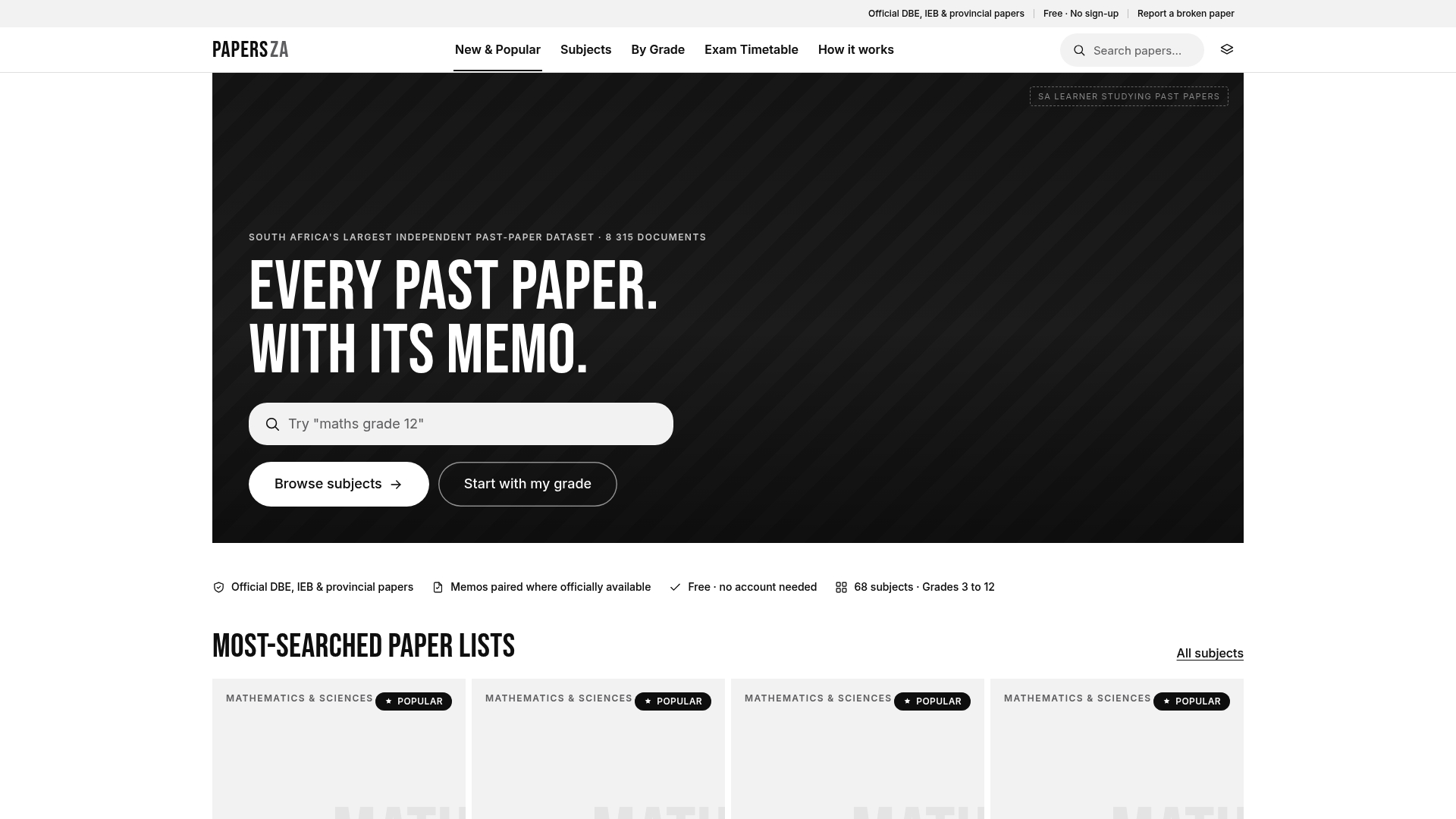
You get official DBE and IEB papers organised by subject, grade, and exam session, each paired with a detailed memo so you can mark your own work the way an examiner would. For Grade 12 specifically, you can pull English past papers and memos, Accounting papers, and every other major subject in one place. No searching across multiple sites, no paywalls. Head to Papersza to find your subject, download the paper, and start your first timed session today.
Useful sources and downloadable resources
These are the primary sources to bookmark before you build your study plan.
- DBE NSC Exam TimetableExaminations/ExamTimetable.aspx) — official NSC exam dates published by the Department of Basic Education; the first thing to download.
- DBE Exam Preparation TipsExaminations/Tipsforexampreparations.aspx) — official guidance on past papers, command words, and exam technique from the DBE.
- DBE Mind the Gap Study Guides/MindtheGapStudyGuides.aspx) — free subject-specific study guides for NSC learners, available for download.
- DBE NSC Past Examination PapersExaminations/NSCPastExaminationpapers.aspx) — official past papers from the DBE, organised by year and subject.
- IEB — official timetables and resources for IEB candidates; check here if you write IEB rather than NSC papers.
- Studyclix — study resource with matric exam tips and timetable guidance for South African learners.
- Papersza past-paper library — South Africa’s largest independent collection of DBE and IEB past papers and memos, free and searchable by subject, grade, and session.
FAQ
How many hours should a Grade 12 student study per day?
During Terms 1–2, aim for 2–3 focused hours per weekday outside school. In Term 3 and the final weeks before NSC exams, increase to 3–6 hours depending on your availability, with past papers making up the majority of that time.
How do you pass Grade 12 with distinctions?
Consistent timed past-paper practice with memo-driven marking is the most reliable route to distinctions. Identify your weak topics from memo errors, schedule targeted revision within 48 hours, and prioritise your highest-credit subjects in your weekly study plan.
When do matric exams start?
The NSC final exams typically begin in late October each year. The exact dates are published by the Department of Basic EducationExaminations/ExamTimetable.aspx) and the IEB on their official websites; always confirm the current year’s timetable directly from those sources.
What are the seven subjects in Grade 12?
NSC candidates write a minimum of seven subjects: two languages (one Home Language and one First Additional Language), Mathematics or Mathematical Literacy, Life Orientation, and three elective subjects chosen from the approved list. The exact combination depends on your school and stream.
Where can I find free Grade 12 past papers and memos?
Papersza provides free, searchable access to official DBE and IEB past papers and memos for all Grade 12 subjects, with no account or registration required. You can browse by subject and download papers immediately at papersza.co.za.