Physical sciences paper 1: Grade 12 past papers and memos

The fastest way to get Grade 12 Physical Sciences Paper 1 past papers and memos is through Papersza’s Grade 12 Physical Sciences archive, which hosts official DBE and IEB PDFs organised by year and session — no account needed, no cost. The Department of Basic Education (DBE) is the primary source for NSC papers; Papersza mirrors those official files and makes them searchable by subject, grade, and session.
Here are the most recent sessions to download first:
- May/June 2026 — Paper 1 (question paper) + Memo
- November 2025 — Paper 1 + Memo
- May/June 2025 — Paper 1 + Memo
- November 2024 — Paper 1 + Memo
- Supplementary 2025 — Paper 1 + Memo (for students who wrote the supplementary sitting)
The May/June 2026 Paper 1 is structured as a 17-page exam with three data sheets, includes 10 questions, and is marked out of 150 in a 3-hour sitting. That structure is consistent across recent NSC papers, so every session you practise gives you a realistic simulation of the real exam.
Table of Contents
- Year-by-year archive: NSC Physical Sciences Paper 1 past papers and memos
- Where do these papers come from, and why does the source matter?
- What the NSC Paper 1 data sheet includes and how to use it
- How to practise with Paper 1 effectively: timing, marking, and revision technique
- Downloading, printing, and organising your Paper 1 files
- How Papersza helps you find Grade 12 Physical Sciences Paper 1 fast
- Key takeaways
- Why free access to past papers actually changes outcomes
- Papersza: your free hub for Physical Sciences Paper 1 past papers
- Useful sources and official links
- FAQ
Year-by-year archive: NSC Physical Sciences Paper 1 past papers and memos
The table below covers recent NSC sittings. Each row shows the session, the document type, and its provenance. Where a DBE PDF is available, Papersza links directly to it; where the DBE has removed older files, Papersza hosts a verified mirror.

A note on sessions: May/June papers are written by full-time candidates; November is the main NSC sitting; Supplementary papers are offered early the following year for students who need a second attempt. All three are valid practice material, though November papers most closely reflect the standard sitting.
IEB papers follow the same Physics-first structure and are also available on Papersza. They are set by the Independent Examinations Board rather than the DBE, so question style and mark allocation differ slightly — useful for stretch practice, but prioritise DBE papers for your main revision.
Where do these papers come from, and why does the source matter?
Not all past-paper files floating around online are equal. A scanned photocopy of a 2018 paper, a watermarked PDF from a tutoring site, or a file with pages missing can all send you into your exam with the wrong formula values or an incomplete question set.
Official DBE-hosted PDFs are the canonical exam documents. Mirrors and archives should reference DBE or IEB origins where possible. Using an unofficial copy risks encountering altered question wording, missing data sheets, or incorrect memo answers — any of which can undermine your preparation rather than support it.
The DBE publishes past papers and memos on education.gov.za, though the portal can be slow and files are sometimes removed after a few years. Provincial portals like the Western Cape Education Department also host selected papers. The IEB publishes its own papers separately for schools in the IEB system.
Papersza solves the access problem by maintaining a searchable, labelled archive of these official files. Every document on the site is tagged with its source (DBE or IEB), year, session, and whether it is a question paper or memo. You are not guessing what you downloaded.
What the NSC Paper 1 data sheet includes and how to use it
Every NSC Physical Sciences Paper 1 PDF comes with a Data for Physical Sciences sheet attached. It contains two tables:
| Table | Contents |
|---|---|
| Table 1: Physical constants | Gravitational acceleration (g), speed of light (c), Planck’s constant (h), Coulomb’s constant (k), and several others with their SI units |
| Table 2: Formulae | Equations for mechanics, waves, electricity, magnetism, and modern physics — the full set of relationships you are expected to apply |
The sheet is provided precisely so you do not need to memorise exact constant values. What matters is knowing which formula applies and how to set up the calculation correctly.
Here is the part most students underestimate: examiners mark using the data-sheet values. If you use a memorised value for g that differs even slightly from the sheet’s figure, you can lose marks — not because your physics is wrong, but because your answer does not match the marking memo. Examiners apply the provided constants for consistency across all scripts.
Pro Tip: When you practise, keep the data sheet open beside you and physically point to the value you are using before writing it into your calculation. This builds the habit of referencing the sheet under exam conditions, and it forces you to check units at the same time.
How to practise with Paper 1 effectively: timing, marking, and revision technique
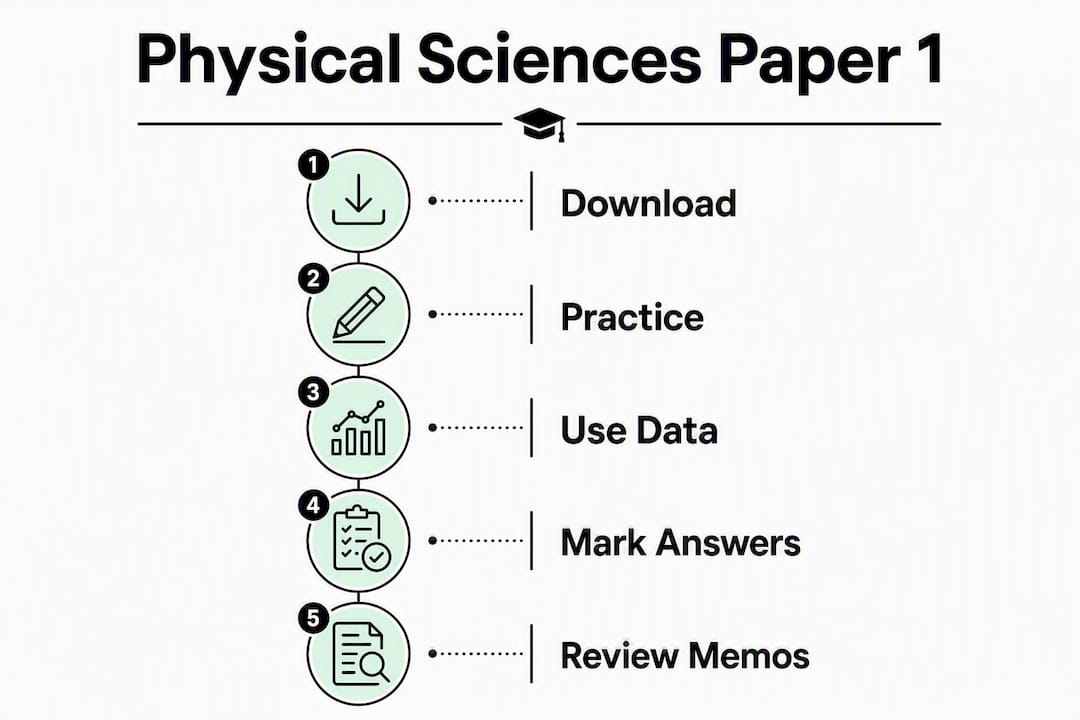
Working through past papers randomly is better than nothing, but a structured approach converts practice into actual marks. Here is a method that works:
-
Start with a diagnostic sitting. Pick a November paper from two or three years ago. Sit it under full exam conditions: 3 hours, no notes, data sheet only. Mark it strictly with the memo afterward. This gives you a baseline and shows you exactly which topics are red (weak), yellow (shaky), or green (solid).
-
Build a topic map. List every Paper 1 topic — mechanics, waves and sound, electricity and magnetism, optical phenomena, modern physics. Colour-code each one based on your diagnostic result. This is your revision priority list, not a vague “study harder” instruction.
-
Allocate time by marks during the exam. A 150-mark paper in 3 hours gives you roughly 72 seconds per mark. A 5-mark question gets about 6 minutes; a 12-mark question gets about 14 minutes. Time management by mark value is one of the most reliable ways to avoid running out of time on the last question.
-
Attempt every question; move on from hard ones. If a question is taking far longer than its mark allocation warrants, mark it, move on, and return at the end. Securing easier marks elsewhere first is a better strategy than fighting one question for 20 minutes.
-
Use the memo to mark strictly, not generously. When you check your work, do not give yourself half-credit for “nearly right.” Log every error type: wrong formula, unit error, data-sheet value not used, sign error, incomplete reasoning. Patterns in your errors tell you exactly what to fix.
-
Repeat weak-topic practice in mixed sets. Once you have identified red topics, practise them in isolation first, then mix them back into timed sets with green topics. Timed mixed practice under pressure is more effective than long, untargeted study sessions.
Pro Tip: Replicate the exam answer-book format when you practise: box your final answer, include units, show concise working, and note where you used a data-sheet value. Examiners award process marks for clear reasoning even when the final numeric answer is slightly off due to rounding.
Downloading, printing, and organising your Paper 1 files
PDF is the only format worth using. It preserves the exact layout, font sizes, and data-sheet tables as the DBE published them. Any other format risks reformatting that shifts question numbers or distorts diagrams.
Before you print, open the PDF and scroll to the last pages to confirm the data sheets are included. A Paper 1 file without its data sheet is incomplete. If the sheet is missing, re-download from Papersza or the DBE portal.
For printing, set your printer to 100% scale (not “fit to page”). Scaling down to 90% makes diagrams and tables harder to read and does not reflect exam conditions. Single-sided printing is better for timed mocks because it matches how the actual exam booklet is laid out.
Pro Tip: Name every file you download using this format: PhySci_Gr12_[Year][Session][Paper/Memo] — for example, PhySci_Gr12_2025_Nov_Paper1.pdf and PhySci_Gr12_2025_Nov_Memo1.pdf. Keep a dedicated revision folder with subfolders for each session. When you sit a timed mock, move that session’s files into a “Done” subfolder so you always know which papers you have already practised.
How Papersza helps you find Grade 12 Physical Sciences Paper 1 fast
Papersza hosts over 8,315 documents spanning grades 3 to 12, all free to access without creating an account. The archive is organised by subject, grade, year, and session, so you are never hunting through a generic file dump.
To find Paper 1 in under a minute:
- Go to Papersza’s Grade 12 Physical Sciences page.
- The page lists all available sessions by year, clearly labelled as Paper 1 or Paper 2 and as question paper or memo.
- Click the Paper 1 link for your chosen session. The PDF opens or downloads directly.
- Repeat for the memo of the same session.
Every file is labelled with its source (DBE or IEB) and session. There is no paywall, no registration prompt, and no subscription. Papersza’s model is straightforward: free access to official past papers, supported by display advertising.
If you want to build foundational mechanics skills before tackling Grade 12 content, Grade 11 Physical Sciences past papers are also available on the same platform. Students who need extra algebra and unit-manipulation practice alongside their physics revision can also find Grade 12 Mathematics past papers there.
Key takeaways
The single most effective preparation strategy for NSC Physical Sciences Paper 1 is to practise with official DBE PDFs under timed conditions, mark strictly with the memo, and fix error patterns before the next sitting.
| Point | Details |
|---|---|
| Download at least three sessions | Get one diagnostic paper, one targeted-practice paper, and one timed mock from recent years. |
| Always use the data-sheet values | Examiners mark against the provided constants; using memorised values risks losing marks even when your method is correct. |
| Time by mark allocation | Budget roughly 72 seconds per mark; move on from hard questions and return if time allows. |
| Mark strictly with the memo | Log every error type after each sitting and repeat weak-topic practice until accuracy improves. |
| Use Papersza for quick access | Papersza’s free, searchable archive gives you official DBE/IEB Paper 1 PDFs and memos by year and session, no account required. |
Why free access to past papers actually changes outcomes
Most students know they should practise past papers. Fewer actually do it consistently, and the gap is almost always access. You cannot sit a timed mock at 9 PM on a Sunday if the DBE portal is down or you cannot remember which folder you saved the file in last month.
That friction is not trivial. The difference between a student who practises six full papers before the exam and one who practises two is not talent. It is whether the papers were easy to find when motivation was high enough to open them. Papersza exists to remove that barrier entirely.
There is also a subtler point worth making about memos. Most students use them to check whether they got the right answer. The better use is forensic: read the memo’s working line by line, compare it to your own, and identify the exact step where your reasoning diverged. That is where the learning lives, not in the final mark. A student who does this after every practice paper builds a mental model of how examiners think, which is a different skill from simply knowing the content.
One more thing: do not skip the supplementary papers. They are often slightly harder than the November sitting, and they cover the same curriculum. If you have already worked through the main November papers, supplementary papers are the best stretch material available.
Papersza: your free hub for Physical Sciences Paper 1 past papers
Every Grade 12 Physical Sciences Paper 1 past paper and memo on Papersza is free, official, and available without signing up. That is the concrete difference from hunting through government portals or paying for a study pack: you search once, download the PDF, and start practising.
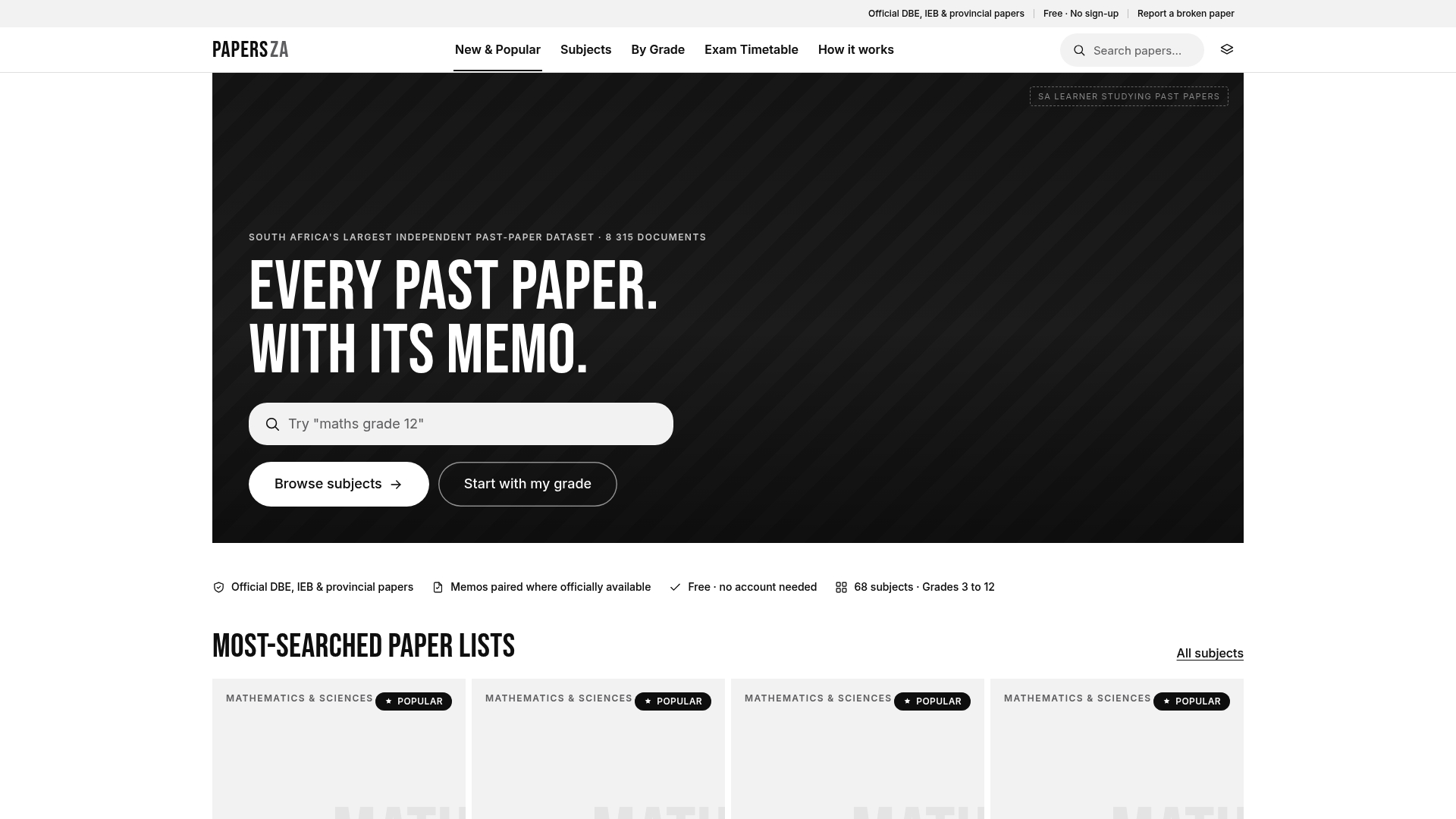
Search “Physical Sciences Grade 12” on Papersza and you will see every available Paper 1 and memo listed by year and session. Click the paper, click the memo, and you are ready to sit your first timed mock today. No account, no cost, no waiting. While you are there, the same archive covers every other Grade 12 subject — from Accounting to Life Sciences — so one bookmark covers your full revision schedule.
Useful sources and official links
- DBE official past papers and data sheets — The authoritative source for NSC Physical Sciences Paper 1 PDFs, memos, and the official Data for Physical Sciences sheet. Use these for final exam practice.
- Papersza Grade 12 Physical Sciences archive — Searchable, labelled archive of DBE and IEB Paper 1 and Paper 2 files with memos; no account required.
- Western Cape Education Department exam portal — Provincial exam papers and resources for Western Cape learners; useful supplement to DBE papers.
- education.gov.za — The DBE’s main portal for NSC results, curriculum documents, and official exam papers.
- Cambridge revision and exam guidance — Practical advice on timed practice, mark-allocation strategy, and exam-day technique for physical sciences students.
- How to study for a science exam — Examination.live — Step-by-step study routine including topic colour-coding, mixed practice sets, and timed mock scheduling.
Prioritise the DBE PDFs for your final revision. Use Papersza when you need fast, organised access to multiple sessions without navigating the government portal.
FAQ
Where can I download Grade 12 Physical Sciences Paper 1 past papers?
The quickest route is Papersza’s Grade 12 Physical Sciences page, which lists official DBE and IEB PDFs by year and session with no account required. The DBE also hosts papers directly on education.gov.za, though older files are sometimes removed.
What topics are covered in NSC Physical Sciences Paper 1?
Paper 1 covers the physics component of the NSC curriculum: mechanics, waves and sound, electricity and magnetism, optical phenomena, and modern physics. Most papers open with multiple-choice questions followed by longer calculation and reasoning questions.
Is the data sheet included in the Paper 1 PDF download?
Yes. Official NSC Physical Sciences Paper 1 PDFs include the Data for Physical Sciences sheet, which contains Table 1 (physical constants including g, c, Planck’s constant, and Coulomb’s constant) and Table 2 (formulae). Always scroll to the last pages of your downloaded PDF to confirm the sheet is present.
How long is Physical Sciences Paper 1 and how many marks is it?
The NSC Physical Sciences Paper 1 is a 3-hour exam with 10 questions, 17 pages plus data sheets, and is marked out of 150.
Should I use DBE papers or IEB papers for revision?
Use DBE papers as your primary revision material if you are writing the NSC. IEB papers are set by the Independent Examinations Board for IEB-registered schools and differ slightly in style and mark allocation. They are useful as stretch practice once you have worked through the main DBE sessions.