Prelim exams explained: what Grade 12 learners need to know

Prelim exams are full syllabus, school run practice tests that copy the format and pressure of the National Senior Certificate finals. Think of them as a dress rehearsal that also counts, just a little, toward your final mark. Before you panic or relax too much, do three things this week.
- Check your school’s timetable — provinces don’t all start on the same date, so confirm yours directly with your school.
- Book two timed past papers in your weakest subjects before prelims start.
- Ask your teacher how much of your school based assessment (SBA) mark the prelim will actually carry.
The one fact worth holding onto: prelims simulate your finals and feed directly into your SBA score, which means how you prepare for them genuinely shapes your November result.
Key Takeaways
Prelim exams work because they force full-syllabus, timed practice under real exam pressure, and the resulting SBA marks give you a concrete, fixable diagnosis before finals.
| Point | Details |
|---|---|
| Prelims are rehearsal, not verdict | They simulate NSC finals and reveal specific gaps you can still fix before November. |
| Know the real weighting | SBA equals 25% of your final mark, with prelims typically contributing around 5 to 7%. |
| Failing a prelim isn’t final | It doesn’t bar you from writing finals, it signals where to focus your remaining weeks. |
| Timed past papers drive improvement | Sit a paper timed, mark it with the memo, then log errors by type. |
| Use a real past-paper archive | Papersza offers free, searchable DBE and IEB past papers and memos for targeted practice. |
Table of Contents
- What are prelim exams in South Africa?
- When are prelim exams held, and who sets the papers?
- Why do prelims matter for your final matric result?
- How do prelim marks affect your final NSC mark?
- How to prepare for prelim exams: a step-by-step plan
- Practise with past papers: a workflow that actually works
- After prelims: what to do in the next few weeks
- Get your practice papers sorted before your next prelim
- Sources
- FAQ
What are prelim exams in South Africa?
A prelim, short for preliminary examination, is a full scale internal exam your school runs to mimic the final NSC paper as closely as possible. It covers the entire year’s syllabus, not just a term or two, and it’s marked to a standard close to what you’ll face in November. Some teachers deliberately pitch prelims slightly harder than the real thing, treating them as a wake up call rather than a soft warm up.
There’s a difference worth knowing between the two exam systems operating in South Africa:
- DBE (public schools): papers are typically set at school, district, or provincial level, following Department of Basic Education guidelines.
- IEB (independent schools): the Independent Examinations Board runs its own prelim process, though the underlying goal, rehearsing final exam conditions, stays the same.
Both systems use prelims the same way: as a stress test for your actual knowledge before it counts for real.
When are prelim exams held, and who sets the papers?
Grade 12 prelims usually run in August and September, close enough to the November finals that there’s real time pressure to fix whatever goes wrong. Don’t assume every province writes on the same dates. Provincial timetables genuinely differ, and some regions have started earlier or later than others in recent years.
Who actually writes your prelim paper depends on your school:
- A subject teacher or school department sets many papers directly.
- A district or provincial department sets others, especially in public schools.
- IEB schools follow their own internal process, separate from provincial DBE offices.
Confirm your exact dates through your school’s official notices, your provincial education department, or the matric exam timetable page on PapersZA, rather than guessing based on a friend’s school.
Why do prelims matter for your final matric result?
Prelims exist to give you an honest, uncomfortable answer to one question: are you actually ready? A good prelim mark feels great, but the real value sits in what a mediocre one reveals. Educators note that prelims provide a realistic projection of how you’ll perform in November, exposing gaps you can’t see from classroom tests alone.
Prelims typically surface three kinds of problems:
- Knowledge gaps — topics you thought you knew but couldn’t apply under pressure.
- Time management failures — running out of time before finishing the paper.
- Exam technique errors — misreading instructions or losing easy marks on formatting.
Pro Tip: *Treat your prelim result as a diagnosis, not a verdict.
Beyond the academic upside, sitting a full exam under real conditions also does something for your nerves. It’s rehearsal for the anxiety, not just the content.
How do prelim marks affect your final NSC mark?
Here’s where a lot of confusion happens, so let’s be precise. Your school based assessment (SBA), a collection of tests, assignments, and practicals gathered across the year, makes up 25% of your final promotion mark, with your final November exam carrying the remaining 75%. The prelim is just one task inside that 25%.
The preparatory examination mark is a component of the SBA rather than a standalone national exam. Depending on how many prescribed assessment tasks a subject includes, the prelim typically contributes a small portion toward your final promotion mark.
That single sentence corrects a common myth: many learners assume prelims carry far more weight than they actually do.
Moderation happens at multiple levels to keep this fair:
- School level — teachers cross-check marking within departments.
- District level — samples get reviewed for consistency.
- Provincial level — further checks confirm standards match across schools.
There’s no single national prelim paper. Each province, and each IEB school, runs its own version, which is exactly why moderation matters so much.
How to prepare for prelim exams: a step-by-step plan
You don’t need a complicated system, you need consistency and honest self-assessment. Here’s a sequence that works for most subjects:
- Do a diagnostic review. Skim last year’s syllabus and flag topics you genuinely feel shaky on, don’t guess, be specific.
- Revise weak topics first. Spend your limited time where the payoff is biggest, not on topics you’ve already mastered.
- Sit a timed past paper. Use the exact time allowed in the real exam, no bathroom breaks, no phone.
- Mark it strictly with the official memo. Be brutal. If the memo wanted a specific term and you wrote something close, mark it wrong.
- Log every mistake by type. Was it a content gap, a technique slip, or a timing issue? Each needs a different fix.
Pro Tip: Simulating full exam conditions, same time limit, same silence, same pressure, builds stamina you can’t get from casual studying. Your brain needs practice sitting still and focused for three hours, not just knowing the content.
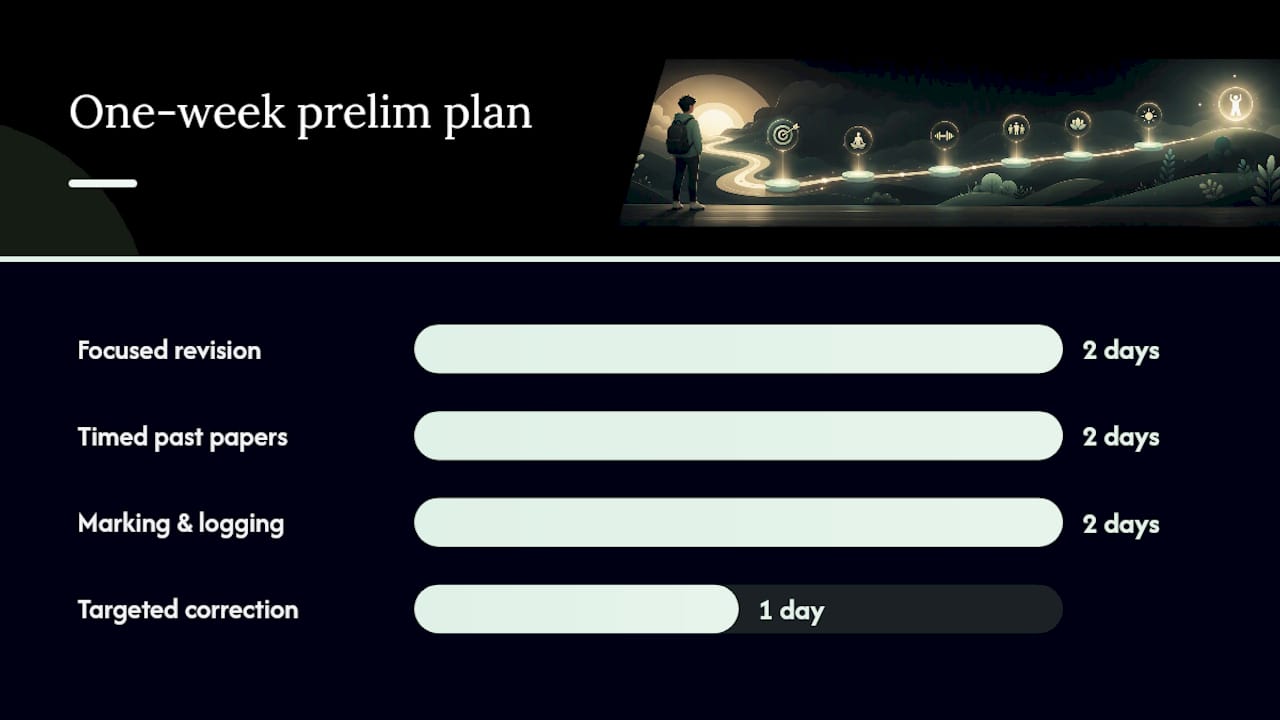
A rough one-week snapshot before your first prelim paper might look like this: Monday and Tuesday, focused revision on your two weakest topics. Wednesday, one timed past paper. Thursday, mark it and log errors. Friday, targeted correction of whatever the log revealed. Weekend, a second timed paper in a different subject, followed by the same marking cycle.
Loop your teacher and parents into this process, especially around any outstanding SBA tasks. Moderators check for evidence, so missing pieces need sorting out before, not after, prelims start.
Practise with past papers: a workflow that actually works
The single most effective prelim preparation method is boringly simple: sit a real past paper timed, mark it against the official memo, then build an error log. Here’s how that plays out in practice.
- Pick a specific past paper. Say, a 2019 November Paper 1 in a subject you’re worried about.
- Sit it under real exam conditions. Full time allowance, no notes, no interruptions.
- Mark it strictly using the memo, not your own judgment of “close enough.”
- Categorise every error as content, technique, or time related, then schedule a focused micro-revision session for whichever category has the most mistakes.
This is exactly the kind of resource PapersZA’s archive was built for, searchable DBE and IEB papers paired with their memos, so you’re never guessing whether your self-marking was accurate. Cross-check your prelim date against the exam timetable page so your practice papers line up with what’s actually coming next on your school calendar.
After prelims: what to do in the next few weeks
Your results are in, now what? Don’t file the paper away. Sit down within a few days and do a proper error analysis while the exam is still fresh.
- Prioritise by damage, not discomfort. Fix the subject dragging your average down first, even if it’s the one you enjoy least.
- Book time with teachers on specific topics, not vague “help me with everything” requests.
- Adjust your revision schedule to reflect what prelims actually showed, not what you assumed going in.
Watch for red flags that need urgent attention: failing multiple subjects outright, consistently running out of time on every paper, or missing SBA evidence your teacher needs for moderation. Any of these justifies a serious parent-teacher conversation now, not in October. Set specific, subject-level goals together rather than a vague “do better” plan.
Why we emphasise past papers
Papersza has spent years building one of South Africa’s largest independent libraries of official past papers precisely because timed, memo-marked practice is what closes the gap between a shaky prelim and a strong final. Keep going, the work you put in now is exactly what moves the needle in November.
Get your practice papers sorted before your next prelim
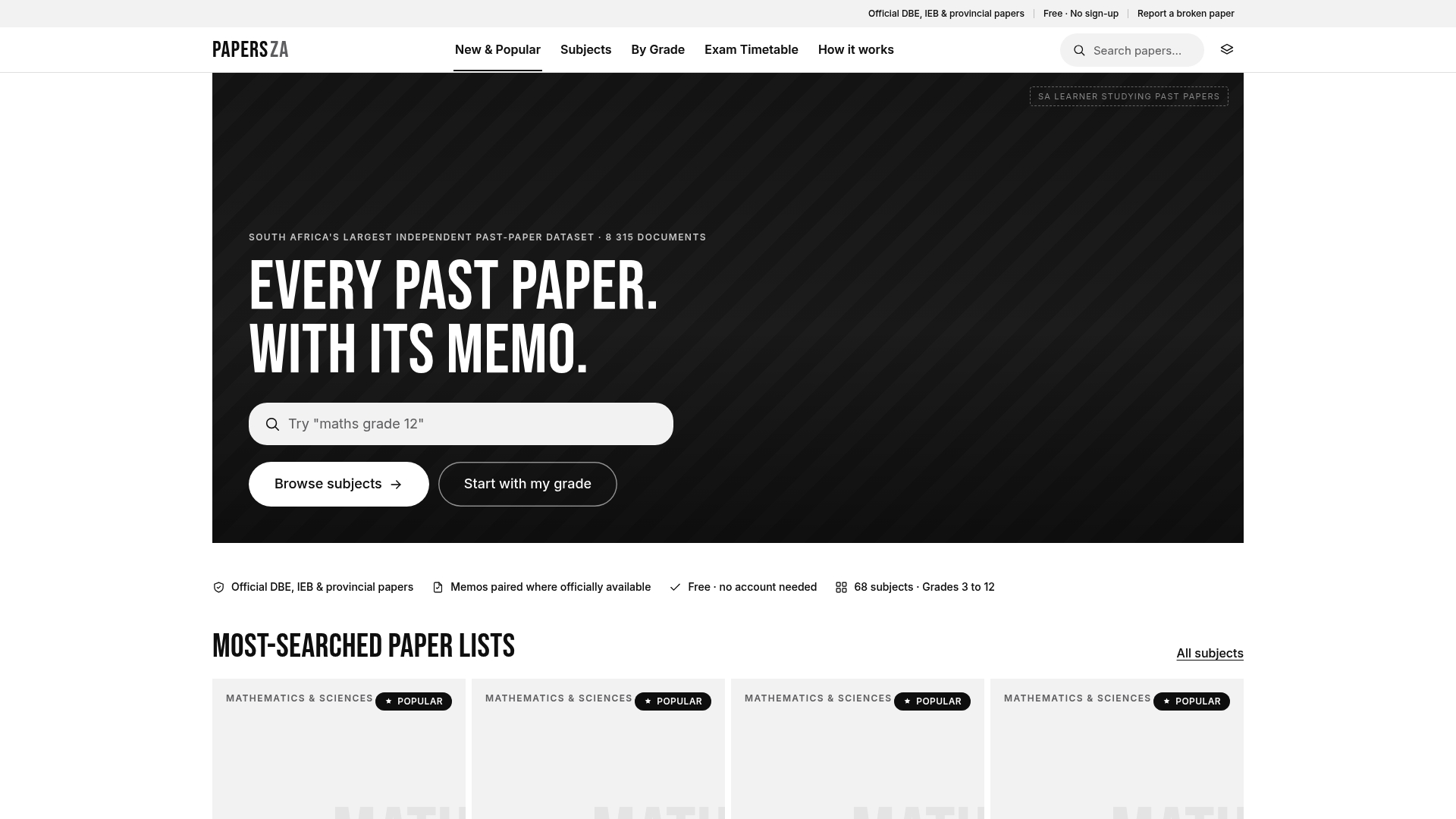
Papersza gives you free, direct access to official past papers and memos for every subject, without needing an account or hunting through scattered PDFs on random forums. That’s the real advantage here: no sign-up wall, no paywall, just a searchable library organised by subject, grade, and year.
A few specifics worth knowing:
- Searchable by subject, grade, and year, so you can pull exactly the paper you need in seconds.
- Free downloads, including the marking memo, so self-assessment is accurate rather than guesswork.
- Timetable and subject pages that help you plan practice around your actual prelim dates.
The site runs on ad support, so access stays free for every learner, parent, and teacher who needs it. If you’re revising Mathematics, start with the Grade 12 Mathematics papers and sit one timed this week. For structured last-minute planning across any subject, a resource like this 48/24/8 revision plan pairs well with your past-paper practice. Not sure how the site works? Check how PapersZA works and pick your first paper today.
Sources
- Statement on weighting given to grade 12 preliminary examination | South African Government
- All systems in place for Grade 12 prelim exams | SAnews
- Prelim to perfect: how to optimise your matric final prep time | IIE
FAQ
What are prelim exams in South Africa?
Prelim exams are full syllabus, school-run practice exams that Grade 12 learners write in August or September to simulate the format and conditions of the final NSC exams.
Why do matrics write prelims?
Matrics write prelims because they give a realistic projection of final exam performance and reveal gaps in knowledge, timing, and exam technique before the marks that actually count.
Is prelims more difficult than finals?
Some schools deliberately pitch prelim papers slightly harder than the final exam as a wake-up call, though the difficulty varies by school and subject.
What happens when you fail prelims?
Failing a prelim doesn’t stop you from writing your final NSC exams.