Spaced repetition for exams: your step-by-step plan

The single most effective thing you can do right now is combine spaced repetition with retrieval practice using past exam papers. Dunlosky et al. (2013) rated both distributed practice and practice testing as “high utility” methods, and UCSD learning-science guidance frames it clearly: spaced practice tells you when to study; retrieval practice tells you how. Your first action today:
- List every syllabus topic for each subject you are preparing.
- Download 3–6 recent past papers and their memos from Papersza, which hosts over 8,315 free papers covering Grades 3–12.
- Group the papers by topic so your first session has a clear target.
Table of Contents
- Why spaced repetition beats cramming every time
- How to build a spaced repetition study plan around past papers
- Which tools work best for running spaced repetition?
- How to turn past exam papers into retrieval sessions
- How to measure whether the plan is working
- A concrete 8-week plan for a Grade 12 student
- Where to find reliable past papers: Papersza
- Key takeaways
- The method feels hard — that is the point
- Free past papers and memos, ready to download
- Useful sources
- FAQ
Why spaced repetition beats cramming every time
Rereading your notes feels productive. It is not. Dunlosky et al. found that highlighting and rereading score low on long-term utility, while distributed practice and practice testing consistently outperform them. The reason is biological: forcing your brain to retrieve a half-forgotten fact strengthens the memory trace far more than passively reading the same page again.
Statistic to know: Practical guides report that students using active recall combined with structured spaced schedules score 12–18% higher on exams than peers using passive review alone.
UCSD guidance adds a useful distinction: spaced practice is the scheduling backbone, and retrieval practice is the learning mechanism. You need both. The UNC Learning Center makes a related point: gather all your materials before you schedule anything. Students who start spacing sessions without their resources waste the first week hunting for notes.
How to build a spaced repetition study plan around past papers
Choose your schedule based on how many weeks remain before your exam. Short sessions done consistently beat long sessions done rarely.
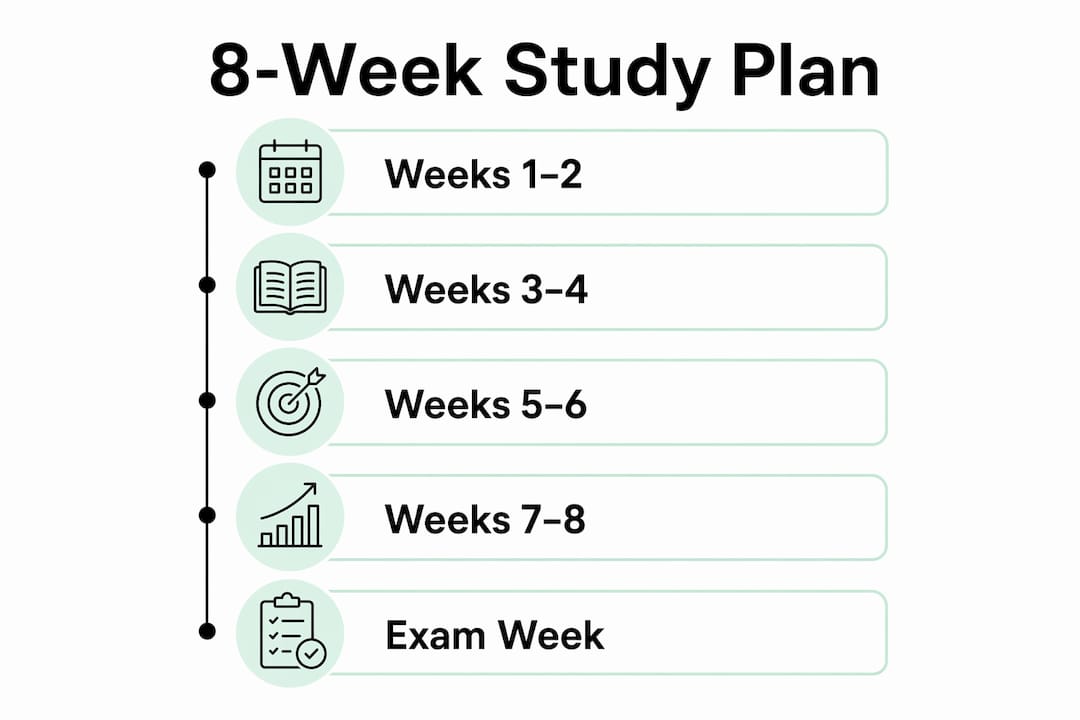
8-week schedule (ideal)
| Week | Focus |
|---|---|
| 1–2 | Collect papers, map topics, do one timed question set per subject |
| 3–4 | First retrieval pass on all topics; log errors into SRS or Leitner box |
| 5–6 | Successive relearning of flagged weak topics; add mixed-topic sets |
| 7–8 | Full timed past papers; final polish on persistent errors |
4-week schedule: Compress weeks 1–2 into days 1–3, then follow the same retrieval and review rhythm at double speed.
2-week schedule: Exam-prep guides note that you need at least 7 days to complete even 2–3 spaced review cycles. With two weeks, focus only on high-frequency topics and do daily short retrieval sessions rather than full papers.
Session structure (45–60 minutes):
- Warm-up: spend 10 minutes reviewing yesterday’s error log.
- Active retrieval: work through a timed past-paper question set (30–40 minutes).
- Mark immediately against the memo.
- Log every wrong answer: topic, question reference, error type.
- Convert errors into flashcards or short-answer prompts for the next review cycle.
Pro Tip: Aim for successive relearning — keep retrieving each item until you get it right across multiple separate sessions, not just once. UCSD guidance identifies this as the single highest-impact adjustment you can make to a standard SRS routine.
Which tools work best for running spaced repetition?
You can run a solid spaced-repetition system with a phone app or a shoebox. The tool matters less than the habit.

Anki is free and uses an algorithm to schedule each card at the optimal interval. It handles the 1–2–7–14 day review pattern automatically and works on Android, iOS, and desktop. The learning curve is real, but it pays off for students with 50+ cards across multiple subjects.
Quizlet is easier to set up and lets you share sets with classmates or a teacher. Its spaced-repetition mode is less sophisticated than Anki’s, but for most Grade 8–12 students it is more than enough.
Low-tech Leitner box: Five physical folders labelled Day 1, Day 2, Day 4, Day 7, Day 14. A correct answer moves the card forward one folder; a wrong answer sends it back to Day 1. No internet required, visible to parents, and tactile enough to keep younger learners engaged.
Google Sheets tracker: UNC and UCSD resources both recommend simple tracking. Columns: Date Learned | Topic | Question Ref | Memo Answer | Accuracy (%). Parents and teachers can check progress without any special software.
Pro Tip: If devices or internet access are limited, the physical Leitner box is the most reliable system. Print question sets from Papersza’s Grade 3 English papers or any grade page, cut them into cards, and you have a fully functional SRS with zero technology.
How to turn past exam papers into retrieval sessions
Treat every past-paper question as a retrieval task, not a reading exercise. The process is straightforward.
- Timed practice first: Cover the memo completely. Work through the question under exam conditions — no notes, no hints.
- Immediate marking: Open the memo and mark your answer the moment you finish. Delay kills the feedback loop.
- Classify each error: Content gap (you never learned it), careless mistake (you knew it but slipped), or time pressure (you ran out of time before finishing).
- Convert to a study item: A content-gap error becomes a flashcard. Front: the question or concept. Back: the memo’s model answer in your own words.
- Tag by topic and difficulty: Label each card so your SRS or Leitner box can cluster weak areas for extra review cycles.
For daily spaced sessions, use short mixed-topic question sets rather than full papers. Save full timed papers for the final two weeks when you need to practise pacing.
How to measure whether the plan is working
Track two numbers: your successive-relearning accuracy on SRS items, and your rolling score on timed past papers. If both are climbing week on week, the plan is working. If either stalls for more than five days, something needs to change.
Simple metrics to watch:
- Accuracy on repeated SRS items (target: 100% on core items before the exam).
- Timed-paper score trend across three consecutive papers.
- Error-type frequency: a rising share of careless mistakes signals fatigue; a persistent content gap signals a topic that needs a slower, deeper pass.
- Session compliance: how many planned sessions did you actually complete?
Adjustment rules: If a topic cluster keeps failing, increase its review frequency and add a short explanation step before retrieval. If time management is consistently poor, switch to full timed papers earlier. If motivation is dropping, shorten sessions to 25 minutes and add one easy win at the start.
Pro Tip: Parents and teachers: frame poor scores as diagnostic data, not failure. A student who scores 40% on a timed paper and logs every error is doing exactly the right thing. The score will rise; the error log is the mechanism.
A concrete 8-week plan for a Grade 12 student
Total weekly time budget: 5–6 hours per subject, split across 4–5 short sessions.
| Week | Focus | Session type |
|---|---|---|
| 1 | Collect papers, map syllabus topics, blurt each topic from memory | Diagnostic |
| 2 | First timed question sets per topic; build initial error log | Retrieval + logging |
| 3 | Successive relearning of Week 2 errors; add new topic sets | SRS review + new input |
| 4 | Mixed-topic retrieval sets; identify persistent weak clusters | Interleaved retrieval |
| 5 | Deep pass on weak clusters; slow explanatory review where needed | Targeted review |
| 6 | Full timed past paper (one per subject); log new errors | Timed paper |
| 7 | Successive relearning of all flagged items; second full timed paper | SRS + timed paper |
| 8 | Final polish: persistent errors only; light timed paper for confidence | Polish + confidence |
Example daily routine (two subjects): 06:30–07:15 Subject A retrieval session. 15:00–15:45 Subject B retrieval session. 19:00–19:20 Review both error logs and update SRS cards.
Sample SRS conversion: Past-paper question: “Explain the difference between fixed and variable costs.” Flashcard front: “Fixed vs. variable costs — what is the key difference?” Flashcard back: “Fixed costs stay constant regardless of output (e.g., rent). Variable costs change with production volume (e.g., raw materials).”
Weekly review checklist: sessions completed, new errors logged, SRS accuracy on reviewed items, timed-paper score recorded.
Where to find reliable past papers: Papersza
Papersza hosts over 8,315 past papers and memos from the DBE, IEB, and provincial authorities, covering every grade from 3 to 12. Access is free and requires no account. The UNC Learning Center recommends gathering all materials before scheduling, and Papersza makes that step fast.
How to use it inside your plan:
- Go to how Papersza works to understand the search and download process.
- Filter by grade and subject to find 3–6 recent papers with memos.
- Download the memos separately so you can mark sessions without seeing answers in advance.
- Organise files into topic folders on your device or print and sort into physical folders.
For Grade 12 students, the Grade 12 English past papers and Accounting Grade 12 papers pages are good starting points. Parents supporting younger learners can pull Grade 6 English papers or Grade 9 FAL papers to build early practice sets.
Key takeaways
Spaced repetition for exams works because it forces active retrieval at the right intervals, turning past-paper errors into targeted study items that stick.
| Point | Details |
|---|---|
| Combine spacing and retrieval | Schedule short sessions AND test yourself actively — both together produce the strongest retention. |
| Start with materials | Collect 3–6 past papers and memos per subject before you schedule a single session. |
| Use the 1–2–7–14 pattern | Review new items after 1, 2, 7, and 14 days to stay ahead of the forgetting curve. |
| Convert errors into cards | Every wrong answer on a past paper becomes a flashcard or short-answer prompt for your next review cycle. |
| Papersza as your paper source | Papersza’s free library of 8,315+ papers across Grades 3–12 gives you all the retrieval material you need in one place. |
The method feels hard — that is the point
Most students abandon spaced repetition after a week because it feels harder than rereading. You sit down, try to recall something, and draw a blank. That blank is not failure. APA guidance on study strategies is clear: the effort of retrieval is precisely what strengthens the memory. Ease is the warning sign, not the goal.
What I find most underestimated about this method is the diagnostic value. A student who completes one timed past-paper session and logs every error knows more about their actual knowledge gaps after 45 minutes than they would after three hours of passive reading. The error log is the plan. Everything else follows from it.
For parents and teachers: the biggest mistake is treating a low score as a sign the student is not trying. A student who scores 50% on a timed paper and logs every error is using the method correctly. Encourage the logging, not just the score. Small, consistent sessions over weeks produce the results; a single long study night does not.
Free past papers and memos, ready to download
Papersza is the free alternative to hunting across multiple sites for reliable past papers. With over 8,315 documents spanning Grades 3–12, including official DBE, IEB, and provincial papers paired with detailed memos, it gives you everything you need to run the plan described in this guide without paying for anything or creating an account.
The practical next step: visit the Grade 12 English past papers page, download three recent papers and their memos, and schedule your first two retrieval sessions this week. That is the whole starting move.
Useful sources
“Distributed practice and practice testing are rated ‘high utility’ methods — the strongest evidence-backed strategies for long-term retention.” — Dunlosky et al. (2013)
- Dunlosky et al. (2013) — The landmark review of learning techniques; the primary evidence base for spaced and retrieval practice.
- UCSD effective studying guidance — Explains the spaced practice / retrieval practice distinction and successive relearning.
- UNC Learning Center: Studying 101 — Practical advice on organising materials before scheduling and simple tracking systems.
- APA GradPsych: Study Smart — Explains why effortful retrieval feels hard and why that difficulty is the mechanism.
- 10000Hours blog: Study techniques for exams — Practical spaced schedules including the 1–2–7–14 pattern and lead-time recommendations.
- NerdSip: Science-backed exam strategies — Score-improvement data for active recall combined with structured strategies.
- Papersza: How it works — Overview of the free past-paper library, coverage, and download process.
FAQ
What is spaced repetition and how does it help with exams?
Spaced repetition means reviewing material at increasing intervals rather than all at once. Dunlosky et al. (2013) rate it “high utility” because it forces active retrieval each time, which strengthens long-term memory far more than rereading.
How far in advance should I start a spaced repetition schedule?
At least 7 days before the exam to complete 2–3 review cycles on core topics; 8 weeks is ideal for full coverage. Starting later forces cramming, which undermines the spacing effect.
Can I use Anki or Quizlet with past exam papers?
Yes. Create flashcards directly from past-paper errors: the question or concept on the front, the memo’s model answer on the back. Anki automates the review intervals; Quizlet is simpler to set up and easy to share with a teacher or study group.
Where can I find free past papers and memos for Grades 3–12?
Papersza hosts over 8,315 free papers and memos from the DBE, IEB, and provincial authorities, covering every grade from 3 to 12, with no account required.
How do I know if my spaced repetition plan is working?
Track your successive-relearning accuracy on SRS items and your rolling score across three consecutive timed past papers. Both should trend upward week on week; if either stalls for more than five days, increase review frequency for the weak topic cluster.