Supplementary exams in South Africa: 2026 guide

The February/March supplementary exam sitting no longer exists. The Department of Basic Education has phased it out, and the two official NSC exam cycles you should be using now are May/June and November. If you or your child missed the November sitting, failed a subject, or want to improve a mark, one of those two cycles is your route forward.
Your immediate next steps:
- Check your eligibility — confirm which subjects you can register for and whether you have the required documents (Statement of Results, ID, and any supporting medical or death certificates if you were absent).
- Register before the deadline — the closing date for May/June applications is generally at the end of January. If you missed that window, the November cycle is your next option.
- Contact your school or provincial education office to confirm the exact registration process in your province, since operational details vary.
The Second Chance Matric Programme (SCMP) offers free tutoring and exam preparation for learners who have not yet met NSC or Senior Certificate requirements. It runs alongside both cycles and costs nothing to join.
Key takeaways
The February/March supplementary sitting is gone; South African matric learners must use the May/June or November NSC cycles to rewrite or improve results, with the May/June closing date generally falls at the end of January
| Point | Details |
|---|---|
| March supps no longer exist | The DBE phased out the February/March sitting; use May/June or November instead. |
| May/June deadline is 31 January | Submit your application by 31 January at the latest, but check your province for earlier cut-offs. |
| SCMP tutoring is free | The Second Chance Matric Programme offers no-cost focused revision at provincial centres for NSC and SC candidates. |
| Documents matter | Bring your Statement of Results, valid ID, and any medical or bereavement certificates if you were absent. |
| Papersza speeds up practice | Over 8,315 free past papers and memos for grades 3–12, searchable by subject and year, no account needed. |
Table of Contents
- What changed: the March supplementary sitting is gone
- Who qualifies for the May/June and November exam cycles?
- How to register for the May/June or November cycle
- The Second Chance Matric Programme offers free support
- Where to find timetables, exam rules, and results
- Study resources and past papers: how to practise effectively
- The part of rewriting matric nobody talks about enough
- Past papers for your rewrite, free and ready to download
- Sources
- FAQ
What changed: the March supplementary sitting is gone
For years, South African matric learners expected a “March supps” sitting shortly after November results. That sitting has been phased out. The DBE’s official position is clear: candidates who want a second opportunity now use the May/June or November examination cycles instead.
This matters practically because many learners (and some tutoring centres) still refer to “supps” as if the March sitting exists. It does not. Searching for “supplementary exam dates 2026” and expecting a February or March date will send you in the wrong direction. The IEB has similarly clarified that its May sitting is not a continuation of the old supplementary model.
The May/June cycle suits candidates who need to act quickly after November results. The November cycle suits those who need more preparation time, or who missed the May/June registration window.
Who qualifies for the May/June and November exam cycles?
Not every learner can register for every cycle. Before you fill in a form, confirm you meet the criteria.
You are eligible if you are:
- A previous NSC candidate from 2008 onwards who wants to improve one or more subject results
- A candidate who was absent from the November sitting with a valid, documented reason (medical certificate, death notice, or similar proof)
- A part-time or adult learner registered for the NSC
- A Senior Certificate candidate (the older qualification, still available to adult learners)
- A candidate registered through a Multiple Examination Opportunity (MEO) arrangement
Key limitations to know:
- You may generally only register for subjects you were already registered for in the previous November sitting, unless the DBE or your assessment body specifies otherwise.
- Absent candidates must submit documentary proof at registration. A verbal explanation is not enough. Keep your medical certificate or relevant documentation safe from the moment you miss a paper.
- You cannot use the May/June cycle to write a subject you have never been registered for. That requires full re-enrolment.
Your Statement of Results is the document that confirms which subjects you sat and what you scored. Bring it to every registration interaction.
How to register for the May/June or November cycle
Step-by-step registration process
- Locate your registration point. Go to the school where you last wrote, a provincial registration centre, or a public adult learning centre. Private candidates register directly with their provincial education department.
- Collect and complete the application form. Your school’s exam officer or the provincial office will have the correct form. Fill it in fully — incomplete forms are rejected.
- Gather your documents. You need your Statement of Results, a valid South African ID (or birth certificate), and any supporting documents if you were absent.
- Submit before the deadline. For May/June, the DBE closing date is typically 31 January. Provincial deadlines can be earlier. The Western Cape Education Department, for example, listed a 6 February 2026 closure for its local Second Chance registration windows, but the provincial exam registration itself closed earlier. Check your province’s page directly.
- Confirm your registration. Ask for written confirmation or a reference number. Do not assume the form was processed.
- If you miss May/June, register for November instead. The November cycle has a later registration window, typically mid-year.
Documents checklist
| Document | Required for | Notes |
|---|---|---|
| Statement of Results | All candidates | Confirms subjects and prior results |
| South African ID or birth certificate | All candidates | Must be valid |
| Medical certificate | Absent candidates | Must cover the exact exam date(s) missed |
| Death notice (family bereavement) | Absent candidates | Official document required |
| Proof of address | Some provinces | Check with your provincial office |
A note on fees: Fees vary by province and registration type. Some candidates qualify for fee waivers, particularly those accessing the SCMP route. Ask your provincial office directly about costs before assuming you cannot afford to register.
Pro Tip: Provincial registration dates differ from the national DBE closing date. Treat 31 January as the latest possible deadline, not the standard one. Check your province’s education website at least six weeks before that date.
The Second Chance Matric Programme offers free support
The Second Chance Matric Programme is a government-funded initiative that gives learners who have not yet met NSC or Senior Certificate requirements access to free, focused tutoring and exam preparation. It runs in both the May/June and November cycles.
What SCMP covers:
- Focused revision on gateway subjects (Mathematics, Physical Sciences, Accounting, English, and others with high failure rates)
- Past-paper practice sessions and exam technique coaching
- “Mind the Gap” study guides, which are free DBE-produced revision booklets aligned to the NSC curriculum
- In-person tutoring at provincial centres, with some provinces offering additional online or broadcast support
Who can access SCMP:
- NSC and Senior Certificate candidates who have not yet met requirements
- Part-time and adult learners registered for the NSC
- Learners who want to improve results, not only those who failed outright
SCMP tutors typically focus on the topics that yield the most marks quickly: exam technique, common question types, and marking rubric awareness. They do not re-teach the entire syllabus. That means you should combine SCMP sessions with independent study using past papers to fill the gaps the programme does not cover.
How to find your nearest centre:
Provincial departments manage their own centre lists. The Western Cape Education Department publishes a full list of local centres, registration dates, and subjects covered. Other provinces follow a similar model. Search “[your province] Second Chance Matric Programme” or call your provincial education department’s exam helpline.
Pro Tip: Register for SCMP as early as possible. Centre capacity is limited in popular subjects like Mathematics and Physical Sciences. Waiting until a week before classes start often means missing out on the most useful sessions.
Where to find timetables, exam rules, and results
Exam-day rules
- Arrive at least 30 minutes before the start time. Late arrivals after the first paper has been distributed may be refused entry.
- Bring your exam admission letter and a valid ID to every session.
- Calculators must be non-programmable and approved by the DBE. Check the approved list before exam day.
- If you miss a paper without a valid reason, you forfeit that subject for the cycle. If you miss it with a valid reason (medical emergency, bereavement), submit documentary proof to the exam centre immediately and contact your provincial office about options.
Checking results
NSC results are released through the DBE and provincial education departments. The DBE publishes the official results release date in advance. After release, you can check results via your provincial education department’s SMS line, online portal, or by visiting your school. If you want to appeal a result, the process runs through your provincial department and has a short window after release, so act quickly.
Study resources and past papers: how to practise effectively
Past papers are the single most effective preparation tool for NSC exams. Working through them under timed conditions, then marking your answers against the official memo, tells you exactly where your marks are going and where they are not.
Official sources for past papers and memos:
- The DBE website hosts past NSC papers and memos by subject and year
- The IEB publishes past papers for IEB-registered candidates
- Provincial education department websites sometimes host additional papers
How to use past papers properly:
- Set a timer and write the paper in full exam conditions, no interruptions
- Mark it immediately using the official memo, not your own judgment
- List every question where you lost marks and identify the pattern (calculation errors, missing key terms, misread instructions)
- Spend the following week targeting only those weak areas, then repeat with a different paper
This rotation method produces faster improvement than passive reading or note-taking. One paper per week, marked honestly, is more useful than three papers skimmed without feedback.
Gateway subjects like Mathematics, Physical Sciences, and Accounting tend to have the most past-paper material available.
Papersza hosts over 8,315 documents covering grades 3–12, including DBE, IEB, and provincial papers paired with memos. No account is needed. You can search by subject, grade, and year and download immediately. For language subjects, the library includes resources like isiZulu SAL past papers, isiXhosa SAL papers, and Sesotho SAL papers across multiple grades.
Pro Tip: When you mark a paper with the memo, pay attention to the exact wording the memo uses for full-mark answers. NSC markers follow the memo closely. Knowing the expected phrasing for a 3-mark definition question can recover marks you are currently losing to imprecise language.
The part of rewriting matric nobody talks about enough
There is a gap between what the official process promises and what actually trips learners up, and it is almost never the content.
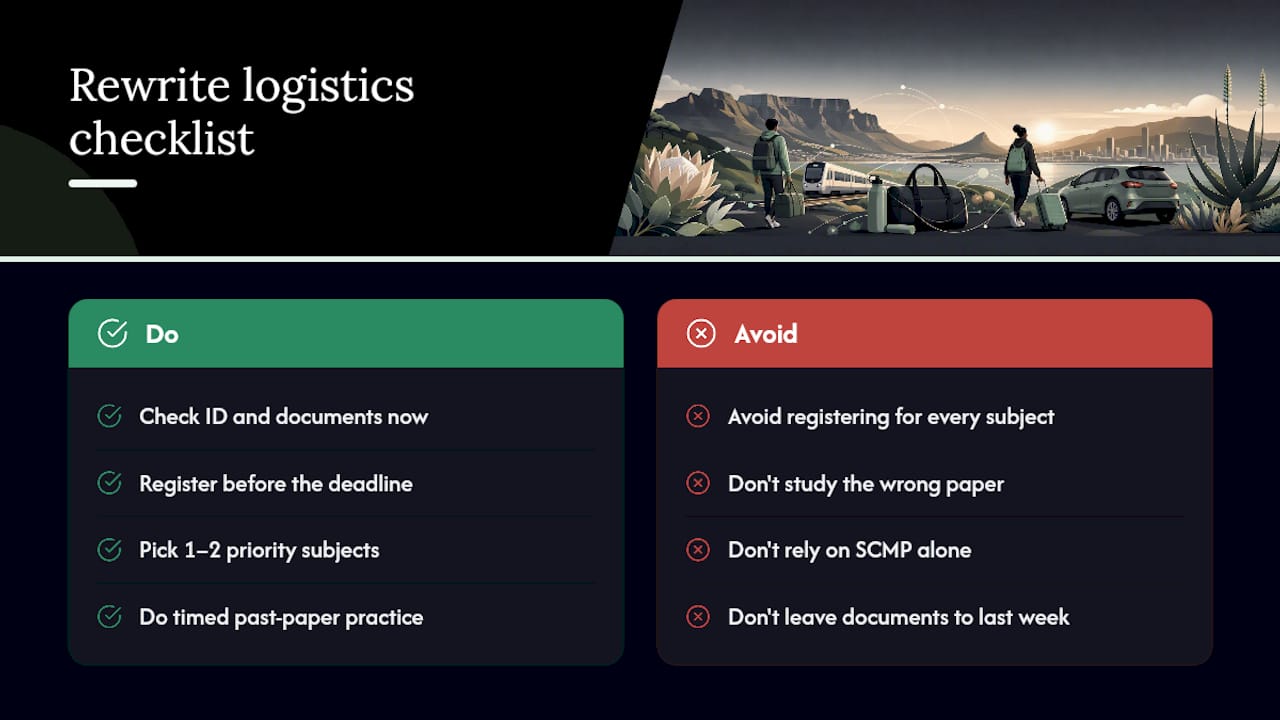
Most candidates who fail a rewrite do not fail because they did not study. They fail because they underestimated logistics: they missed the registration deadline by a week, they arrived at the exam centre without their admission letter, or they spent three months studying the wrong paper (Paper 2 when they needed Paper 1). The administrative side of a rewrite is genuinely unforgiving.
The second thing people underestimate is subject selection. Registering for every subject you want to improve sounds sensible, but splitting your preparation across five subjects in eight weeks usually means doing none of them well. Pick the one or two subjects where the mark improvement matters most for your next step, whether that is a university application, a college programme, or a specific career path, and go deep on those.
The SCMP is genuinely useful, but it works best as a supplement to self-study, not a replacement for it. Tutors cover the high-yield topics. You still need to do the timed past-paper work yourself to convert that knowledge into exam marks.
One more thing: check your ID and documentation now, not the week before the exam. A learner who arrives at the exam centre with an expired ID or a missing Statement of Results faces a problem that no amount of preparation can fix on the day.
Past papers for your rewrite, free and ready to download
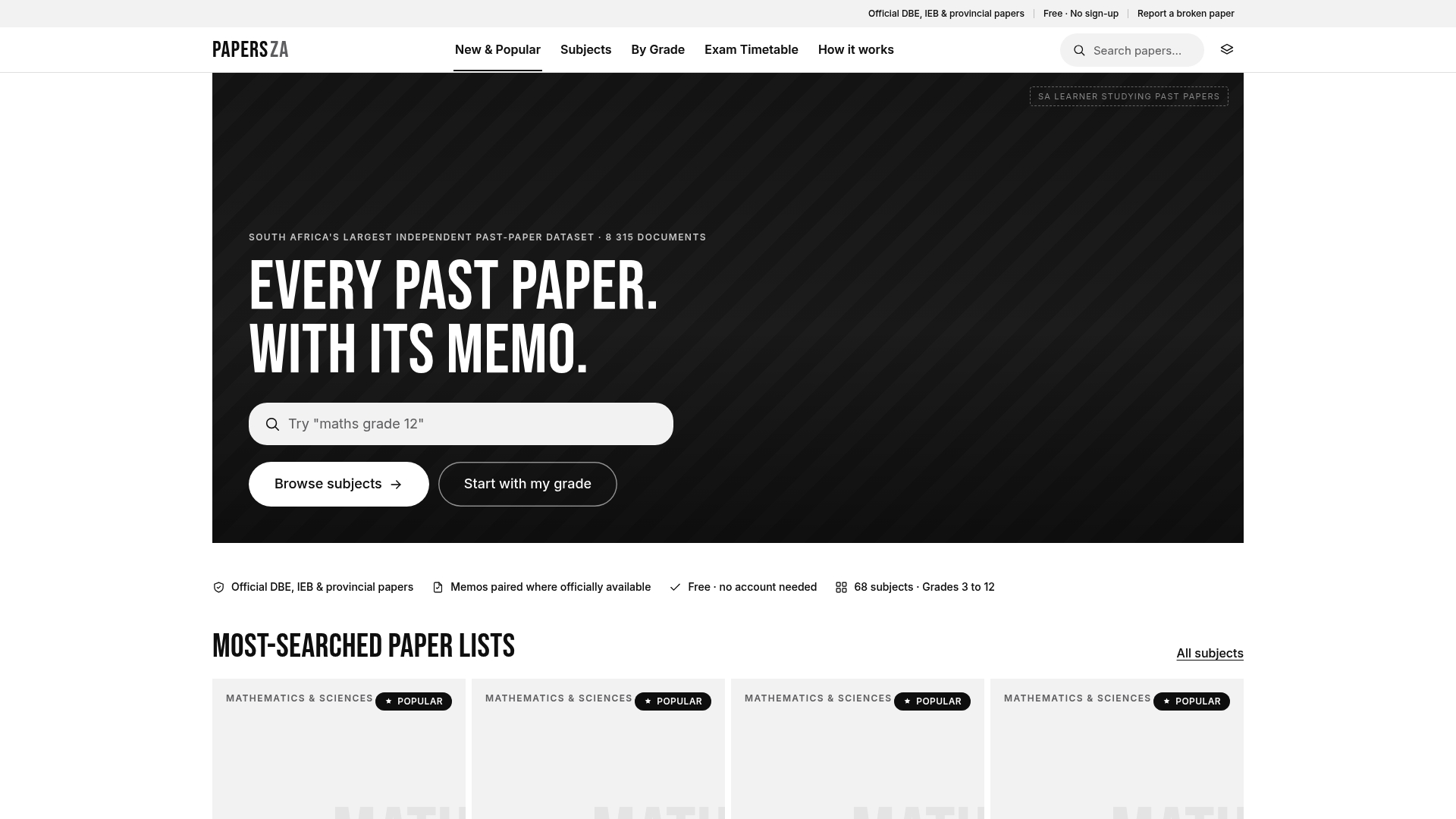
Papersza is the fastest way to access official South African past papers and memos without an account, a subscription, or any cost. The library covers all Grade 12 subjects, with DBE, IEB, and provincial papers paired with marking memos so you can mark your own work immediately. For candidates targeting specific subjects, collections like Business Studies Grade 12 are organised by year and session, making it straightforward to build a timed practice schedule. Not sure how to navigate the library? The how it works page walks you through finding the right paper in under a minute. Start with the most recent past paper for your subject, write it under exam conditions, and mark it against the memo.
Sources
Bookmark these pages for registration notices, timetables, results, and free study materials:
For exact registration dates, centre addresses, and subject availability in your province, always cross-check the national DBE page with your provincial education department’s website. National policy sets the framework; provinces set the operational details.
FAQ
Who qualifies for matric supplementary exams?
Previous NSC candidates from 2008 onwards, candidates absent with a valid documented reason, part-time and adult learners, and Senior Certificate candidates all qualify to register for the May/June or November cycles. You may only register for subjects you were previously registered for, unless the DBE specifies otherwise.
What is the difference between a matric rewrite and a supplementary exam?
The term “supplementary exam” historically referred to the February/March sitting, which has been phased out. A matric rewrite now means registering for the May/June or November NSC cycle to improve results or complete outstanding subjects.
Does NSFAS pay for supplementary exams?
NSFAS funds registered students at public universities and TVET colleges, not NSC exam registration fees. Exam registration fees are paid to your provincial education department. Learners who cannot afford fees should ask their provincial office about fee waivers.
How do I find my nearest Second Chance Matric centre?
Check your provincial education department’s website or search “[your province] Second Chance Matric Programme.” The Western Cape Education Department publishes a full centre list as an example of how provinces list locations, subjects, and dates.
Where can I download past papers to prepare for my rewrite?
The DBE website hosts official NSC past papers and memos. Papersza offers a free searchable library of over 8,315 documents covering grades 3–12, including DBE, IEB, and provincial papers with memos, and requires no account to download.