Where to find past papers in South Africa (grades 1 to 12 and tertiary)

The fastest route is the National Department of Basic Education’s NSC past examination papers pageExaminations/NSCPastExaminationpapers.aspx) for Matric, PapersZA for grades 3 to 12 with memos and no login, and your university’s own repository for tertiary modules. Each source covers a different slice of the puzzle.
- DBE NSC page: official Matric question papers and memos, straight from government.
- PapersZA: a free, searchable archive covering grades 3 to 12, DBE, IEB, and provincial papers with memos attached.
- Provincial portals (Gauteng, Western Cape, KwaZulu-Natal, and others): useful when you need a paper set specific to that province’s assessment calendar.
- University and TVET archives: for tertiary exam prep, mostly institution-specific.
Most files download as PDFs. Some of the newest papers get restricted for exam integrity reasons, and a handful of provincial links go dead without warning. When that happens, the department’s own contact channels are usually the quickest fix.
Table of Contents
- Where to look by education level: DBE, provincial, IEB, and university archives
- How to search for and download the exact paper you need
- Are past paper apps and aggregator sites worth using?
- Why pairing official archives with PapersZA works better than either alone
- How to actually use past papers to improve your marks
- Why the search itself matters more than people think
- Start with PapersZA, then confirm against official archives when it matters
- Sources
- FAQ
Where to look by education level: DBE, provincial, IEB, and university archives
Matric papers have one clear home. The National Department of Basic Education hosts NSC exams going back several years, organized by subject and exam session (May/June, October/November). If a specific year’s link is broken, the page lists webmaster contact details for that exact problem.
Below Matric, the picture splits by province and school type.
- Provincial education department portals handle exams set at provincial level, plus supplementary resources. The Gauteng Department of Education’s exam papers page is a good template for how these are structured: subject folders, grade filters, and downloadable PDFs. Western Cape, KwaZulu-Natal, Limpopo, Mpumalanga, and Free State run similar setups on their own department sites, though navigation quality varies a lot from province to province.
- IEB past papers live on the Independent Examinations Board’s own portal rather than the DBE site, since IEB sets and marks its own matric exams for independent schools. If your child attends an IEB school, don’t waste time searching DBE archives for their exact paper.
- University and TVET college archives are the least standardized part of the system. Some, like Nelson Mandela University’s exam papers repository, are open and searchable without a student login. Others, including the University of Johannesburg’s institutional repository, require you to browse by author or department listing. Many UK and international university libraries, such as the Bodleian’s exam paper archive, show what a well-built archive looks like: simple search plus advanced filters by course code and year. South African institutions are catching up unevenly, and some recent papers stay behind a student login wall.
For grades 1 to 9, the landscape thins out. Provincial portals occasionally post School-Based Assessment (SBA) exemplars and term test papers, but coverage is patchy compared to the Matric years. This is where an aggregator like PapersZA fills a real gap, since it indexes primary and senior phase papers that individual provincial sites often bury or skip entirely.
How to search for and download the exact paper you need
Generic searches waste time. Specific ones work.
Try phrases like “Grade 12 Mathematics past question paper 2019 site:education.gov.za” or “Grade 10 Afrikaans question paper Oct/Nov 2018” instead of just typing the subject name. Adding the exam session term (May/June or Oct/Nov) narrows results fast, since most departments file papers by session rather than by month alone.
A few habits that save real time:
- Use the site’s own search bar or filter menu before falling back to Google. Most university repositories and the DBE page have better internal search than their site design suggests.
- For tertiary papers, search by course code (e.g., “ACC101”) rather than the full course name. Codes are consistent year to year; names sometimes change.
- Learn the file naming pattern: papers usually pair a question paper file with a separate memorandum or memo file, and some subjects add an annexure or data sheet as a third download.
- If a file is missing, restricted, or the link times out, contact the webmaster number listed on the DBE page rather than assuming the paper doesn’t exist.
Pro Tip: Bookmark the exact subject and grade page you use most, rather than the homepage. Provincial sites in particular restructure their menus often, and a direct bookmark survives redesigns better than a saved search.
Are past paper apps and aggregator sites worth using?
Aggregators trade a little reliability for a lot of convenience. That’s the honest trade-off, and it’s usually worth it if you verify what you download.

The upside is real: one search box instead of six government websites, memos bundled with question papers, and no need to know which province set which exam. The downside is that some aggregator sites carry heavy advertising or host outdated papers without saying so.
A quick verification checklist before you trust a downloaded file:
- Check that the paper carries visible DBE, IEB, or provincial headers and logos, not a generic template.
- Confirm the memo is actually attached, not just promised in the page description.
- Prefer sites that name their source (DBE, provincial department, specific university) over ones that give no origin at all.
Mobile apps built for offline past paper access can be genuinely useful during load shedding or on a limited data plan. Check the app’s own description first. Most independent apps state plainly that they’re not affiliated with the DBE, which is fine, as long as they’re upfront about it and show where their papers actually came from.
Why pairing official archives with PapersZA works better than either alone
Official government and university archives are the record of truth. If you ever need to confirm a paper is genuine, the DBE NSC page or your provincial department’s site is where you check it.
PapersZA exists to solve a different problem: speed. The platform hosts a large number of documents spanning grades 3 to 12, sourced from DBE, IEB, and provincial papers, and every download is free with no account required. That volume matters most for younger grades and older years, where official portals often go thin.
- Memos are paired with question papers wherever available, so self-marking doesn’t require a separate hunt.
- No login or payment wall means a parent checking a paper on a phone in five minutes doesn’t hit friction.
- Official sources remain the reference point for authenticity, and PapersZA draws directly from them rather than from unverified third parties.
How to actually use past papers to improve your marks
Downloading a paper doesn’t teach you anything by itself. What moves the needle is a repeatable weekly routine.
- Do a timed run first. Set a timer matching the real exam length, close your notes, and attempt the full paper as if it counted. Simulating real conditions is the single biggest difference between students who improve fast and those who plateau.
- Mark it yourself with the memo, immediately after. Don’t wait a day. Go line by line, and be honest about partial marks versus marks you guessed your way into.
- Log every mistake by topic, then revise before your next attempt. A simple notebook or spreadsheet works fine: date, subject, topic, what went wrong. After a week of focused revision on your weakest two or three topics, re-test with a different year’s paper on the same topics.
Rotate subjects across the week rather than grinding one subject for days straight. Exam stamina is built by switching cognitive gears, not by repetition of the same content. And when a topic keeps showing up in your error log, take it straight to a teacher rather than re-reading the same textbook section for the fourth time.
Pro Tip: Keep your error log visible, on your wall or phone lock screen. Students who track weak topics somewhere they see daily tend to close those gaps faster than students who only think about them the night before the next practice paper.
Why the search itself matters more than people think
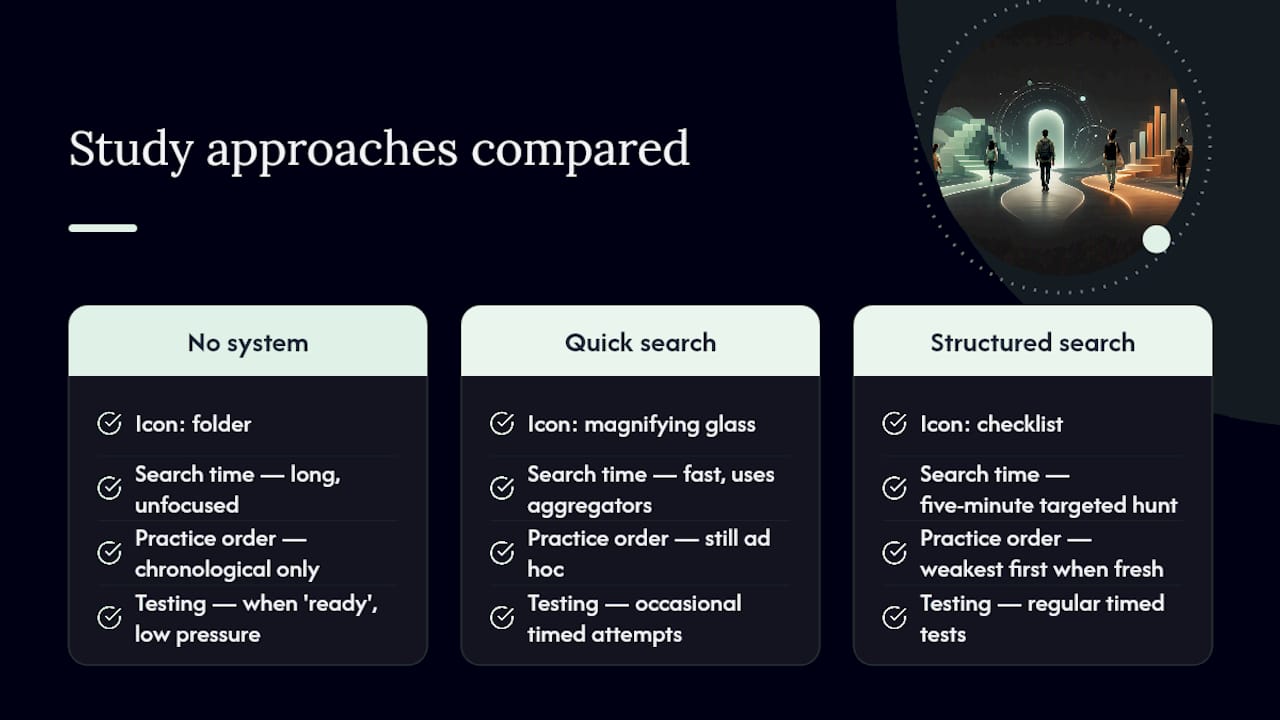
Most advice on past papers focuses entirely on where to download them, as if access were the whole problem. It isn’t. The bigger issue is that South African students often collect a folder of papers and never build a system for using them.
The conventional wisdom, download everything, work through it chronologically, undersells how much the order of practice matters. Starting with your weakest subject when you’re mentally fresh beats saving it for last when you’re tired. Testing under real time pressure before you feel ready beats waiting until you feel confident, because confidence built without time pressure evaporates the moment the real clock starts.
If there’s one thing worth doing differently, it’s treating the archive hunt as a five-minute task, not a project. Official sources confirm authenticity. An aggregator like PapersZA gets you volume and speed without an account wall. Spend the time you save on actually marking your own work against the memo, since that’s the step most students skip and the one that teaches the most.
— Nkosi
Start with PapersZA, then confirm against official archives when it matters
PapersZA gives you what a folder of bookmarked government links can’t: one search box across grades 3 to 12, memos already paired with the question papers, and zero forms to fill in before you download.
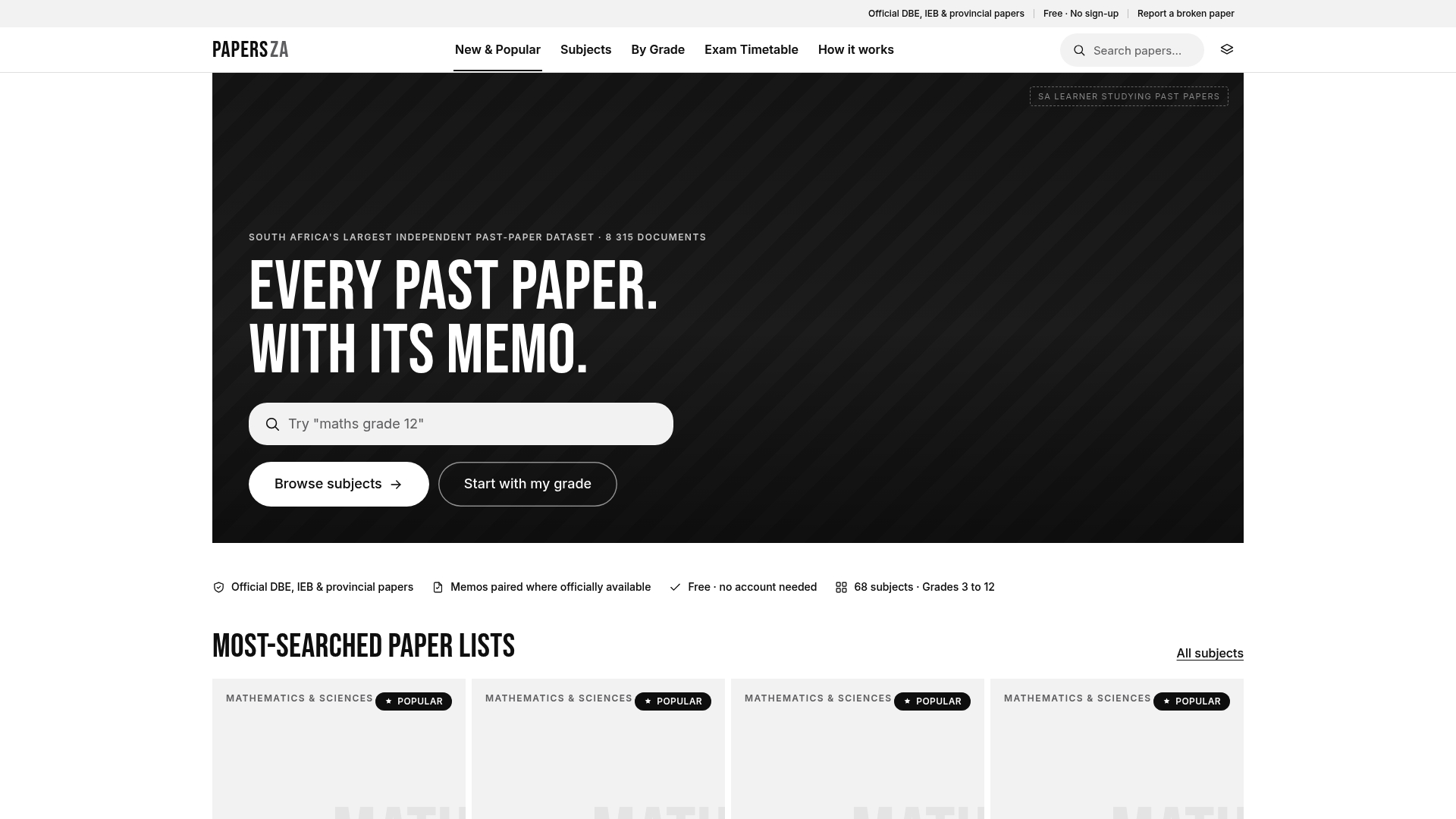
The fastest way to use it is simple. Filter by grade, then subject, then year, and download the question paper and memo together so you can mark your own work the same day you write it. High-traffic subjects get their own dedicated pages, including Mathematics Grade 12, Physical Sciences Grade 12, and English Grade 12, so you’re not digging through a generic subject list. If you ever need to double-check a paper’s origin for a school assignment or a formal revision plan, cross-reference it against the DBE or provincial source directly. For a walkthrough of how the archive is organized, see how PapersZA works and start pulling the papers your next test actually covers.
Sources
FAQ
Where can I find past South African exam papers?
Start with the DBE NSC page for Matric, provincial department portals for regional papers, and PapersZA for a free, searchable archive covering grades 3 to 12 with memos.
Where can I access past papers without creating an account?
PapersZA offers free downloads of past papers and memos for grades 3 to 12 without requiring registration or login, which sets it apart from many university repositories that require a student account.
Where can I find past papers for Grade 10?
Grade 10 papers are less standardized on official provincial sites than Matric papers, so an aggregator like PapersZA is often the quickest route; subject pages such as Physical Sciences Grade 10 list multiple years and sessions together.
Which website has the most complete collection of past papers?
PapersZA hosts a large number of documents across grades 3 to 12, drawing from DBE, IEB, and provincial sources, making it one of the largest independent collections available for free download in South Africa.