Cognitive levels in CAPS exams: what they are and how to use them

Cognitive levels describe how hard you have to think to earn the marks on a question. In CAPS exams, the DBE sorts questions from simple recall at the bottom, through understanding and applying, to analysing and evaluating at the top. Each subject’s examination guidelines say how much of the paper should sit at each level. Once you can see the level behind a question, you can practise the right skill instead of rereading notes.
TL;DR
- CAPS builds its question papers on Bloom’s taxonomy, grouped into lower, middle and higher cognitive levels.
- The grouping and the weightings differ by subject. Grade 12 Life Orientation uses six Bloom levels in three bands (30%, 40%, 30%). Computer Applications Technology uses three levels, L1 to L3.
- A command word is a clue, not a guarantee. The same word can be used at different levels, so read the whole question.
- Use past papers and memos to label every question by level, then work out which level costs you marks.
- Always check the subject’s own examination guidelines for the exact weightings.
Table of Contents
- What cognitive levels are
- The levels, one at a time
- How the weightings work
- How to spot the level of a question
- Why CAPS papers mix the levels
- Turn past papers into a level-by-level study plan
- For teachers and parents
- Perspective
- Find past papers to practise on
- Common mistakes when working with cognitive levels
- FAQ
- Sources
What cognitive levels are
A cognitive level is a category of thinking. Recalling a definition is one kind of thinking. Using a known method on a familiar problem is another. Judging which of two solutions is better, and defending the choice, is a third.
CAPS borrows this idea from Bloom’s taxonomy. The DBE’s Grade 12 Life Orientation examination guidelines group Bloom’s six levels into three bands: lower order (Levels 1 and 2), middle order (Levels 3 and 4) and higher order (Levels 5 and 6). The Business Studies guidelines tell teachers to link subject content to low-, middle- and high-order levels in both teaching and assessment.

The point is fairness and balance. A paper made only of recall questions would reward memorising. A paper made only of hard problem-solving would leave many learners with no way to show what they know. A spread of levels lets weaker and stronger learners both show their understanding, and it separates the top achievers from the rest.
The levels, one at a time
Subjects name and number the levels differently, so treat the labels below as a map rather than a universal list. The Computer Applications Technology (CAT) guidelines give a clear three-level example.
Level 1: remembering
In the CAT examination guidelines, L1 (also written C1) covers recall of factual or process knowledge in isolation, and one-step or basic routines. Think of naming a part of a computer, or listing the steps you already know by heart.
These questions are usually the quickest marks. They are also where careless errors creep in, because learners rush.
Level 2: understanding and applying
The same guidelines describe L2 (C2) as showing understanding and using known routines in familiar contexts, where the information you need is immediately available. You are not inventing anything. You are taking something you have practised and using it on a scenario that looks familiar.
In most subjects this is the biggest band, and it is where steady practice from past papers pays off most.
Level 3: analysing, evaluating and creating
In the CAT guidelines, L3 (C3) covers analysing, evaluating and creating. You must break a problem apart, weigh options, or build something new, often in a context you have not seen before. Marks here are harder to earn, and memos for these questions usually accept a range of valid answers.
How Life Orientation splits it
Life Orientation uses all six Bloom levels. Levels 1 and 2 are lower order, Levels 3 and 4 middle order and Levels 5 and 6 higher order. If you are preparing for that subject, our guide to Life Orientation past papers and memos shows where to find them.
How the weightings work
Each subject’s guidelines set suggested weightings for the levels. Two examples from the DBE documents show the pattern.
| Subject and document | Levels used | Suggested weighting |
|---|---|---|
| Grade 12 Life Orientation, 2021 guidelines | Lower (1 and 2), middle (3 and 4), higher (5 and 6) | 30%, 40%, 30% |
| Grade 12 CAT Senior Certificate guidelines, 2015 | L1, L2, L3 in Paper 1 and Paper 2 | 30%, 40%, 30% |
The Life Orientation weightings come from the 2021 examination guidelines, and the CAT figures from the 2015 CAT guidelines.
The 2015 CAT document makes a second distinction that trips up many learners: levels of difficulty are not the same as cognitive levels. It sets the overall difficulty at 30% easy, 40% moderate and 30% difficult. A question can test recall (a low cognitive level) and still be difficult because the content is obscure. A question can test application and still be easy because the content is familiar.
So a paper that feels hard is not necessarily a paper full of high-level questions. Keep the two ideas apart when you analyse your results.
Other subjects, such as Mathematics, Physical Sciences and Accounting, use their own level names and percentages. Open the current examination guidelines for your subject on the DBE website and find the section on weighting of cognitive levels. It is usually near the start of the document.
How to spot the level of a question
You have three clues to work with: the command word, the marks, and the context.
Read the command word
The CAT guidelines tell learners that action words show what to include in an answer, and that naming or listing tests a lower level than discussing. That gives you a rough ladder:
- Lower: name, list, state, define, identify
- Middle: explain, describe, calculate, apply, compare
- Higher: analyse, evaluate, justify, recommend, design
Our guide to exam command words explains each one and how to answer it.
Do not trust the word alone
The Life Orientation guidelines warn that the same action word, such as “describe”, may be used at different cognitive levels, and that the design of the question shows the level required. “Describe the stages of the cycle” is recall. “Describe how this change would affect the person in the scenario” asks you to apply and reason.
This is a good example of why the question’s design matters more than its first word. Examo’s explainer on exam question types and rubrics covers how question design shapes what a question really tests.

Check the marks and the context
A one-mark question is rarely a higher-order question. A question with a new scenario, a data table or a source text, and several marks, usually asks for more than recall. Ask yourself two things:
- Could I answer this straight from my notes, word for word?
- Do I need to use information in the question that I have never seen before?
If the answer to the first is yes, it is likely lower order. If the answer to the second is yes, it is likely middle or higher order.
Why CAPS papers mix the levels
The examination guidelines tie the levels to teaching as well as testing, which means the weightings are meant to shape how you are taught, not only how you are marked. The Business Studies guidelines say teachers should link content to low-, middle- and high-order levels in teaching and assessment.
The practical result for you: if you only learn definitions, you can collect the lower-level marks and no more. Most of the marks in a typical paper sit above recall, so understanding and application matter as much as memory.
Turn past papers into a level-by-level study plan
Past papers are the best practice material because they are written to the same weightings as the paper you will sit. Here is a method that works for most subjects.
Step 1: Pick a full paper and write it under exam conditions
Use the same time limit and no notes. Download the question paper and the memo from PapersZA, where papers and memos are organised by subject, grade, year and exam session.
Step 2: Mark it with the memo
Be strict. Do not give yourself marks for answers that are “nearly” there.
Step 3: Label every question
Next to each question, write L, M or H (lower, middle, higher), using your subject’s guidelines and the clues above. For subjects with three levels, write 1, 2 or 3.
Step 4: Add up your marks by level
A simple table in your notebook is enough:
| Level | Marks available | Marks earned | Percentage |
|---|---|---|---|
| Lower | |||
| Middle | |||
| Higher |
Compare your percentage in each band. A learner who scores well on lower-level questions but poorly on higher-level ones needs a different plan from one who loses marks on simple recall.
Step 5: Fix the weakest band
- Weak at lower level: build short daily recall sessions. Cover the page, write what you remember, then check.
- Weak at middle level: redo worked examples without looking, then do similar questions from other years.
- Weak at higher level: read the memo for these questions closely. Note how the marks are split between reasoning and the final answer, then write your own answer to the same question a few days later.
Step 6: Repeat with a different year
Use a paper from another year and compare your band scores. Improvement should show in the weak band first.
Subject-specific examples help. If you take Business Studies, try the May/June 2024 Grade 12 paper and the May/June 2023 paper, and label the questions against the cognitive levels in the guidelines. If you take CAT, our page on the CAT practical exam shows how to prepare for the practical side.
For teachers and parents
Teachers can use the same labelling exercise to build balanced class tests. Take an old paper, tag each question, and check that your own test roughly follows the guideline weightings. Reviewing a paper in this way also shows quickly whether learners are being asked to do more than copy from the textbook.
Parents do not need to master the taxonomy. Ask your child one question after a past paper: “Which questions did you lose marks on, and were they recall questions or thinking questions?” That one conversation points to the right kind of help, whether it is a revision routine or a teacher’s explanation.
Perspective
Every week we see learners download a paper, write it, and only look at the total. The total hides the most useful information. Two learners can both score 55% and need completely different help, because one lost marks on recall and the other on reasoning.
That is why we organise PapersZA by subject, grade, year and exam session, with the memo beside the paper. You can pick any year, label the questions, and see which cognitive level holds you back. You do not need an account, and you do not pay for it.
Our advice is simple: stop treating past papers as a pile to get through. Treat each one as a test of a single skill, repeat it across years, and the pattern will show you where to spend your time.
Nkosi
Find past papers to practise on
PapersZA is a free, searchable library of official DBE, IEB and provincial past papers and memos for grades 3 to 12, and you do not need to register. Choose your subject and grade, download a paper with its memo, and start labelling questions by level.
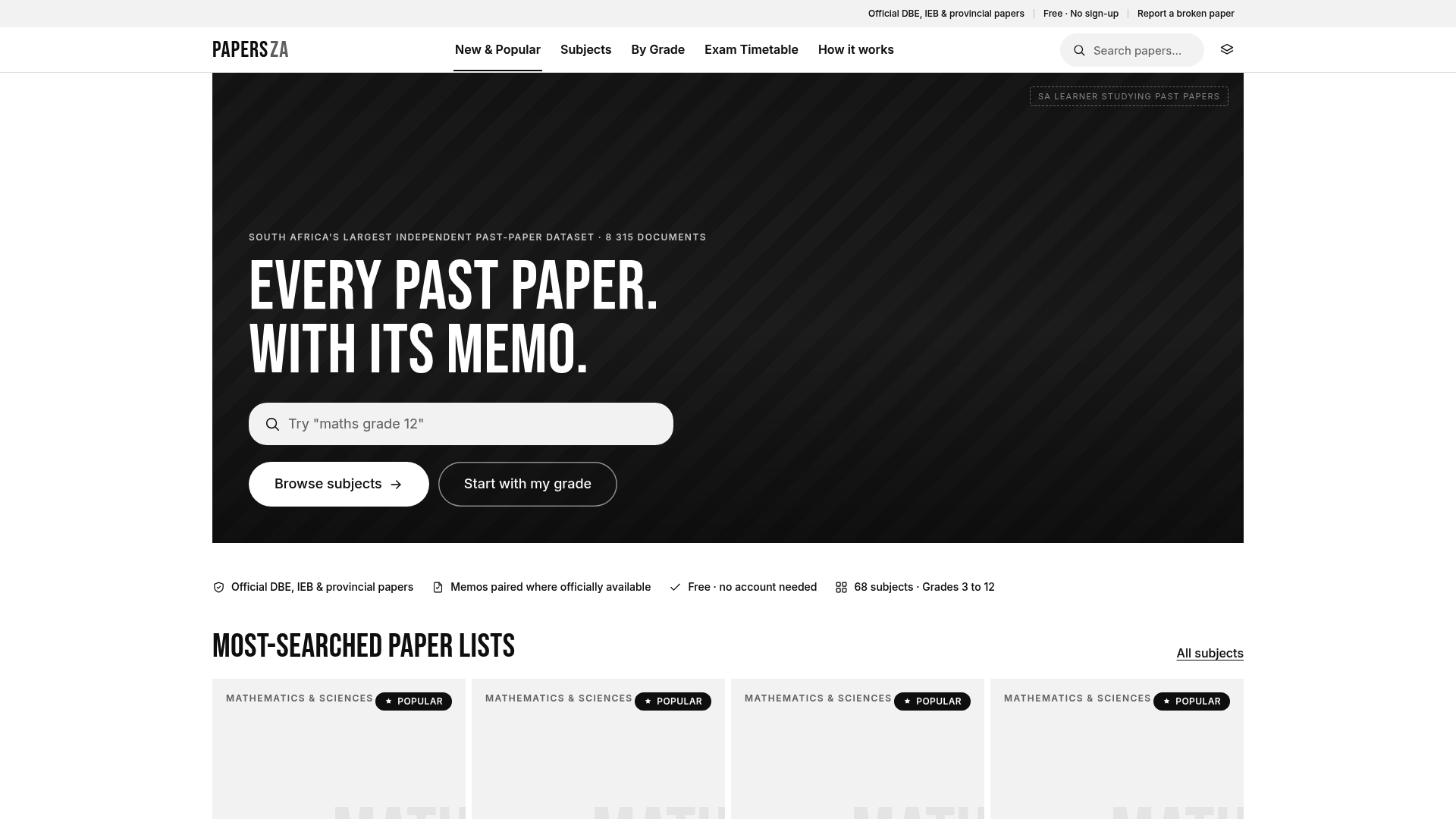
Start at the PapersZA home page, or go straight to a paper such as the Business Studies Oct/Nov 2023 Grade 11 question paper.
Common mistakes when working with cognitive levels
- Treating “hard” as “higher order”. As the 2015 CAT guidelines show, difficulty and cognitive level are separate. A difficult recall question is still recall.
- Skipping the memo for higher-level questions. The memo shows how marks are awarded for reasoning, which is the part most learners underestimate.
- Practising only your strongest level. It feels good, but it does not move your mark.
- Memorising model answers. A model answer to one scenario will not fit the next scenario. Learn the reasoning behind it.
- Ignoring the examination guidelines. They say how your subject is weighted. Read them once at the start of the year.
FAQ
How many cognitive levels are there in CAPS?
It depends on the subject. Grade 12 Life Orientation uses six Bloom levels grouped into lower, middle and higher order, while the Grade 12 CAT guidelines use three levels, L1 to L3. Check the examination guidelines for your subject for the exact structure.
What are the weightings of the cognitive levels?
They are set per subject. For Grade 12 Life Orientation the suggested split is 30% lower order, 40% middle order and 30% higher order. The 2015 CAT guidelines use 30%, 40% and 30% for L1, L2 and L3.
Is a command word enough to tell me the level?
No. Words like “name” and “list” usually point to lower levels, and “discuss” asks for more. But the Life Orientation guidelines note that a word such as “describe” can appear at different levels, so read the whole question and look at the marks.
Does a hard question mean a higher cognitive level?
Not necessarily. The CAT guidelines treat difficulty (easy, moderate, difficult) separately from cognitive level. A question can be difficult because the content is obscure while still testing only recall.
Sources
- Grade 12 Life Orientation examination guidelines, 2021 (DBE)
- Business Studies Grade 12 examination guidelines, 2021 (DBE)
- Computer Applications Technology examination guidelines, 2021 (DBE)
- Grade 12 Senior Certificate CAT guidelines, 2015 (DBE)
- Exam question types and rubrics