Grade 11 Study Timetable: A Weekly Plan That Works

A good Grade 11 study timetable does three things: it starts from your real week (school, transport, sport, chores), it gives every study block one subject and one task, and it gets reviewed every weekend. Below you will find the method, a sample weekday and weekend, and a way to build past papers and memos into the plan so you know what to fix next.
TL;DR
- List your fixed commitments first, then fill the free blocks. Do not start with an ideal week you cannot keep.
- On weekdays, study two or three subjects, not all of them. Use weekends for longer revision and past papers.
- Give each block one subject and one task, such as ten questions or one memo check.
- Sleep, food, water and a walk are part of the timetable, not extras.
- Review the plan at the end of every week and change what did not work.
Table of Contents
- Why Grade 11 needs a timetable
- Step 1: Write down your fixed week
- Step 2: Mark free blocks and match them to your energy
- Step 3: Split your time between subjects
- Step 4: Give every block one subject and one task
- A sample Grade 11 weekday
- A sample weekly overview
- Step 5: Use past papers and memos to steer the timetable
- Looking after yourself inside the timetable
- Step 6: Review the plan every week
- Common timetable mistakes
- Moving on to matric
- Free past papers and memos for your timetable
- Perspective
- FAQ
- Sources
Why Grade 11 needs a timetable
Grade 11 is the year when the work gets heavier but the pressure still feels a little distant. That is exactly why a plan helps. The final Grade 11 papers count towards your year mark, and the habits you build now are the ones you carry into matric. If you want the wider picture of the year, our Grade 11 exam preparation plan covers the full run-up to exams.
A study schedule helps you stay organised, meet deadlines and reduce stress, according to University of Johannesburg Career Services. A timetable is not about studying more hours. It is about knowing what you are doing at 16:30 on a Tuesday so you do not spend that time deciding.
Step 1: Write down your fixed week
Before you add a single study block, list everything that cannot move. The same UJ guide suggests starting with fixed commitments such as classes, part-time work, extracurricular activities and family obligations.
For a Grade 11 learner in South Africa that usually means:
- School hours and the trip there and back (taxi, bus, lift or walking)
- Sport practice, matches, choir, church or cultural activities
- Chores, looking after younger siblings, cooking
- Meals, showers and sleep
- Part-time work, if you have it
Draw a simple grid with Monday to Sunday across the top and the hours of the day down the side. Block out the fixed items in one colour. What is left is your real study time. Many learners are surprised to find it is less than they thought, which is good news: you can plan honestly instead of guiltily.
Step 2: Mark free blocks and match them to your energy
Look at the white space on your grid. A practical rule from a weekly study timetable guide is to mark free blocks of at least 30 minutes, and to choose the ones when you feel most awake and your home is quiet.
That last part matters in South Africa, where load shedding, a noisy household or shared devices can change what is possible. If the evening is unpredictable in your home, put your hardest subject in the early afternoon or early morning and keep the evening for lighter tasks that can be done by candlelight or phone torch, such as reading notes or testing yourself aloud.
Two more habits keep the plan realistic:
- Leave a spare block. Things go wrong: a late taxi, a family event, a headache. A spare slot in the week lets you catch up without wrecking everything.
- Keep one day mostly free of study. The same guide recommends it, and it is what stops burnout by October.
Step 3: Split your time between subjects
The most common mistake is giving every subject an hour every day. By Wednesday you are behind in all of them. We suggest this instead:
- On weekdays, pick two or three subjects per evening. Prioritise those you have at school the next day, so what you revise is fresh and your teacher can answer questions.
- Use weekends for the bigger jobs: full revision of a topic, assignments, essays and past papers.
- Rotate subjects so you do not tire out on one. UJ advises you to rotate subjects and schedule challenging ones at your peak study times.
Give more time to the subjects that are hardest for you or carry the most weight in your future plans. If you want to study engineering, Mathematics and Physical Sciences deserve more blocks than Life Orientation. That is not neglecting the rest; it is being honest about priorities.
Weighting your subjects: a simple method
Rate each of your subjects from 1 (comfortable) to 3 (struggling) based on your last test or exam result. Subjects rated 3 get three blocks a week, rated 2 get two, rated 1 get one. Add them up and check the total fits your free blocks from Step 2. If it does not, you have too many priorities, so drop a block from the subjects rated 1 rather than squeezing everything.

Step 4: Give every block one subject and one task
“Study Maths” is not a task. “Do ten questions on functions and check them against the memo” is. One suggested approach is to give each block one subject and one achievable task, for example ten Mathematics questions or drawing a plant cell from memory.
Good tasks are small and checkable:
- Answer one past paper question and mark it with the memo
- Summarise a chapter on one page without looking at the book
- Make a mind map of a topic, using colours and pictures
- Explain a concept aloud as if teaching a friend
That last pair comes straight from the Department of Basic Education, which advises learners to teach concepts aloud and use colours, pictures and mind maps to learn and remember. Our guide to the active recall method shows how to turn this into a habit.
Keep blocks short enough to stay focused. The Department also recommends that you break learning sections into manageable parts so you do not become tired, unfocused or anxious.
A sample Grade 11 weekday
A sample routine from a UK local authority study plan includes time to decompress after school, a 45 to 60 minute core-subject block, a short break, a lighter task and an evening wind-down. Here is how that could look for a learner who gets home around 15:00. Change the times to suit your own day.
| Time | Activity |
|---|---|
| 15:00 to 16:00 | Snack, rest, shower, decompress |
| 16:00 to 16:50 | Block 1: hardest subject for tomorrow (one task) |
| 16:50 to 17:10 | Break: walk outside, water, stretch |
| 17:10 to 17:50 | Block 2: second subject, a lighter task |
| 17:50 to 19:00 | Supper, chores, family time |
| 19:00 to 19:30 | Block 3 (optional): flashcards or reading notes |
| 19:30 onwards | Wind-down, pack your bag, sleep on time |
Notice what is missing: a marathon. Two focused blocks of the right length beat four hours of staring at a page.
A sample weekly overview
This example is for a learner taking Mathematics, Physical Sciences, Life Sciences, English, Afrikaans, Geography and Life Orientation, who finds Maths and Physical Sciences hardest. Adapt it to your own subjects.
| Day | Block 1 | Block 2 |
|---|---|---|
| Monday | Mathematics | Afrikaans |
| Tuesday | Physical Sciences | English |
| Wednesday | Mathematics | Life Sciences |
| Thursday | Physical Sciences | Geography |
| Friday | Light review of the week’s notes | Free evening |
| Saturday morning | Past paper (timed): Maths or Physical Sciences | Mark with the memo |
| Saturday afternoon | Free or sport | Free or sport |
| Sunday | Life Sciences or Geography revision | Plan the week ahead |
The Sunday slot to plan the week ahead is small but powerful. Ten minutes to see what tests, assignments and activities are coming means you can move blocks around before you fall behind.
Step 5: Use past papers and memos to steer the timetable
Past papers are the most direct way to find out what you know and what you do not. The Department of Basic Education says it provides previous exam papers so learners can revise and find out what they know and do not know. Its exam tips also say to work through past examination papers when preparing for finals.
Here is a way to use them inside your timetable:
- Pick a subject and a paper. Choose a Grade 11 paper from a previous year and session.
- Do it under exam conditions. Set a timer for the paper’s time and put your phone away.
- Mark it with the memo. Be strict. Note every mark you lost.
- Sort your mistakes. Mark each one as “did not know”, “misread the question” or “careless”.
- Add blocks. Each “did not know” topic becomes a task in next week’s timetable.
On PapersZA you can find papers by subject, grade, year and exam session, and no account is needed. For example, you can open the Business Studies Grade 11 question paper from Oct/Nov 2023 or the Oct/Nov 2011 paper to see how the style of questions has stayed the same or changed.
Turning topics into questions is also a strong method. UNISA’s exam preparation brochure describes turning learning outcomes into questions as particularly useful for question-and-answer study. Past papers hand you those questions ready-made.
Looking after yourself inside the timetable
A timetable that ignores your body fails by the second week. The Department of Basic Education’s exam tips are blunt: sleep at least 8 hours, eat properly, drink plenty of water and take a walk outside. Build these into the grid as real entries. Put “lights out 21:30” in the same colour as Maths.
If you notice that stress is taking over, speak to a parent, teacher or school counsellor. Our article on exam stress management for South African students has practical ideas that fit into a busy week.
Step 6: Review the plan every week
No timetable survives contact with real life unchanged. At the end of each week, review your progress, reflect on what worked and adjust the upcoming week’s plan. Ask yourself:
- Which blocks did I actually do, and which did I skip?
- Was the skipped block at a bad time, or was the task too big?
- Which subject felt worst when I marked a past paper?
- Did I rest enough?
Move skipped blocks to the spare slot or reduce them. Do not simply pile them onto next week. A plan you follow at 70% is better than a perfect one you abandon.
Common timetable mistakes
- Colour-coding for hours and never studying. The grid is a tool, not the work.
- Starting with the favourite subject. Do the hardest task in your best energy slot.
- No breaks. Short breaks keep the next block useful.
- Only reading notes. Reading feels productive but tests nothing. Add questions, memos and recall.
- Ignoring the exam timetable. Once your school shares its Grade 11 exam schedule, work backwards from it and place a past paper for each subject in the weeks before. Your school sets its own dates, so check the official schedule from your teacher.
Moving on to matric
The same method scales up. When you reach Grade 12, our matric study timetable templates and the guide to prelim exams pick up where this plan leaves off. If you take Physical Sciences, the exam strategy guide helps you plan your paper-by-paper practice.
Free past papers and memos for your timetable
PapersZA is a free library of official DBE, IEB and provincial past papers and memos for Grades 3 to 12, organised by subject, grade, year and exam session. There is no account to create and nothing to pay, so you can add a paper to any Saturday block in seconds.
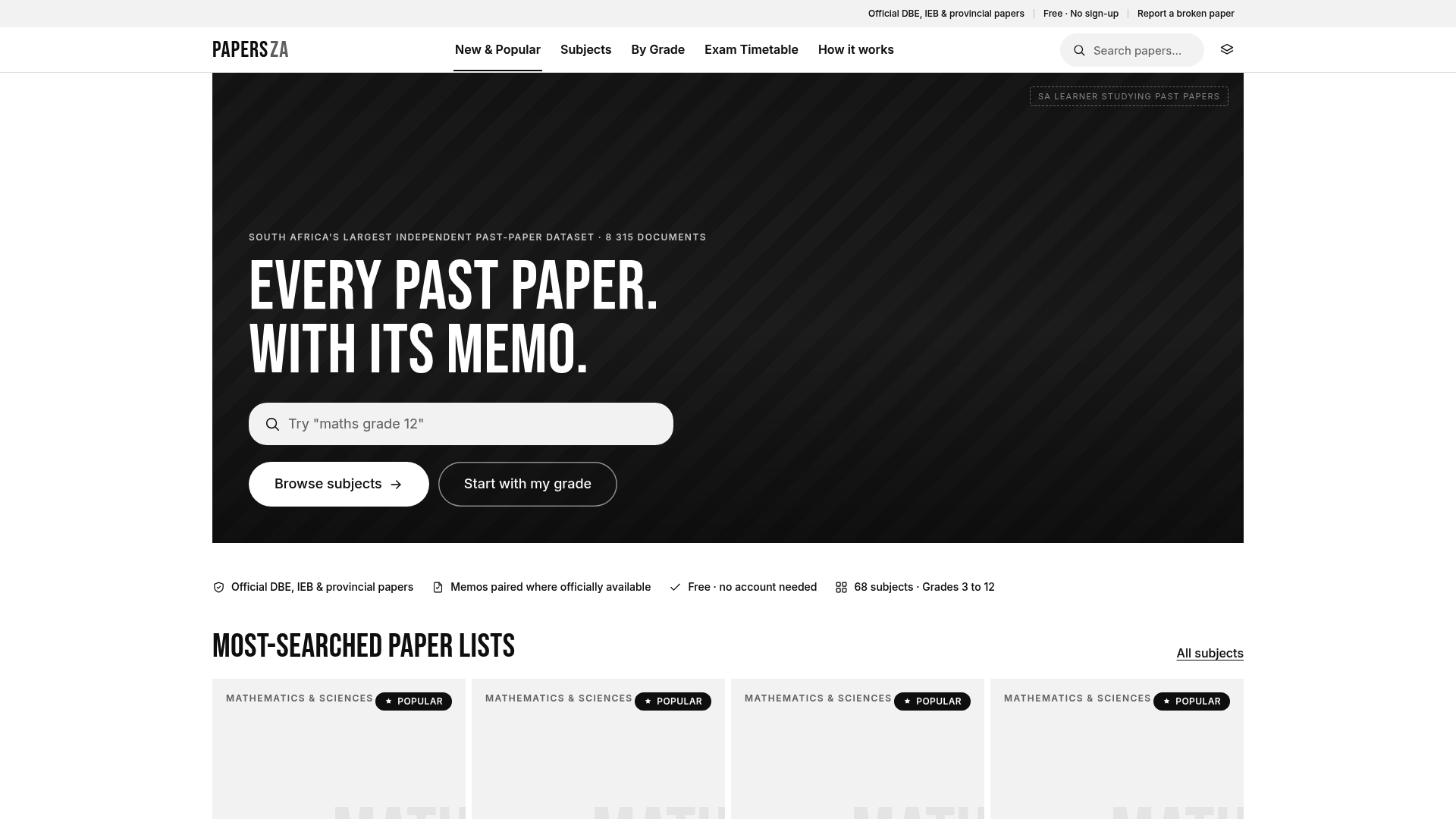
Browse the full collection on the PapersZA homepage and pick the subject you rated 3 on your list.
Perspective
We built PapersZA because the hardest part of studying is often not the studying, it is finding the right paper and its memo. A timetable and a past paper work together: the timetable tells you when, the paper tells you what.
Our view is that every Grade 11 learner should treat past papers as the centre of the plan, not a last-minute extra. A paper marked against a memo shows you in one sitting where your marks are leaking, and that is the information your next week’s blocks should be built on.
That is why we keep everything free, without accounts or paywalls, and in one place across DBE, IEB and provincial papers. A learner who can open a paper in seconds is far more likely to actually do it.
Nkosi
FAQ
How many hours should a Grade 11 learner study each day?
There is no single correct number, and the research we checked does not set one. A workable start is two focused blocks of 40 to 60 minutes on school days and longer sessions on weekends, then adjust after your first weekly review. Quality matters more than hours: one subject and one task per block.
Should I study every subject every day?
No. On weekdays, choose two or three subjects, prioritising those you have at school the next day. Use weekends for revision, assignments and past papers, and rotate subjects so you do not tire out on one.
When should I start preparing for Grade 11 final exams?
Start with a weekly routine now, then add a timed past paper per subject in the weeks before your school’s exam dates. Schools set their own Grade 11 exam schedules, so ask your teacher for the current timetable and work backwards from it.
How do I use past papers in my timetable?
Schedule one timed paper or section on the weekend, mark it with the memo, and list the topics you got wrong. Those topics become the tasks in next week’s weekday blocks. You can find papers by subject, grade and year on the PapersZA homepage.
Sources
- Career Services Quick Tips, University of Johannesburg
- Tips for exam preparations, Department of Basic Education
- NSC past examination papers, Department of Basic Education
- A Weekly Study Timetable Around School and Housework
- Year 11 study plan ideas, Gloucestershire County Council
- Exam preparation brochure, UNISA