Self-Marking Past Papers: A Step-by-Step Guide for Learners

To self-mark a past paper, write it under exam conditions, then mark it with the official memo for that exact paper, award marks the way the memo says (including method marks and part-marks), and record every lost mark with its reason. The score matters less than the pattern behind it. That pattern tells you what to revise next. This guide walks you through each stage, for any grade from 3 to 12.
TL;DR
- Match the paper and memo: same subject, grade, year, session and examination body (DBE, IEB or provincial).
- Write the paper first, timed and without notes, before you open the memo.
- Mark with the memo’s own rules: part-marks, working, penalties and valid alternatives all count.
- Log each lost mark with a reason (knowledge gap, careless error, misreading, time), then build your revision list from that log.
- Retest the weak topics until you can answer them correctly, then move to a new paper.
Table of Contents
- Why self-marking is worth the effort
- What you need before you start
- Step 1: Choose a paper that matches you
- Step 2: Write the paper under exam conditions
- Step 3: Mark with the memo, not with your gut
- Step 4: Calculate and record your score
- Step 5: Turn your marks into a revision plan
- What your score can and cannot tell you
- A quick example of the process
- Find your next paper and memo
- FAQ
- Sources
Why self-marking is worth the effort
The Department of Basic Education (DBE) says previous NSC papers should be used to revise and prepare for upcoming examinations, and that they help learners see what they already know and what they do not. That second part is the whole point of marking yourself. Writing a paper is practice. Marking it properly is diagnosis.
A teacher cannot mark every paper you write at home, and waiting a week for feedback slows you down. When you can mark your own work accurately, you get feedback the same afternoon, while the questions are still fresh in your head.
There is a catch. Self-marking only helps if you mark honestly and by the memo’s rules. Marking generously gives you a score that feels good and tells you nothing. The rest of this guide is about marking accurately.

What you need before you start
Gather these before you write anything:
- The question paper for your grade and subject.
- The matching memo (marking guideline). Keep it closed until you finish writing.
- A timer set to the paper’s full duration.
- Permitted tools only: an approved calculator, data sheets or formula sheets if the real paper provides them.
- A pen in a different colour for marking, so your original answers stay visible.
- A simple record sheet or notebook page for your score and error log (we show a layout below).
If you are not sure where to download papers and memos, our guide on where to find past papers in South Africa lists the sources for grades 1 to 12 and tertiary level.
Step 1: Choose a paper that matches you
A mismatched paper wastes an evening. Check four things:
- Grade and subject. A Grade 10 learner can use Grade 12 papers later in the year for stretch practice, but start with your own grade.
- Examination body. Public schools mostly follow DBE or provincial papers. Independent schools often write IEB papers, which can differ in style and emphasis. Use the body your school uses.
- Paper number. Many subjects have Paper 1 and Paper 2 testing different content. Know which topics each covers.
- Syllabus changes. Topics and formats shift over the years. If an older paper contains content your teacher has not covered or has removed, ask your teacher whether to skip those questions.
Before you use papers for practice, cover the content first. The DBE and Western Cape Education’s Grade 12 revision booklet advises studying the content, then working through past papers. Using a paper to learn a topic for the first time is slow and discouraging. Using it to test a topic you have already studied is where it pays off.
Step 2: Write the paper under exam conditions
The score is only useful if the conditions were realistic. Set it up like this:
- Put your phone in another room.
- Set the full time allowed for the paper.
- Use only what the real exam allows.
- Write full answers, not bullet-point shortcuts, wherever the real paper wants full sentences, calculations or essays.
The DBE’s exam preparation tips give a sound routine for the paper itself. Use the reading time to read the instructions and the whole paper, note the mark allocations, and manage your time. You do not have to answer in numerical order, so start with the questions you feel most sure about.
The mark allocation is a pacing tool. A rough guide: if a paper is 150 marks in 3 hours, you have about 1.2 minutes per mark. A 4-mark question deserves a few minutes, not fifteen. If you keep running out of time during practice, that is useful information, and you should log it later as a time error.
For guidance on the Grade 12 English paper layout, see our English Paper 1 format guide. For essay-heavy subjects, the Business Studies essays guide shows how to structure long answers so they match what markers look for.
Step 3: Mark with the memo, not with your gut
Open the memo only after the time is up. Then mark every question in your marking colour. Resist the urge to correct answers silently; leave your original visible and mark it.
Know the marking rules
A memo is more than a list of right answers. The DBE’s Grade 12 marking guideline for November 2020 sets out principles that apply in many papers:
- A correct final answer earns full marks.
- If the final answer is wrong, the working is marked, and part-marks are awarded where the memo specifies them.
- Penalty rules apply, but you are not penalised twice for the same mistake.
- Valid alternative answers that the memo does not list can still earn marks.
Check the rules in the memo for your particular subject, because they differ. Mathematics and Physical Sciences marking works with consequential errors and units. Language papers mark content and language separately. Humanities papers often mark a point only when it is explained, not just named.
Watch for two traps
The first is answering twice. A 2024 Western Cape NSC marking guideline states that when a candidate answers a question twice, only the first attempt is marked. If you crossed out nothing and wrote two answers, mark the first one only.
The second is statement-and-reason questions. The same guideline separates statement marks from reason marks, and a reason mark is given only when the statement is correct. A good reason attached to a wrong statement earns nothing.

Marking tough questions fairly
When your answer looks different from the memo, ask three questions:
- Does it say the same thing in different words?
- Would a marker be able to tick it without guessing what I meant?
- Did I include the specific term, unit, step or example the memo asks for?
If the answer to the third question is no, do not award the mark. If you are genuinely unsure, mark it as lost, put a question mark next to it and ask your teacher. Being a little strict with yourself is safer than being generous, because the real marker will not give you the benefit of the doubt.
Step 4: Calculate and record your score
Add up your marks per question, then per section, then in total. Convert the total to a percentage. A table like this keeps everything in one place:
| Question | Topic | Marks available | Marks earned | Marks lost | Reason for loss |
|---|---|---|---|---|---|
| 1.1 | Example topic A | 6 | 4 | 2 | Knowledge gap |
| 1.2 | Example topic B | 4 | 3 | 1 | Careless error |
| 2.1 | Example topic C | 8 | 8 | 0 | n/a |
| 2.2 | Example topic D | 10 | 5 | 5 | Ran out of time |
Use a consistent set of reasons. Four are enough for most learners:
- Knowledge gap: you did not know or could not recall the content.
- Careless error: you knew it but slipped, such as a sign, a unit or a copying mistake.
- Misreading: you answered a different question from the one asked.
- Time: you rushed or did not finish.
This breakdown matters because each reason needs a different fix. A knowledge gap needs revision. A careless error needs checking habits. Misreading needs slower, more deliberate reading of command words. Time problems need more timed practice.
Step 5: Turn your marks into a revision plan
A percentage on its own does not tell you what to do on Monday. Your error log does.
- Sort lost marks by topic. The topic with the most lost marks goes first.
- Go back to your notes or textbook for that topic. Western Cape Education’s Grade 12 Tips for Success 2026 recommends choosing revision questions that strengthen weaker areas, and notes that past questions show the types of questions to expect.
- Fix the cause. Relearn the content, write out the method, or practise the question type.
- Retest. The DBE and Western Cape revision booklet advises continuing to correct and retest until you can answer correctly, using the memo to see what must be revisited.
- Move on to a new paper only when the weak topics start to hold.
If you want a ready-made rhythm for this loop, our 4-week past papers study plan schedules papers, marking and revision days. Matric learners can slot it into a Grade 12 study timetable, and Grade 11 learners can use the Grade 11 exam preparation plan.
For a worked subject example, our Physical Sciences Paper 1 page collects Grade 12 papers and memos, which are good for practising method-mark marking.
What your score can and cannot tell you
A self-marked score is a useful signal, not a verdict. Keep these points in mind:
- One paper is a small sample. A single paper covers only some of the content. A strong result may mean you got lucky with the questions. Look at the trend across several papers, not one score.
- Your marking may be a little off. Even careful learners can be too kind or too harsh. If your self-marked scores are consistently much higher than your school test results, tighten your marking or ask your teacher to mark one paper so you can compare.
- Familiar papers inflate scores. If you have seen the questions or the memo already, the result reflects memory, not understanding. Use papers you have not seen.
- Conditions matter. An open-book, untimed attempt cannot predict an exam performance.
- Rules change. A paper from many years ago may test content or formats that are no longer examined. Check with your teacher before relying on an old paper’s score.
The healthy way to use the number is to ask what it tells you to do next. Worried about the pressure of it all? Our guide on managing exam stress with past papers shows how to practise without panic.
A quick example of the process
Say you write a Business Studies paper for practice. You could try the May/Jun 2024 Grade 12 Business Studies paper, set a timer, and write all of it. Afterwards you mark with the memo, find that most lost marks are in the essay and that you lost several because you named points without explaining them. Your next step is not “study everything”. It is to practise writing explained points for that essay type, then retest with a different year’s paper. That is the difference a log makes.
Perspective
We built PapersZA around one idea: a past paper is only useful when you can check your work against the official memo, for free, without friction. Learners lose momentum when they have to register, hunt across several sites, or guess whether a memo belongs to the paper in front of them.
That is why we keep DBE, IEB and provincial papers together, organised by subject, grade, year and session, with memos alongside. When the paper and memo sit side by side, self-marking becomes a habit instead of a chore.
Our advice is simple. Write one paper properly rather than skimming three. Mark it strictly. Write down why each mark was lost. The learners who improve fastest are the ones who treat a wrong answer as information.
Nkosi
Find your next paper and memo
PapersZA hosts past papers and memos for grades 3 to 12, from the DBE, the IEB and provincial education departments. Every document is free to download, and you do not need an account.
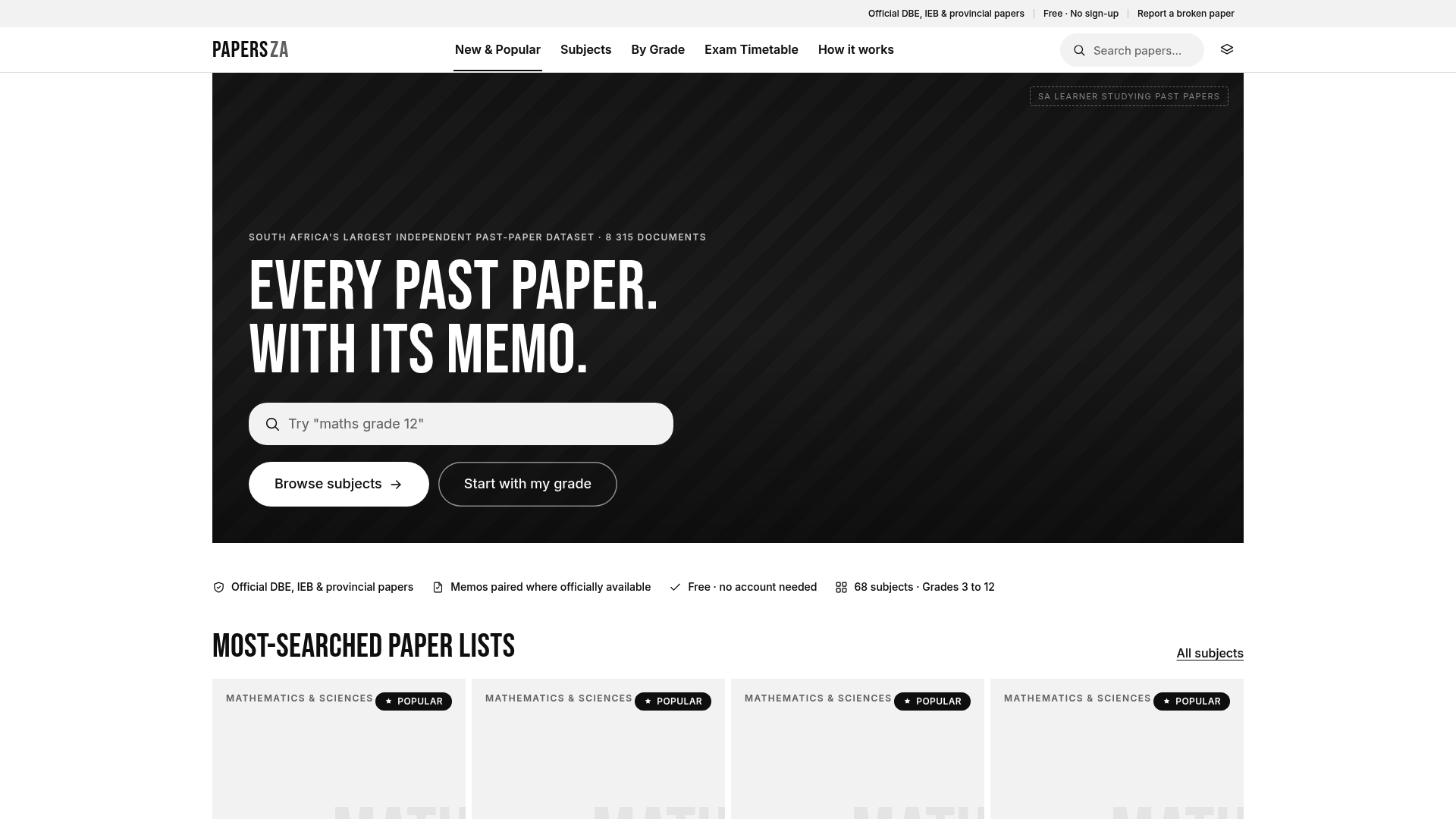
Pick your subject and year on the PapersZA home page, download the paper and its memo together, and start your first timed attempt. Learners preparing for Grade 9 can also see our Grade 9 June exams guide.
FAQ
Should I look at the memo while I write the paper?
No. Looking at the memo while writing turns practice into copying and hides what you really know. Finish the paper in the time allowed, then open the memo. If you get stuck on a question, leave it, move on and come back, as the DBE’s exam tips recommend.
How strict should I be when I mark my own work?
As strict as the memo. Award full marks only for what the memo asks for, give part-marks where it lists them, and mark the working when the final answer is wrong. Where an answer is a valid alternative the memo does not list, you can credit it, but check with your teacher if unsure.
How many past papers should I do?
Quality beats quantity. One paper written under exam conditions, marked carefully and followed by targeted revision is worth more than several half-attempted papers. Closer to exams, plan a steady rhythm such as the schedule in our four-week study plan.
Can I self-mark essay and open-ended questions?
Yes, but it is harder. Use the memo’s list of expected points and any rubric, and tick a point only when your answer clearly makes and explains it. If possible, ask a teacher or a classmate to mark one essay as a check on your own judgement.
What score means I am ready for the exam?
No single score guarantees readiness. Look for steady improvement across several different papers under timed conditions, and for fewer repeated errors in your log. Your teacher can help you judge whether your results match what the exam expects.
Sources
- DBE: Past Exam Papers
- DBE: Tips for exam preparations
- DBE: Grade 12 marking guideline, November 2020
- Western Cape Education: NSC marking guideline, November 2024
- Western Cape Education: Grade 12 Tips for Success 2026
- DBE and Western Cape Education: Grade 12 Business Studies revision booklet